


Slips unearthed at Liye archaeological site dig into details of Qin life










As you drive through the mountain roads toward the small town of Liye in Longshan county, Hunan province, in late autumn, you are greeted by countless orange trees laden with fruit. The oranges are nearly or fully ripe, and paint the valley in shades of gold.
A well-known local specialty, oranges from Liye are distributed nationwide, and the residents take great pride in their produce, probably much like their ancestors did more than 2,000 years ago.
During the Qin Dynasty (221-206 BC), this area, then known as Qianling county, was abundant with orange groves, as recorded on bamboo and wooden slips that served as government documents at the time. Farmers' granaries were filled with millet and other grains, while locally grown wax gourds were presented to Qin emperors as tributes.
Last week, the Liye Qin Slips Museum and the Liye Ancient Town Archaeological Site Park reopened to the public following a comprehensive renovation.
Opened in 2010, the museum is the first in China dedicated to the preservation, display, and research of the invaluable Qin slips. It was built facing the archaeological site, where nearly 38,000 slips were discovered in 2002, unearthed from an ancient Qin Dynasty well.
These slips, containing more than 200,000 characters, offer remarkable insights into the Qin government's political system and everyday life in this border town.
The text on the slips provides detailed information about the local population, products, taxation, judicial system, postal services, and medicine, making them one of the most significant archaeological discoveries related to the Qin Dynasty.
During a ceremony to mark the reopening of the museum, more than 700 slips, which had been preserved and studied by other institutions, were returned and added to its collection.
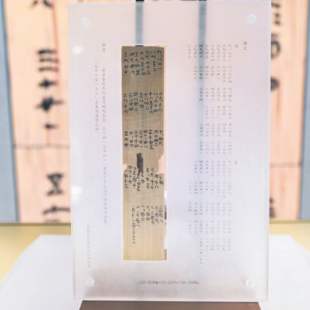
The renovated museum's main exhibitions guide visitors through various aspects of life in the ancient Qianling county. One of the most popular exhibits features a slip inscribed with a multiplication table, evidence that Chinese people used this calculation method more than 2,000 years ago, predating its use in the West.
Rats, those perennial pests that plagued granaries and spread disease, were also a constant thorn in the side of the Qin people. Records of rat-catching by local officials and granary clerks are seen on several slips displayed in the museum.
In addition to the Qin slips, the exhibition features other artifacts, including bronze wares and ceramics, most of which were also unearthed at the Liye site. The museum also features digital interactive zones that incorporate VR, AR, and AI technologies, offering visitors an immersive trip through history.
Among the experts attending the reopening ceremony of the museum was Long Jingsha, one of the archaeologists who led the excavation of the slips in 2002.
Reflecting on his work 23 years ago, Long recalls how he and his colleagues had to dig through the mud bare-handed to retrieve the slips from the 16-meter-deep ancient well.
"We considered wearing gloves to protect our hands from the stone and ceramic debris mixed in the mud," he says. "But only with bare hands could we sensibly feel the fragile slips and hold them carefully."
Today, archaeological work continues at the Liye site and surrounding areas, Long says, aiming to connect separate ancient towns and tombs and gather more materials for research into the commandery-county governance system of the Qin Dynasty.
Zhang Chunlong, a researcher at the Hunan Provincial Institute of Cultural Relics and Archaeology, notes that of the nearly 38,000 slips unearthed in Liye, about 18,000 contain written characters.
To date, more than 9,000 have been analyzed, with photos and text explanations published in three volumes of Liye Qinjian (Liye Qin Slips), Zhang says, adding that he and his colleagues are working on Volume IV, which will include the texts from more than 4,000 slips.
limuyun@chinadaily.com.cn