


New V&A exhibition explores modern spirit of traditional Chinese crafts










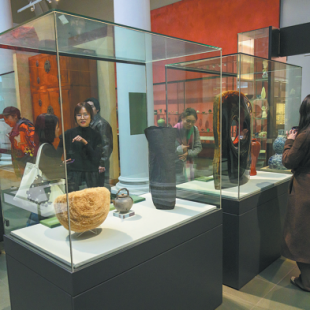
LONDON — Stepping into the China Gallery, once renowned for its ancient artifacts and traditional handicrafts, visitors may be surprised to find contemporary Chinese studio works currently displayed alongside historic treasures. The juxtaposition creates a dialogue between past and present, redefining the Chinese collection of the Victoria and Albert Museum, one of Britain's largest art and design museums.
The exhibition, Dimensions: Contemporary Chinese Studio Crafts, which opened on Oct 28, marks the first major exhibition dedicated solely to the topic. Nearly 50 of the artworks featured in the show have been newly acquired by the V&A.
Since joining the museum's Chinese department, curator Li Xiaoxin, the creative force behind the exhibition, has sought to reconnect with China's illustrious ceramic heritage. Despite the museum's extensive historical collection, Li noticed a lack of representation of modern Chinese artists — an absence that inspired a five-year research journey that culminated in this exhibition.
"Traditional ceramics were made for practical use as vessels or religious sculptures, and always served a function," Li says. "Contemporary ceramic art is different. Its focus lies not on utility, but on how artists employ the material and craftsmanship of ceramics as a form of expression."
By placing modern pieces beside Ming Dynasty (1368-1644) vases and Tang Dynasty (618-907) figurines, the exhibition highlights how generations of Chinese artisans, from imperial kiln masters to today's independent studio artists, have continually balanced material, beauty and meaning while embracing modernity.
From the mountains of Yunnan province in the southwest to the coastal plains of Shandong province in the east, Li traveled extensively to meet artists transforming traditional crafts into contemporary art.
Among them is Lin Fanglu, whose fiber sculpture She's Bestowed Love rises like a crimson wave, commanding the China Gallery's space. The work employs the ancient Bai ethnic tie-dye technique, once used to decorate clothing. Lin first encountered the craft during her 2014 stay in Dali Bai autonomous prefecture in Yunnan, where she lived among local artisans.
Her transformation of blue-and-white textiles into a red sculptural form captures the emotional depth of the women who keep the tradition alive.
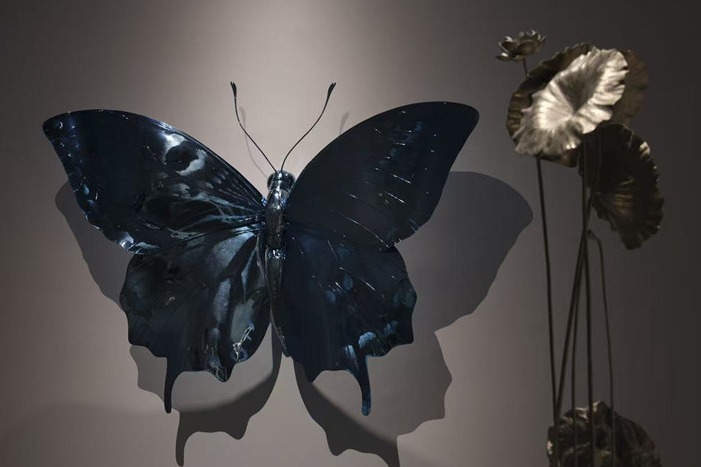
Beside Lin's work stands Zhao Jinya's glass installation The Two of Us No 9, which gleams with refracted light. Created in 2021 in Zibo, Shandong, the birthplace of China's colored glass art, the piece reflects Zhao's dual education in China and Britain.
"I use glass not just for beauty," Zhao explains. "It's about existing between cultures through observing and feeling as an outsider. I don't try to separate Chinese and Western influences; they naturally coexist within me."
Also featured is Eliza Au, a Canadian-born artist of Chinese heritage, whose latticed stoneware draws inspiration from traditional Chinese wooden architecture. Her repeated visits to Jingdezhen, the historic porcelain capital in Jiangxi province, provided both cultural connection and creative inspiration.
"Spending time in Jingdezhen gave me a sense of familiarity and an entryway into a culture with such a deep lineage," says Au. "It offered not just artistic insight but also a feeling of belonging."
In the Ceramics Galleries, Room 146, the story of Chinese clay continues to show today's spirit of free experimentation.
Lu Chuan, curator and co-founder of the craft innovation organization GyreCraft, emphasizes the enduring continuity of Chinese craftsmanship.
"No culture begins from nothing," Lu says. "To understand art and culture, we must look back to our roots, to see where traditions originate and how they evolve through the experiences of different people and regions."
This philosophy underpins Li's curatorial vision: to connect the V&A's new acquisitions to the centuries-old legacy of Chinese ceramics.
"Through these works, I want audiences to see the many new faces of contemporary China, and to understand how Chinese society continues to evolve in every aspect of life," Li says. "It's time for our cultural stories to keep pace."