


Ode to oneness
Chinese American composer's creation intertwines ancient poetry, Taoist thought and Beethoven's spirit, Bilin Lin reports.










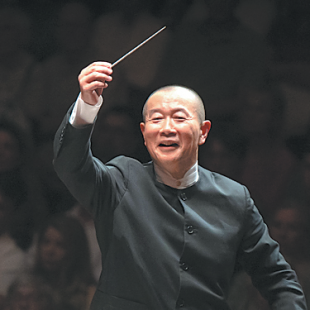
It was originally intended to celebrate the 250th anniversary of Ludwig van Beethoven's birth, but the pandemic delayed the 2020 premiere, giving Chinese American composer Tan Dun time to expand his Choral Concerto: Nine into a three-part composition.
Entitled, Nine, Wine, and Time, the parts draw on rich layers of meaning. Tan explains that "nine" in Chinese is pronounced jiu — a word that not only denotes the number but also suggests "wine" and conveys the idea of something "everlasting".
Tan says he found a profound connection between Beethoven's Ninth Symphony and Chinese philosophy, noting that the ancient Taoist thinkers Lao Tzu and Chuang Tzu, some 2,500 years ago, expressed ideas similar to those found at the beginning of Ode to Joy, where Friedrich Schiller's lyrics proclaim that "all people are brothers and all creatures are together in this one world".
Elements of Taoist and Buddhist traditional chants flow through the choral writing. Tan also notes that the work incorporates poetry by Qu Yuan, written about 2,400 years ago, and by Li Bai, from 1,300 years ago.
Speaking about incorporating Li Bai's poetry, he reflects on the poet's reverence for nature, a quality that clearly resonated with the audience.
The work was performed by the Bard Conservatory Orchestra at the Lincoln Center's Alice Tully Hall on Oct 29 to mark the 20th anniversary of the Bard College Conservatory of Music, where Tan is dean, as well as to honor President Leon Botstein's 50th year at the helm of Bard College.

"I thought it was amazing, overwhelming, so beautiful, so powerful," says Elizabeth Aaron, an assistant high school principal from Summit, New Jersey. "It was stunning to listen to the voices do the wind and nature.
"The way it felt like nature — the voices and instruments made me feel as if I were (out) in the world," she adds.
That sense of natural harmony extended beyond the choral writing to the orchestra itself, where musicians found Tan's techniques equally striking.
"It worked really well. It was very powerful and effective for me. Everything seemed to fit together in a logical, effective way," says Whitacre Hill, a French horn player.
Hill says he was impressed by how Tan achieved "a vocal effect from the singers that sounded like a violin's ponticello", which is a bowing technique that creates a metallic, eerie or ghostly sound by playing very close to the bridge.
"I've never heard anything by Tan Dun before, and it was huge, and impressive, and so creative, and powerful. I was really amazed," Hill adds.
Born and raised in Hunan province, China, Tan studied at the prestigious Central Conservatory of Music in Beijing before moving to the United States.
Over the decades, Tan has earned both Grammy and Academy Awards, and his works have been showcased in renowned institutions such as New York's Guggenheim Museum, the Museum of Modern Art and Beijing's Chambers Fine Art gallery. His celebrated compositions include Marco Polo, Tea: A Mirror of Soul, and Buddha Passion. Tan is widely recognized for blending elements of his Chinese heritage with contemporary forms, creating music that bridges cultures and speaks to audiences worldwide.