


Gold, bronze and mystery
New studies reveal an astonishing blend of artistry, technology and spiritual belief, Peng Chao reports in Chengdu.









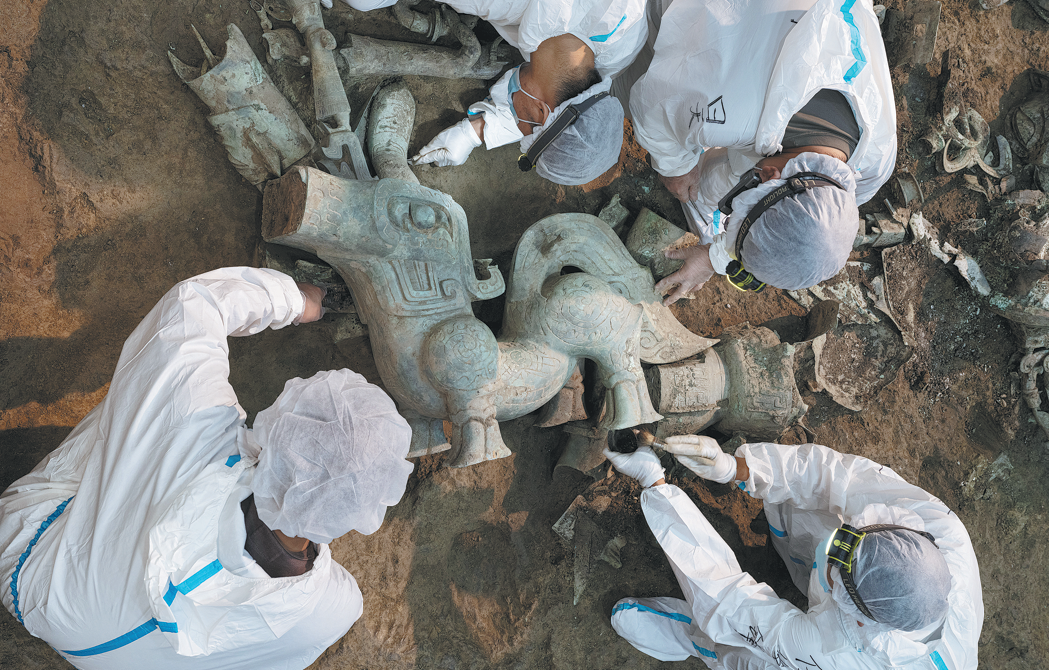
Sanxingdui in Guanghan, Sichuan province, stands out as one of the most mesmerizing names in the story of early Chinese civilization.
First discovered in the 1920s, Sanxingdui has yielded a wealth of discoveries over nearly a century of archaeological research. Among its most remarkable findings are those from the eight "sacrificial pits", which have astonished the world with their exquisite artifacts and mysterious origins.
The first two pits, unearthed in 1986, revealed magnificent bronze and gold masks that instantly captured global attention. A new round of excavations beginning in 2019 uncovered six additional pits (No 3 to 8), sparking even greater public curiosity about the site's origins and chronology.
Recent research has now provided more solid clues. According to new carbon-14 analysis conducted by Peking University, there is a 95.4 percent probability that the burial of the sacrificial pits No 3, 4, 6, and 8 occurred between 1201 BC and 1012 BC.
This places the period in the late Shang Dynasty (c.16th century-11th century BC), according to a September release from the Sichuan Provincial Cultural Relics and Archaeology Research Institute.
Identical fragments found across pits No 1, 2, 3, 4, 7, and 8 suggest that these artifacts were buried at the same time, says Ran Honglin, the institute's lead archaeologist at Sanxingdui. This discovery provides key evidence for establishing a precise chronological framework for the site.
A joint study by the Sichuan provincial institute, the Palace Museum, the University of Science and Technology Beijing, and the Needham Research Institute at the University of Cambridge in the United Kingdom has also offered new insights into Sanxingdui's bronze-casting techniques.
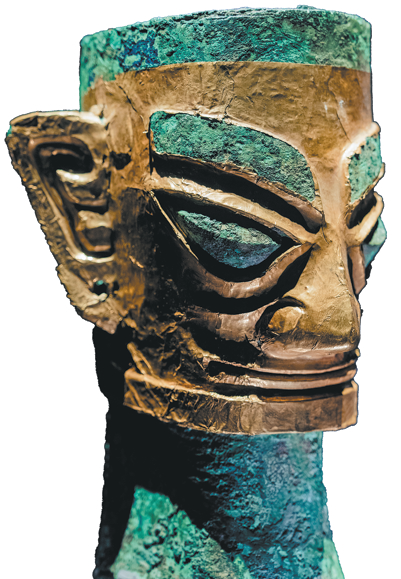
According to the study, Sanxingdui developed an innovative casting technology centered on sectional casting, complemented by integral casting and forging, during the late Shang Dynasty.
In the production of bronzeware, the inner core, or the clay core, and the outer mold worked together to cast the shape of the vessel.
To reinforce and support the inner core during its production process, bronze workers added organic or metal strip-shaped materials, similar to steel bars used to reinforce concrete in modern architecture.
Bronze workers also used supports in the casting molds to maintain the relative position between the inner core and the outer mold, thereby avoiding misalignment and adhesion between the two components, says Guo Jianbo, a researcher at the Sichuan provincial institute.
The unique techniques effectively solved the challenges in molding slender and curved objects, and were indispensable for casting objects such as the bronze divine tree — one of the most magnificent finds from Sanxingdui. These techniques indicate that people casting bronze in Sanxingdui were flexible and skilled craftsmen, Guo says.
Multidisciplinary research on five aspects of Sanxingdui, including the manufacturing techniques of excavated gold artifacts, bronze painting techniques, standardized pottery production, rice cultivation methods and ivory preservation technology, has also made significant progress, according to Guo's institute.