


Concert sets the stage for sharing classic Chinese poetry with Italy









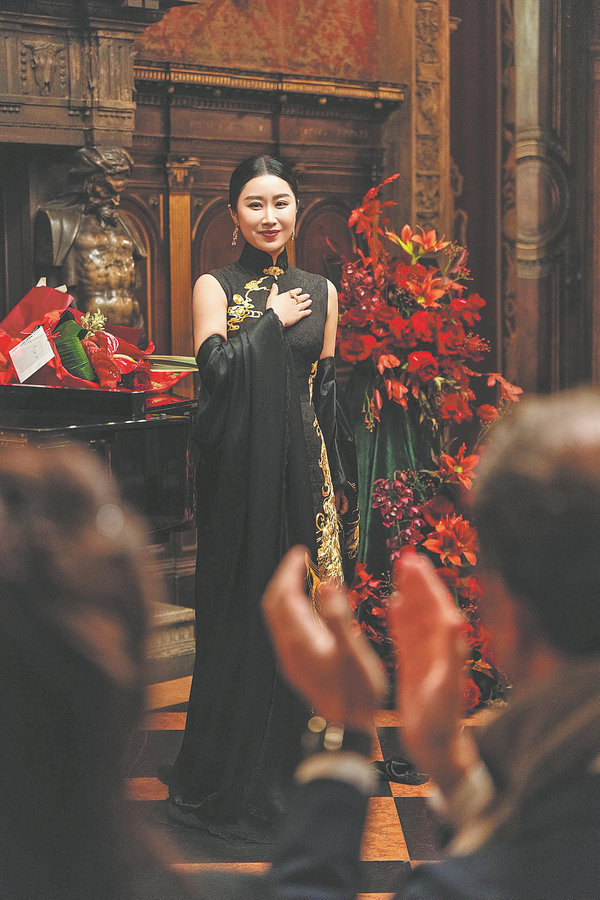
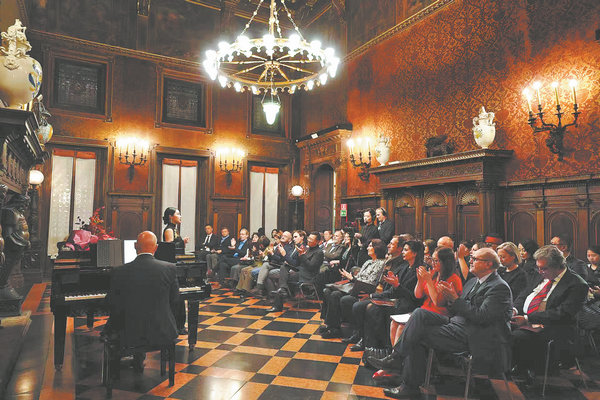
On Nov 6, at the Bagatti Valsecchi Museum in Milan, Italy, the stage was set for a concert unlike any other. The audience at the prestigious Italian venue, a 19th-century house that is now a museum, gathered to hear not just a soprano's voice but the beauty of Chinese poetry brought to life through music.
The concert, held to celebrate the 55th anniversary of diplomatic relations between China and Italy, was a momentous occasion of cultural exchange and a personal triumph for coloratura soprano Cao Yaqiong.
The programs featured songs based on Chinese poems that span millennia. Highlights among the 18 songs were Spring Dawn, composed by Li Yinghai and based on a poem of the same title by Meng Haoran of the Tang Dynasty (618-907); Spring Flower and Autumn Moon, composed by Wang Long and based on a poem composed by Li Yu, also of the Tang Dynasty; and Wang Ning Mei, a song written by Wang Liping for the classic Chinese television adaptation of Dream of the Red Chamber, one of the four masterpieces in Chinese literature, written by Qing Dynasty (1644-1911) author Cao Xueqin.
Cao Yaqiong's decision to present classical Chinese poetry in Italy was driven by a deep-rooted sense of cultural responsibility. Having spent over a decade studying in the European country, she became immersed not only in Western classical music but also in the beauty of the country's art, architecture and traditions.
"My time in Italy has shaped me profoundly," she says. "I also realized that the true beauty of art transcends borders. Chinese poetry, with its richness and depth, is a cultural treasure. I want to share that with the world."
Each piece selected for the concert, she says, reflects a different period in Chinese poetry, highlighting its timeless beauty and universal appeal. She concluded the concert with the popular Chinese folk song, Jasmine Flower.
"I chose to perform these works because they show the evolution of Chinese poetry over 3,000 years. I wanted to capture that unbroken thread of beauty and emotion," she says.
Cao Yaqiong graduated from the Wuhan Conservatory of Music in Hubei province, and later studied at the Conservatorio Giuseppe Verdi di Milano. She has a career both in Europe and her homeland, holding concerts in Italy, Germany and China, as well as performing at music festivals, including the Salzburg Festival and Festival Verdi.
For Cao Yaqiong, this concert was more than a performance; it was a way to introduce Italian audiences to the elegance of Chinese poetry, blending Eastern words with Western musical techniques.
"Music is a universal language. Through it, I can share the soul of China with the world," she says. "When the audience in Italy hears Jasmine Flower alongside poetry of the Tang and Song (960-1279) dynasties, they get a direct and emotional understanding of Chinese culture."
In addition to Chinese songs, she also performed Italian songs, such as Musica Proibita, a romantic song composed in 1881 by Stanislao Gastaldon, and L'ultima Canzone (The Last Song), a chamber song written by Italian composer Francesco Paolo Tosti in 1905.
"It was a celebration of both our cultures," she adds.
One of the most memorable parts of the performance was Cao Yaqiong's collaboration with Italian musicians. The fusion of cultures in the rehearsal room was a beautiful and enlightening experience.
"When I perform these Chinese pieces, I explain to the musicians the stories and symbolism behind the poetry," she says. "Once they understand the historical context, they can add more color and depth to the music, helping bring the Chinese poems to life in a way that resonates with both Eastern and Western audiences."