China ready to take tougher steps over Takaichi remarks










A series of strong reactions and warnings from China sends a clear signal that Beijing is prepared for further countermeasures if Tokyo refuses to withdraw the erroneous, dangerous and provocative remarks made by its prime minister on the Taiwan question, and that Japan must bear full responsibility for all ensuing consequences, observers and analysts said.
If Japanese Prime Minister Sanae Takaichi keeps going down the wrong path, there will be a comprehensive impact on bilateral ties, which will inevitably lead to Japan's loss of development opportunities brought about by bilateral cooperation and further damage the country's credibility in the international community, they said.
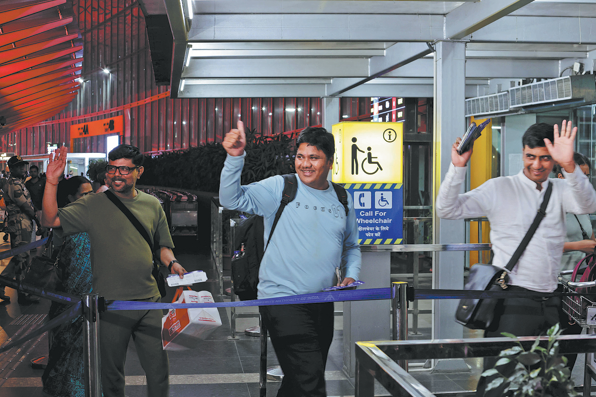
The Foreign Ministry and its diplomatic missions in Japan have advised Chinese citizens to avoid traveling to Japan in the near future, citing a worsened environment for people-to-people exchanges and a significant risk to the personal safety and lives of Chinese citizens.
In response, major Chinese carriers — including Air China, China Eastern Airlines and China Southern Airlines — announced on Saturday special arrangements for Japan-bound travelers, allowing eligible passengers traveling before Dec 31 to change or refund their tickets free of charge.
In another development, the Ministry of Education released an overseas study alert on Sunday, advising Chinese citizens to carefully consider their plans to pursue studies in Japan. The Ministry of Culture and Tourism issued a reminder on the same day, also advising Chinese tourists to avoid traveling to Japan for the time being.
On Nov 7, Takaichi told a Diet meeting that the Chinese mainland's "use of force on Taiwan" could constitute a "survival-threatening situation" for Japan, in which Japan's Self-Defense Forces could exercise the right of collective self-defense.
Her remarks marked the first time a Japanese prime minister had mentioned the relevance of a "survival-threatening situation" in parliament and hinted at the possibility of military intervention over the Taiwan question.
Senior Chinese officials in charge of diplomacy, defense and Taiwan affairs soon issued a slew of stern warnings in response, saying that Japan will pay a heavy price if it dares to militarily interfere in Taiwan Strait affairs. However, Takaichi has refused to retract her remarks.
Observers said China's rapid and forceful responses show that Beijing views Takaichi's remarks as a major and substantive threat to its sovereignty and national reunification, one that demands resolute and high-level countermeasures.
Ding Nuozhou, a Japanese affairs expert at Nankai University's Japan Institute, told China Media Group that the coordinated statements from multiple departments of the Chinese government show that the situation has escalated beyond an ordinary diplomatic dispute.
"Throughout the process, China has given Japan ample room to correct its mistakes," he said.
"Even as tensions rose, Beijing laid out a clear path to resolve the issue: Japan must immediately reflect and retract its erroneous remarks. Should Japan remain obstinate, China will not exercise further restraint."
On issues concerning national sovereignty and territorial integrity, he added, China will never compromise.
China has repeatedly emphasized that the one-China principle is the political foundation for establishing and developing diplomatic relations with other countries, as well as a basic norm in international relations and a prevailing international consensus.
Beijing also stressed that the Taiwan question lies at the core of China's core interests, and it is purely an internal matter that brooks no external interference.
Chen Yang, a visiting research fellow at Liaoning University's Institute of Japan Studies, said that Takaichi has gravely undermined the political foundation of mutual trust, and that Japan — not China — must bear full responsibility for the worsening of bilateral ties.
The leaders of the two countries held a bilateral meeting late last month in Gyeongju, the Republic of Korea, during which Takaichi assured the Chinese side that Japan would abide by its position on the Taiwan question as stated in the 1972 Japan-China Joint Statement.
However, soon after that, Takaichi posted photos and comments on social media about her meeting and exchange with an individual from the authorities of Taiwan region on the sidelines of the Asia-Pacific Economic Cooperation meetings, referring to the person as a "senior adviser to the presidential office of Taiwan".
"Less than two weeks later, she again made inflammatory remarks on Taiwan, eroding China's confidence in the Takaichi Cabinet, and making it far more difficult for Beijing to trust the Japanese government's political commitments," Chen said.
Her remarks triggered criticism in Taiwan as well. Hung Hsiu-chu, former chairperson of the Chinese Kuomintang party, wrote on social media on Saturday that Taiwan is no longer a Japanese colony and that Japan, having yet to fully account for its historical wrongdoings, is in no position to act as an arbiter on the Taiwan question.
Ma Ying-jeou, also a former chairman of the Kuomintang, emphasized in a social media post on Saturday that foreign interference is unacceptable in cross-Strait affairs, which must be handled through direct dialogue between the two sides.
This year marks the 80th anniversary of China's victory in the War of Resistance Against Japanese Aggression (1931-45) and the world's victory against fascism, as well as the 80th anniversary of Taiwan's restoration.
Experts noted that Japan committed innumerable crimes during its colonial rule in Taiwan, and should be especially cautious in its words and deeds at such a critical moment.
On Saturday, the People's Liberation Army Daily ran a frontpage commentary urging Takaichi to clarify whether Japan intends to repeat the mistakes of militarism, to again make enemies of the Chinese and other Asian peoples, and to subvert the postwar international order.
Lyu Yaodong, deputy director of the Chinese Academy of Social Sciences' Institute of Japanese Studies said that the national behavior of Japan, a defeated country in World War II, is strictly constrained by the United Nations Charter and by Article 9 of its pacifist Constitution, which renounces war and the threat or use of force as a means of settling international disputes.
"These provisions form the cornerstone of East Asia's postwar order and cannot be unilaterally overturned by Japan," Lyu said.
A commentary in People's Daily, the flagship newspaper of the Communist Party of China, noted that Takaichi's fallacies on Taiwan are not isolated political rhetoric. "Behind them lies the obsession and arrogance of Japan's right-wing forces in seeking to break free from the constraints of the pacifist Constitution and to pursue the status of a 'military power'. "
By linking a "Taiwan contingency" to the exercise of Japan's right to collective self-defense, the commentary warned that the move "appears designed to justify Japan's military expansion and carries the dangerous signal of a potential resurgence of militaristic tendencies in Japanese policy."
Lyu said: "Japan simply does not wish to remain on a path of pacifism. This not only harms China-Japan relations, but also undermines regional peace, stability and security. A country that deliberately stirs up trouble must draw the alarm of its Asian neighbors and the vigilance of the broader international community."
zhaojia@chinadaily.com.cn