Science helps 'dead land' bloom









Under the blazing desert sun in Dunhuang, Gansu province, fields now glimmer with golden bales of cotton, each tightly wrapped in plastic and standing as a symbol of decades of scientific work to tame the region's saline-alkali soil.
"We call them the golden eggs laid by what was once dead land," said local technician He Shengbing, gesturing to the 1,000-kilogram bales.
For decades, nearly 95 percent of Dunhuang's 25,000 hectares of farmland were too salty for crops. The topsoil's organic matter measured just 1.22 percent, the salt content reached 0.15 percent, and the pH level stood at 8.44 — far too alkaline for roots to survive. Farmers saw seedlings sprout weakly, wilt and die under the harsh desert sun.
Today, the landscape looks dramatically different. Standing beside a stack of freshly pressed cotton bales, Yang Xu, a graduate student at China Agricultural University, explained how science is helping revive Dunhuang's salty earth.
"Our lab has been working across the country — in Northeast China, Inner Mongolia autonomous region and Xinjiang Uygur autonomous region — areas with some of the most severe saline-alkali soils," he said. "We chose Dunhuang because its climate is very similar to Xinjiang's: extremely arid, with strong evaporation and little rainfall."
Since May, Dunhuang has served as one of the university's first pilot bases for saline-alkali land management. Researchers there compare traditional local methods — the control group — with new test plots treated under a comprehensive soil improvement plan.
Developed by professor Hu Shuwen's team, the plan combines organic fertilizers, biobased soil conditioners, microbial agents and pH regulators, all delivered through drip irrigation with precise timing.
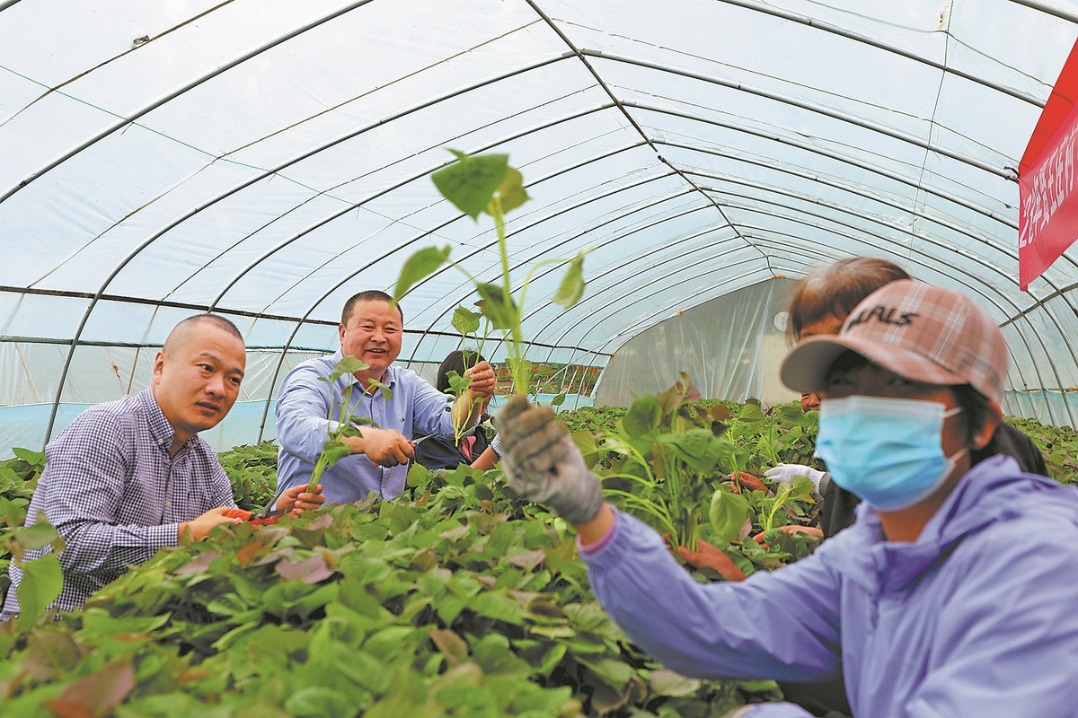
Working with the local government, Hu's team tests new soil-enhancement materials and application models. "We've developed several biobased and microbial conditioners," said Yang, a member of Hu's group. "They come in granular, powder and liquid forms, all tailored for local farming practices."
Dunhuang's water-fertilizer integration system helps apply the products directly to the root zone. "We mix them with base fertilizers in spring, then apply soluble powders or liquids during irrigation," Yang said. "This improves soil structure, helps air and water move through the soil, and boosts nutrient absorption."
Their focus, he said, is on changing the soil — not the crop. "We're not changing the cotton. We're changing the earth it grows in."
At the center of the transformation is a simple tool: a thin black drip-irrigation line stretching across every field.
"We first used it to save water," said He Shengbing, a senior agronomist at the Dunhuang agricultural technology center. "But we soon discovered it's also a powerful tool against soil salinity."
Under traditional flood irrigation, large volumes of water evaporate quickly, leaving concentrated salt on the soil surface — "soaking the crops in brine", He said. "They end up like pickled vegetables."
Drip irrigation works differently. With tiny holes spaced every 30 centimeters, it delivers water slowly and directly to the roots. "The moisture pushes salts downward and outward, keeping them away from the root zone," He said, sketching a teardrop shape in the sand. The resulting "wet bulb" is about 50 centimeters deep and acts as a protective pocket for the plant. "It's like giving the roots their own shelter," he said.
The same lines can also deliver nutrients — an approach known as integrated water and fertilizer management. By combining irrigation with precise fertilization, farmers can improve nutrient use while reducing salt buildup. "It's the most effective method we've found so far," He said.
Dunhuang plans to invest 17 million yuan ($2.4 million) in 2025 to expand its saline-soil treatment program. The effort will improve 567 hectares of cotton fields and restore another 667 hectares of farmland across four towns. Three 67-hectare pilot zones are also being built to test salt-tolerant crops and new soil conditioners.
"The biggest change now is synergy," He said. "Science, policy and funding are finally aligned."
For years, he added, scientists had ideas but lacked the means to apply them. "Farmers couldn't afford the technology. Now, with government support and public awareness, our knowledge can finally take root across the land."
Dunhuang's approach — bringing together the United Nations Food and Agriculture Organization, research institutes, local governments, enterprises and farmers' cooperatives — has been recognized as a "Five-in-One "model at the Global Conference on Scientific Utilization and Development of Saline Soil, held in Dunhuang on Sept 11. The model was highlighted as a replicable example of sustainable land management in arid regions.
Years of work are showing results. The organic content of the topsoil has risen to 1.35 percent, the salt concentration has dropped to 0.12 percent, and cotton yields have increased by up to 20 percent. The region now saves 20 percent of its agricultural water each year.
"Every drop counts here," Yang said. "We're proving that even the harshest land can bloom with the right care."
"The difference is easy to see," He added. "In the test plots, plants stand taller, greener and stronger. At harvest, the numbers speak for themselves."
Contact the writers at huyumeng@chinadaily.com.cn





- Vice-chairman of CPPCC Jiangxi Provincial Committee placed under investigation
- Five trapped in flooding accident at Heilongjiang coal mine
- Long March 5 rocket deploys tech demo satellite into space
- China launches communication technology test satellite
- Spokesperson warns against aggression toward mainland fisherman
- Lhasa wetland reserve recognized as world's highest altitude wetland