Root causes behind Takaichi's provocative and dangerous remarks alarming for all









The visit to Beijing this week by Masaaki Kanai, director-general of the Asian and Oceanian Affairs Bureau of Japan's Ministry of Foreign Affairs, comes at a critical moment for China-Japan relations.
According to reports, Kanai will seek to explain that Japanese Prime Minister Sanae Takaichi's Taiwan-related remarks "do not signal a shift in Japan's security policy", and appeal to China to "refrain from actions that further damage ties" and drop its travel warnings that are "incompatible" with the direction of building a "strategic, mutually beneficial relationship".
Yet the Japanese side must understand that soothing words alone — not to mention the misjudgment the soothing words imply — cannot offset the deeply damaging impact of Takaichi's provocative and dangerous remarks. What is needed is an unequivocal retraction of her erroneous remarks — not attempts to engage in damage limitation out of fear of the economic consequences.
Takaichi has, within just weeks of taking office, repeatedly made provocative statements and taken irresponsible moves touching on the Taiwan question at the cost of China-Japan relations. They reflect the deeply ingrained political climate in the right-wing circle of Japanese politics.
Her suggestion in the Diet last week that Japan may revise its decades-old three nonnuclear principles — refusing to "possess, produce or introduce" nuclear weapons — is especially alarming. Takaichi openly stated she "could not say" whether these principles would be maintained in the coming revision of Japan's security strategy. Hinting that Japan might allow nuclear weapons on its territory crosses a dangerous line that cannot be brushed off as a mere "careless remark" as some in Japan have tried to portray it.
Her declaration that a "contingency in Taiwan" could represent a "survival-threatening situation" for Japan, opens the door to Japan's exercising of its right of collective self-defense — a statement that implies possible military intervention in the Taiwan Strait. This is a blatant interference in China's internal affairs, a provocation against historical justice and a challenge to the post-World War II international order established by the Cairo Declaration and the Potsdam Proclamation, under which Taiwan was restored to China in 1945.
Domestic excuses offered by Japanese commentators — that Takaichi is merely "forthright", or that she was conducting some "self-reflection" — ring hollow. Her words and deeds follow a predictable pattern rooted in the "poisonous soil" that has nurtured the right-wing political groups in Japan for years: historical revisionism, colonial sentiment toward the Chinese island of Taiwan, the specter of militarism and a toxic misunderstanding of China.
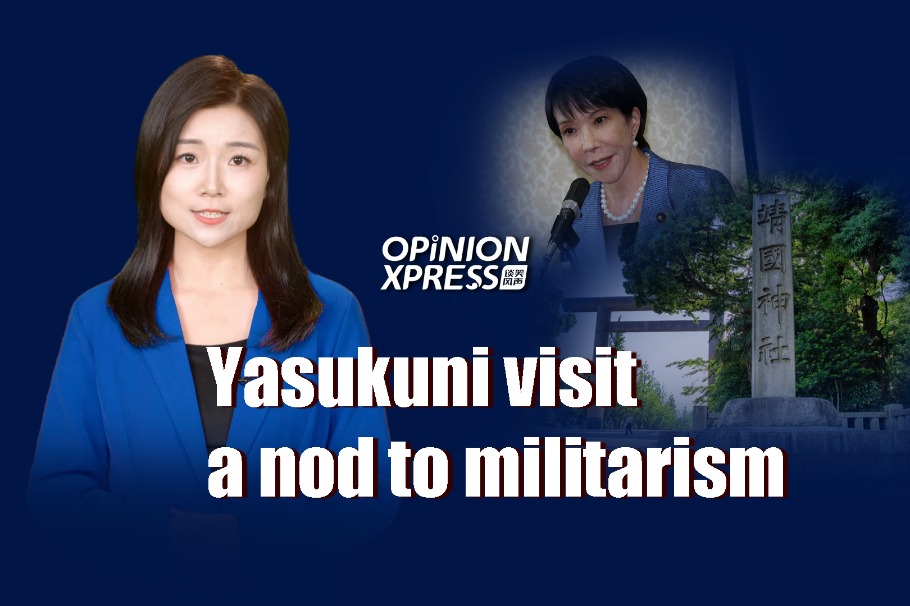
Takaichi has built her political identity on questioning the Murayama Statement, denying historical atrocities such as the Nanjing Massacre, visiting the Yasukuni Shrine, which enshrines 14 Class A Japanese war criminals from World War II, and aligning closely with far-right revisionist groups. Her connections with "Taiwan independence" separatist forces, her appointments of individuals from the "Japan-Taiwan Parliamentary Friendship Group" to key political positions, and her rapid-fire provocations since taking office are all consistent with this trajectory. No responsible policymaker can pretend these actions are coincidental.
Japan's neighbors — and indeed much of the international community — have reasons to worry. History shows that Japanese militarism invoked a contrived "survival-threatening situation" to justify its aggression against its neighbors. Today, Takaichi's rhetoric and her push for military expansion, relaxation of arms-export restrictions and discussions about revising nuclear policies collectively point toward a troubling future for Japan.
Tokyo's concern for the economic impact of the fallout underscores Tokyo's real fear: that the trouble created by Takaichi will hurt Japan's already fragile economy. Nomura Research Institute has warned that a big drop in Chinese visitors could deliver a significant economic hit. Also the latest preliminary Japanese data show that Japan's GDP contracted by 1.8 percent annualized in the third quarter.
Japan's claim that Beijing's travel warnings are "incompatible" with bilateral ties is an evasion of the real issue: It was Takaichi's words that sparked the latest spike in tension. If Tokyo wishes to remedy the situation, it must begin by addressing the root cause, not by urging China to overlook the problem. Kanai's visit should therefore not be an exercise in damage control motivated by economic anxieties. It should be the moment when Japan shows its commitment to addressing the underlying structural problem — the right-wing political climate that encourages, rewards and normalizes inflammatory remarks about Taiwan.
The responsibility lies fully with Tokyo. Words that provoke must be retracted. Political habits that endanger peace must be reexamined. And the region's hard-won stability must not be sacrificed for the ambitions of a few politicians caught in the currents of right-wing revisionism.



Today's Top News
- Stronger RMB points to resilience
- US defense policy act fuels Taiwan tensions
- Japan's nuclear ambitions call for high alert: Editorial
- China repatriates 952 telecom fraud suspects from Myanmar
- Chinese defense ministry criticizes latest US defense bill
- China sets a world record in maglev technology