Trade-in program likely to continue next year
Initiative boosts consumption via subsidies for upgraded, greener items









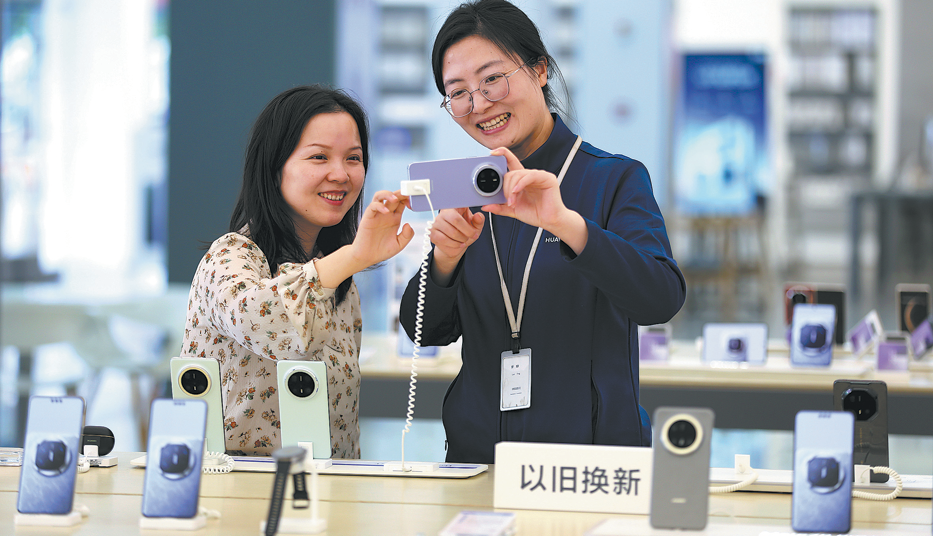
China is likely to extend the consumer goods trade-in program into 2026, as analysts said there is still substantial, unmet demand among Chinese households to upgrade home appliances and digital devices, as well as ample fiscal headroom to underpin the consumption campaign.
The initiative, proven effective in driving big-ticket item spending and delivering tangible benefits to households, is expected to enable China to begin the 15th Five-Year Plan (2026-30) period on a sound footing, they added.
China's trade-in program is a government-backed initiative to boost domestic consumption by providing subsidies for consumers who trade in outdated items like white goods, automobiles and electronics for new, more efficient models.
Although an official announcement has not yet been made, multiple policy signals and clear market trends — particularly the shift toward smart and green products — suggest an extension is possible.
This likelihood was reinforced by the State Council, the country's Cabinet, which set explicit targets for aging vehicles and outdated appliance recycling volume through 2027 in a March 2024 document that launched the current trade-in round.
In addition, the 2024 Government Work Report pledged to issue ultra-long special treasury bonds "over each of the next several years". These bonds have served as the funding mechanism of the trade-in initiative.
These policy statements, coupled with Beijing's emphasis on boosting household consumption in its recommendations for the next five-year blueprint released last month, indicate that policymakers are likely to extend the trade-in program into 2026, according to market watchers.
Wang Wei, former director of the Institute of Market Economy at the Development Research Center of the State Council, told China Daily in an exclusive interview that while stimulating consumption has been top economic priority this year, it will also remain crucial in 2026 — the inaugural year of the 15th Five-Year Plan.
Maintaining a pro-consumption macroeconomic orientation is essential, which requires a further scaling-up of targeted fiscal spending in this regard, Wang said, adding that the mechanism of ultra-long special treasury bonds, deployed for the trade-in program in 2024 and 2025, should be extended into next year.
Yu Xiangrong, chief China economist at Citi, said that the funding pool for the trade-in program in 2026 is expected to remain at around 300 billion yuan ($41.3 billion), unchanged from the levels seen in 2025.
Yu said the policy emphasis will shift from sheer scale to smarter allocation by expanding the range of eligible products and extending the program's reach into rural communities.
A faster-than-expected issuance of national subsidies for consumer goods trade-ins in the first half of the year has tightened availability in recent months, leaving a pool of unmet demand that analysts say will help make the case for extending the program into 2026.
Looking into next year, Xu Dongsheng, vice-chairman of the China Household Electrical Appliances Association, said that policymakers could consider setting differentiated incentive rates based on a product's price bracket and technological profile.
Premium products, particularly those with AI integration, higher-efficiency and environmentally friendly features, could receive a higher subsidy proportion. These categories, seen as drivers of future industry trends, align with national priorities for technological advancement and carbon neutrality. Meanwhile subsidies for basic, functionally straightforward products would be scaled back appropriately, Xu said.
According to an executive meeting of the State Council on Friday, industrial upgrading must be guided and propelled by consumption upgrading, where high-quality supply better satisfies diverse demand.
It is essential to deploy new technologies and business models, deeply integrate AI to enhance their capabilities, and concentrate efforts on key sectors to introduce novel products and value-added services, thereby expanding new consumption frontiers, as noted during the meeting.





Today's Top News
- Xi chairs CPC leadership meeting on Party conduct, anti-corruption work
- Why Hainan Free Trade Port stands out
- Rule of law strengthens business environment
- Documents affirm one-China principle
- Central SOEs urged to push upgrading
- Agreement boosts ocean governance