



Shameful betrayal of commitments the real threat









In her classic study The Chrysanthemum and the Sword, US anthropologist Ruth Benedict argued that Japan's social psychology was shaped by a system of "obligation" and "shame".
From Benedict's perspective, the obligation arises from duties transmitted through hierarchy and daily social interactions, while shame derives from the need to maintain personal honor and avoid public disgrace.
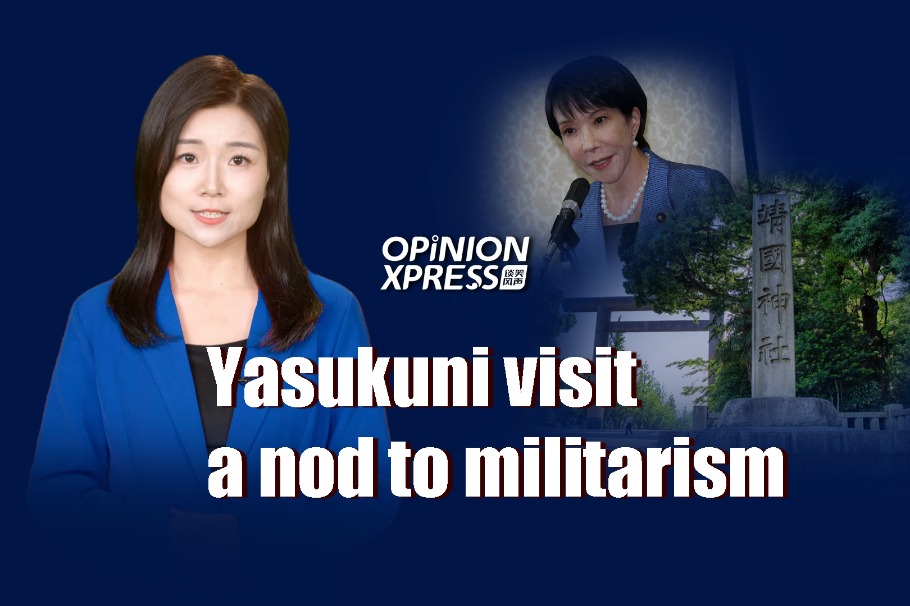
Yet the "obligations" that seem to animate Prime Minister Sanae Takaichi, which stem from a political lineage that has long romanticized Japan's militaristic past, are glorified instead of being a source of shame. By publicly signaling a readiness to engage in armed intervention over the Taiwan Strait situation — under the pretext of a fabricated "external threat" — Takaichi has actually voiced a military threat against China with her provocative and dangerous remarks on Taiwan during recent Diet deliberations.
Japan's modern political trajectory since the Meiji Restoration has often swung between the two poles of the chrysanthemum and the sword proposed by Benedict: The former representing restraint and civility, the latter aggression and expansionism as embodied by Takaichi's erroneous remarks on the Taiwan question.
Her remarks mark a regression toward the impulses that plunged Japan and the wider region into the catastrophe of war. They are not simply rhetorical overreach. They constitute a calculated political gamble that uses "national security" and "regional stability" as leverage for Japan's "normalization" with the removal of the shackles on militarization. Shackles that to some in Japan are a source of shame, when in actual fact they are an obligation imposed on it by its unbridled aggression.
Takaichi's attempt to crack open the Pandora's box of remilitarization not only violates the spirit of Japan's "pacifist" Constitution; it also interferes in China's internal affairs and disrupts the postwar international order that has underpinned peace in East Asia for decades.
Takaichi's ascent to political prominence is inseparable from the rise of hard-line right-wing forces within Japan. Lacking substantive diplomatic experience, she has leaned heavily on ideological signaling to cement her identity as a far-right leader, treating such positioning as both a badge of honor and a shortcut to power.
Despite Japan's 1.8 percent economic contraction year-on-year in the third quarter, Takaichi is ignoring the country's economic woes.
Due to the pernicious influence of the right-wing politicians, public evaluation of the political leadership of the country increasingly appears less concerned with improving livelihoods and more attracted to the illusion of restoring a mythologized past.
Born in 1961, Takaichi grew up during Japan's economic rise. In the following decades, she developed an expansionist mentality similar to the generation of Japanese politicians belonging to Japan's first rise from the late 19th century to the early 20th century, who turned the country into a war machine. Under the leadership of Takaichi, Japan seems to stand at a similar crossroads now. The danger is that in driving this trend, Takaichi and her supporters are doing so despite being fully aware of its upshots. Yet history offers clear evidence of where valorizing aggression leads.
Rather than repudiating it, Takaichi and other politicians uphold "the sword" rather than "the chrysanthemum" out of a misguided sense of loyalty to the past. With this mindset they try to keep the Japanese public in ignorance of the country's past wrongs by distorting and burying the uncomfortable truths of history. This fog of misinformation that cloaks reckless ambitions is being thickened with the rhetoric of upholding "regional peace" and "stability" against a "China threat".
Japan's past aggression originated from similar claims of "external threats" or acting on an expressed "duty" to maintain order in Asia. The result was not prosperity but suffering and atrocities at the unsheathing of "the sword". Its "Greater East Asia Co-Prosperity Sphere" during World War II became synonymous with destruction, exploitation and immeasurable suffering in the region.
Today, the same playbook is being revived. Invoking "external threats" serves as a convenient pretext to push for revision of the Constitution, accelerate Japan's remilitarization and steer Japan back toward the path of becoming a power free to act without shame. The Taiwan question is merely the lever that has been chosen to advance this agenda.
Some observers may still expect rationality and responsibility from Japan's leadership. But repeated instances of reckless political maneuvering show a pattern resembling the "irrational moves" of the game of Go, a popular game in East Asia — moves that appear bold but violate basic principles and ultimately lead to defeat. Such behavior invites domestic backlash, international criticism and heightened regional risk.
Japan's genuine obligations on the Taiwan question are clearly defined in the four political documents between China and Japan — solemn commitments that leave it no wriggle room. The country's true shame lies in it betraying these obligations. Yet Tokyo's current policy orientation signals it feels no shame in taking this course of action.



Today's Top News
- Stronger RMB points to resilience
- US defense policy act fuels Taiwan tensions
- Japan's nuclear ambitions call for high alert: Editorial
- China repatriates 952 telecom fraud suspects from Myanmar
- Chinese defense ministry criticizes latest US defense bill
- China sets a world record in maglev technology








