Tech giants target unmanned logistics









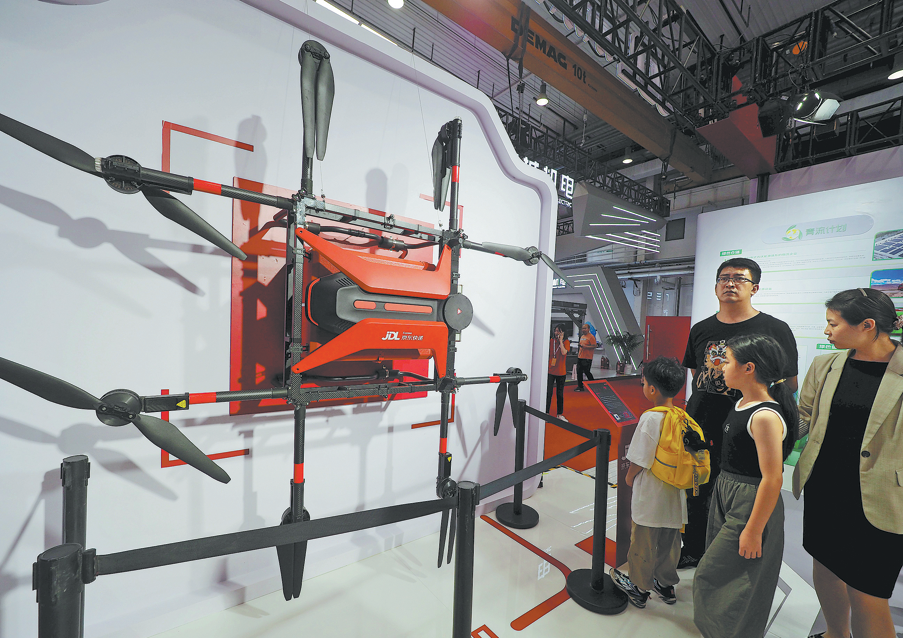
Chinese tech heavyweights are ramping up resources to expand their presence in the fast-developing unmanned logistics and delivery sector to boost efficiency and address challenges from rising labor costs and a shortage of couriers.
Compared to traditional delivery practices, unmanned deliveries entail lower delivery costs, larger carrying capacity and greater safety records, while improving user experience in the fiercely competitive logistics field, industry experts said.
Liu Qiangdong, Chinese e-commerce giant JD's founder and chairman, recently said that the company will build the world's first fully unmanned delivery station in April.
According to Liu, with the appearance of artificial intelligence and robotics, the proportion of China's social logistics costs in GDP is expected to drop from over 14 percent to less than 10 percent in the next five years.
The company has announced plans to purchase 3 million robots, 1 million autonomous vehicles and 100,000 drones to upgrade logistics and supply chains over the next five years.
He said many of JD's automated devices have already realized large-scale operation, estimating that robotics and drones will see explosive growth in the future.
Liu said robots will liberate human beings from repetitive and heavy work, and technological advancements will create a large number of new types of jobs, new demand and new services.
Cainiao Group, the logistics arm of Alibaba Group Holding Ltd, has invested heavily in the research, development and operation of unmanned delivery vehicles since 2016, aiming to boost last-mile delivery efficiency and cut operational costs for courier stations.
Li Qiang, chief technology officer of Cainiao, said autonomous driving is the key technology to significantly cut the share of logistics costs in GDP.
Driven by rising demand for unmanned delivery, a series of supportive policies and technological innovation, unmanned vehicles are rapidly penetrating into a wide range of industries, Li said.
"In the next three to five years, we expect over 200,000 unmanned vehicles to be deployed in the logistics industry, which will further drive technological advancement and cost reductions across the sector," he said, adding that autonomous vehicles have achieved commercialization and large-scale application in the logistics sector.
The company will bolster the development and transformation of the logistics industry by leveraging its strengths in intelligent technologies covering AI and autonomous driving, so as to address last-mile delivery challenges.
Mo Daiqing, a senior analyst at the Internet Economy Institute, a domestic consultancy, said the adoption of autonomous delivery vehicles can potentially reallocate couriers' work hours by releasing them from parcel delivery and giving them a chance to spend more time on customer service and maintenance of such vehicles.
Industry statistics showed that revenue from China's low-speed autonomous driving industry reached 12.3 billion yuan ($1.73 billion) last year, up 45 percent year-on-year, with approximately 33,000 unmanned vehicles sold, an increase of 34 percent from the previous year.
By the end of 2025, sales of low-speed autonomous vehicles in China are expected to exceed 47,000 units, with the revenue reaching 18.5 billion yuan.
Currently, unmanned delivery vehicles are gradually moving toward large-scale commercial adoption, with application scenarios expanding from designated areas to fully open roads, said Guo Tao, deputy head of the China Electronic Commerce Expert Service Center.
"The open road scenarios are mainly concentrated in the urban delivery segment, including traditional logistics services such as express and freight delivery, as well as deliveries related to community group-buying and supermarket retail. The widespread use of unmanned delivery vehicles will be conducive to greatly reducing logistics costs."
"Along with the advancements of autonomous driving, the internet of things, and sensor technologies, unmanned delivery vehicles boast enhanced capacities in terms of road condition perception and obstacle avoidance," Guo said, adding that these vehicles could effectively relieve logistics pressure during e-commerce platforms' promotional campaigns.
Lu Zhenwang, CEO of Shanghai-based Wanqing Consultancy, said unmanned delivery services have been deployed in some designated areas and scenarios, such as hotels, universities and supermarkets, given the current autonomous driving technologies and complicated traffic situations.
Lu said Chinese tech giants are betting big on the intelligent logistics sector, covering driverless vehicles, drones and robots to gain an upper hand amid fierce competition.






Today's Top News
- Xi chairs CPC leadership meeting on Party conduct, anti-corruption work
- Why Hainan Free Trade Port stands out
- Rule of law strengthens business environment
- Documents affirm one-China principle
- Central SOEs urged to push upgrading
- Agreement boosts ocean governance