Sinologists help to bridge civilizations
Xi's reply deeply inspires, strengthens confidence of young foreign academics









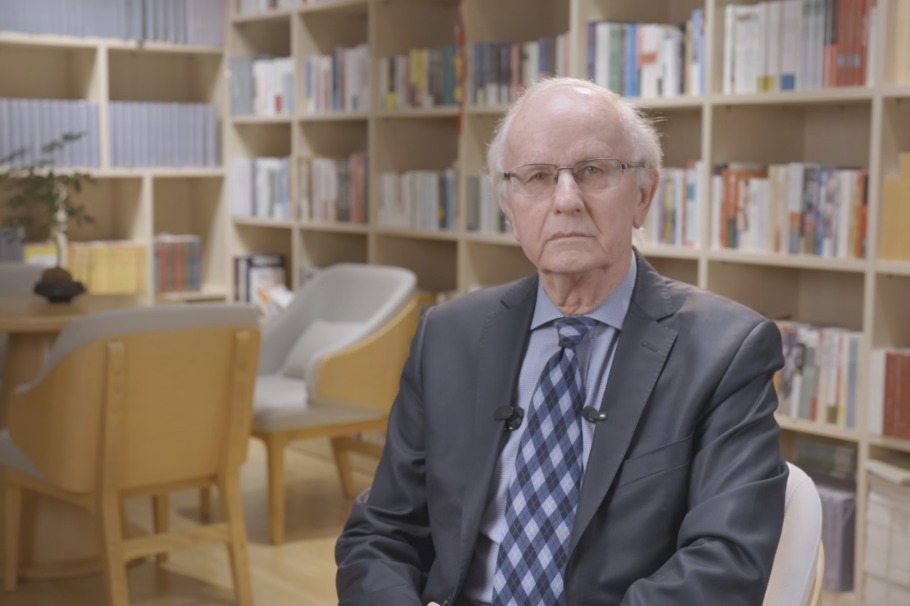
On a sunny morning in early November, young Russian Sinologist David Kolosov, on behalf of 61 young Sinologists from 51 countries, picked up his pen and carefully wrote each Chinese character stroke by stroke on paper, hoping to share with President Xi Jinping the experiences and insights gained through China studies.
"In this digital era, handwritten lines show the authenticity of communication, and allow the recipient to feel the human touch between the words," he said.
The authors of the letter were invited to attend the 2025 World Chinese Language Conference held in Beijing about two weeks ago. The three-day event was attended by around 5,000 people from over 160 countries.
"We (young Sinologists) are not foreigners who only know how to say a few phrases in Chinese. Many of us are studying and living here, researching both today's China and its past, and we want President Xi to know this," Kolosov said.
That is why they decided to write a letter to the Chinese president and express their willingness to deepen their study and facilitate cultural exchanges through this special format.
They soon received a reply from Xi, who expressed his delight that the young Sinologists not only cherish the Chinese language and culture, but also actively foster the progress of Sinology and mutual learning among civilizations.
In his letter, Xi emphasized that Sinology represents a common heritage shared by all humanity.
Xi encouraged these young Sinologists to continue to present a true, multidimensional and panoramic image of China to the world, contributing their wisdom and strength to building a community with a shared future for humanity.
"The reply letter deeply inspired me and strengthened my confidence in the future study and promotion of Sinology," Kolosov said.
A PhD candidate studying comparative political science at Peking University, Kolosov said that Sinology is not only about exploring traditional Chinese thought, but also about digging into the wisdom of humanity.
"Just like studying Aristotle and Plato, researching the thought of Confucius and the Four Books and Five Classics (the core carrier of Confucianism) is equally important, as these thoughts can also contribute to the development of world civilizations," he said.
Kolosov's passion for Chinese culture began with a zest for the characters. "It's so different from other countries' writing systems, full of charm," he said, adding that Chinese characters have preserved the wisdom of China for thousands of years.
Kolosov said that his supervisor at the university, who is well-versed in both Western theory and Chinese tradition, helped to expand his horizons.
"This perspective allowed me to understand different cultures and ideas from more angles," said Kolosov, who is also active on social media and television shows, sharing his observations about China from day-to-day experiences.
"I've been in China for about 15 years and the reason that keeps me in the country is not the skyscrapers or asphalt roads, but the people," he said.
"In the beginning, we might be labeled as 'Russians' or 'Chinese'. Once we really get to know each other, we realize that shared values and common interests matter far more than nationality," he said.
Worldwide appeal
Xu Baofeng, director of World Sinology Center at Beijing Language and Culture University, said the global rise of a "Sinology fever" demonstrates the appeal and worldwide influence of Chinese culture.
Now more than 80 countries have incorporated Chinese into their national education systems and there are over 200 million global learners and users of the language, according to Xu.
He cited examples such as a South African teenager studying Chinese to understand the Chinese animated film Ne Zha, a Spanish vlogger promoting Chinese cuisine in the Tianjin dialect, and the vocational training of livestreaming in Chinese in e-commerce across Southeast Asia.
These phenomena, Xu said, have shown that Sinology is increasingly integrating into daily life around the world in diverse forms, and it is moving beyond academic classrooms to enter broader social spaces.
The letter to Xi from the 61 Sinologists further demonstrated the international community's strong expectations for China studies and underscored its value as a bridge between civilizations, added Xu.
For Alaa Mamdouh Akef, an assistant professor at Peking University's School of Foreign Languages, the letter to Xi is both a "work report" and a commitment to show that young Sinologists can continue to be entrusted with greater responsibilities.
In the letter, they expressed gratitude for the door China has opened for them to gain a deeper understanding of Chinese civilization, said the co-author.
"We, young Sinologists from different countries and academic backgrounds, are listeners to China's stories as well as storytellers of China," he said. "It is this dual identity that makes us gradually aware of our responsibilities to convey the real thoughts and voices on world platforms."
While introducing China's history, literary works and development experience to the Arab world through research and translation, the Egyptian assistant professor said he is also teaching students to present China in Arabic in an accurate, rigorous and persuasive way.
He said he has realized that Sinologists are not only academic researchers but, as President Xi said, they also build bridges between different languages and civilizations.
Xu, from Beijing Language and Culture University, said that Sinologists should delve deeply into Chinese culture and accurately interpret its core values, while at the same time they should focus on contemporary China, connecting their studies with global developments to explain the cultural logic and value of China's path.
The development of Sinology is both the process of Chinese civilization stepping onto the world stage and the process of world civilizations embracing China, he said.
From shaping international rules to advancing regional governance, and from public-health cooperation to global poverty alleviation, Sinology, with its unique Eastern wisdom, is offering Chinese solutions to global challenges, Xu said.
The people-centered governance philosophy has helped African countries form practical plans for tackling poverty, he said, adding that China-Africa cooperation in promoting traditional Chinese medicine shows the implementation of TCM's holistic view of health.
zhoujin@chinadaily.com.cn