China plans to implement key education reforms










China is set to expand the scope of free education and consider extending its compulsory schooling system as part of its upcoming 15th Five-Year Plan (2026-30), marking one of the most significant education reforms in recent years.
The proposed changes aim to reduce family education costs while building a more skilled workforce for the future.
According to the recommendations for formulating the 15th Five-Year Plan adopted in October at the fourth plenary session of the 20th Central Committee of the Communist Party of China, the country has proposed steadily expanding the scope of free education and increasing the number of years for compulsory education.
Momentum for education reforms gained ground in August when the State Council, China's Cabinet, issued a guideline to gradually implement free preschool education.
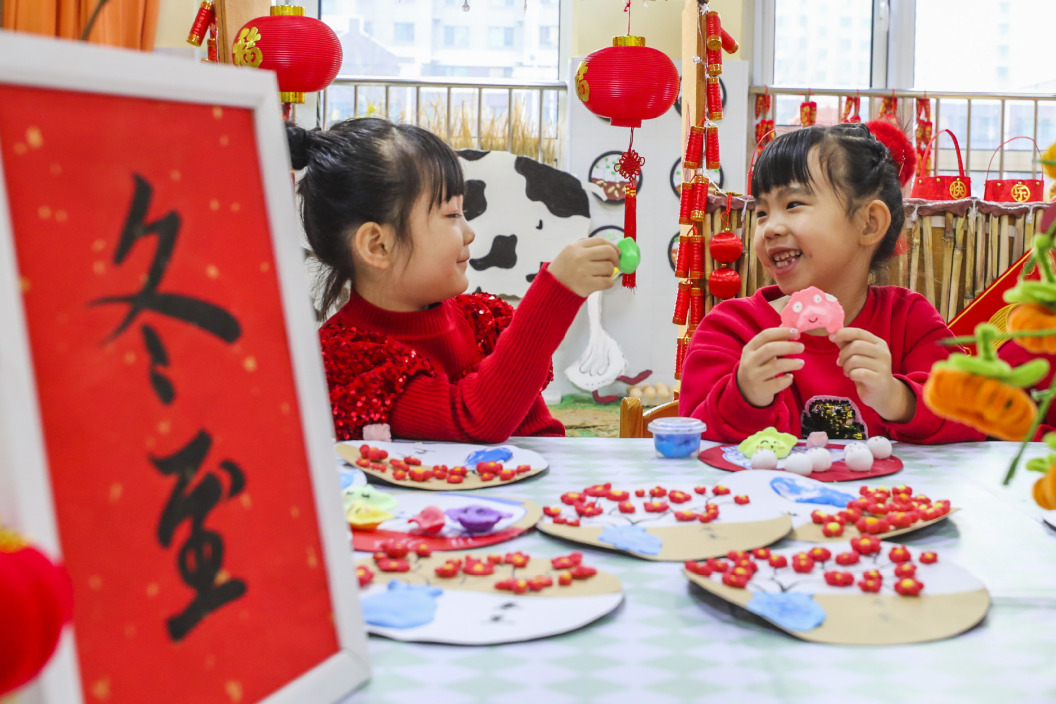
The policy, which took effect in the autumn semester, waived education fees for students who are in their final year at public kindergartens, initially benefiting about 12 million children. The country already offers free and compulsory education for children in primary and middle schools.
Experts have welcomed the proposed changes, calling them a strategic shift toward greater educational equity.
"This represents a fundamental reorientation toward 'investing in people'," said Gao Hang, vice-dean of the Renmin University of China's School of Education. "By redirecting resources from traditional infrastructure to human development, we are strengthening the government's commitment to safeguarding every citizen's right to education."
Initially, the expansion of free education will likely prioritize preschool levels, Gao said, noting that the declining birth rate has reduced the number of preschool-age children, making it financially feasible to achieve free preschool education under China's current fiscal system.
In contrast, the number of senior high school students is still growing, posing greater fiscal challenges, he added.
Xue Eryong, a professor at Beijing Normal University's Faculty of Education, said that expanding the scope of free education aims to broaden access to basic public education services, enabling more people to receive high-quality education and lay a foundation for lifelong development.
Envisioning 15 years of free basic education as an ideal goal, he proposed gradually extending free preschool education from one year to three years and expanding free senior high school education in regions with adequate resources.
Gao, from Renmin University of China, emphasized the role of compulsory education in promoting equity, building a talent pool and supporting fertility-friendly policies. He noted that compulsory education helps curb the rate of school dropouts due to financial difficulties, improves foundational knowledge and reduces household education costs, thereby encouraging higher birth rates.
Xue, from Beijing Normal University, clarified that free education does not equate compulsory education. Compulsory education must fulfill three criteria — free provision, mandatory attendance and uniformity in quality.
While preschool education may achieve free provision, making it compulsory would require ensuring mandatory enrollment and standardized quality nationwide, he said.
Xue added that extending compulsory education to the preschool level aligns better with the overall development of a child, as well as social needs, because the high school level involves diversified pathways, including academic, vocational and social learning.
Gao said that China must take a dialectical view of developed countries' reforms to extend compulsory education.
There are some questions that warrant deeper examination, like whether more years of schooling would necessarily improve national competence, and how can the country avoid a potential "education welfare trap" caused by excessive investment, he said.
As a major country with a large population, which is also at a crucial stage of technological advancement and industrial upgrading, China faces multiple challenges in considering such an extension, Gao said.
These include debates over upward or downward expansion, the trade-off between prolonged learning and delayed entry into the workforce, and the clash between growing educational demands and limited fiscal resources, he added.
Wu Ni, director of the Chinese Academy of Education Sciences' Institute of Education Strategy, highlighted the solid foundation for these reforms. With compulsory education achieving basic equilibrium in all 2,895 counties and a 95.9 percent consolidation rate, China has built the world's largest education system, he said.
Regional initiatives have laid the groundwork, Wu noted. Beijing aims to achieve 90 percent coverage of affordable kindergartens by 2025.
In Shandong province, all cities are expected to have adequate student capacity in high schools by 2026, while by 2027, over 60 percent of counties and county-level districts in Shandong are expected to achieve universal and affordable preschool education.
In the Xizang autonomous region, 15 years of free education has been in practice since 2012.
Wu underlined the importance of a phased and region-specific approach, encouraging economically developed regions to pilot reforms first. Dynamic resource allocation mechanisms should be established to align with demographic trends and fiscal capacities, ensuring sustainable and effective implementation, he said.
zoushuo@chinadaily.com.cn

- Vice-chairman of CPPCC Jiangxi Provincial Committee placed under investigation
- Five trapped in flooding accident at Heilongjiang coal mine
- Long March 5 rocket deploys tech demo satellite into space
- China launches communication technology test satellite
- Spokesperson warns against aggression toward mainland fisherman
- Lhasa wetland reserve recognized as world's highest altitude wetland