Unified national market domestic demand unleasher










Editor's note: China has pledged to advance the development of a unified national market over the next five years. At the same time, boosting domestic consumption has become a priority. Wei Jianguo, former vice-minister of commerce, spoke to China Economic Net on these issues. Below are excerpts of the interview. The views don't necessarily represent those of China Daily.
The goal of building a unified national market is to allow key factors of production to flow in accordance with market principles.
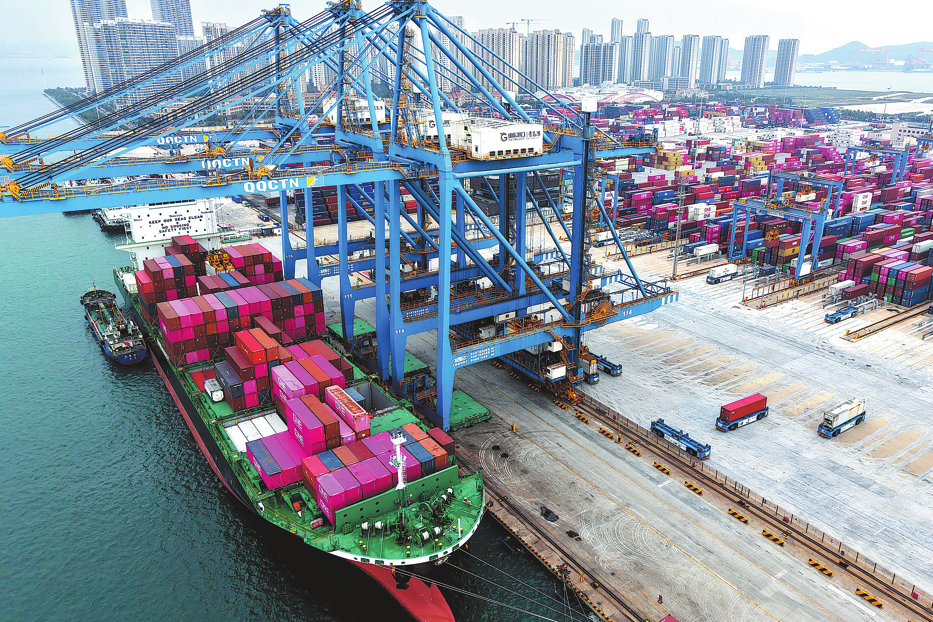
Backed by the institutional strengths of socialism with Chinese characteristics and the advantages of a supersized market, China is well positioned to make efficient use of production factors. Therefore, progress in developing a unified national market is likely to be faster and more effective than in many Western economies.
Currently, the priority is to unleash the potential of China's vast domestic market so that production factors can be optimally allocated and upgraded. Major urban clusters such as the Yangtze River Delta, the Guangdong-Hong Kong-Macao Greater Bay Area and the Beijing-Tianjin-Hebei region should take the lead in piloting reforms, with large cities, including Shanghai, Guangzhou, Shenzhen and Tianjin, at the forefront.
Shanghai, for instance, can be transformed from a "major Chinese hub" to a "major global hub".
The first step is to combine an effective market with a well-functioning government to establish the city as a national center for factor allocation.
The second step is to attract production factors from around the world by letting multinational corporations, financial institutions and investors see that investing in China can yield returns.
This, in turn, will position China's vast market as a central anchor and driving force in the global industry, supply and value chains.
A unified national market would ensure that consumers enjoy more tangible benefits and convenience, workers are offered broader career development opportunities, entrepreneurs benefit from greater market efficiency and investors get more optimized resource allocation.
It would be overly simplistic to attribute insufficient consumption solely to a lack of income among households. In reality, constraints stem mainly from three factors: income, structure and the consumption environment.
On the income front, it is essential not only to increase people's earnings but also to promote a fairer and more reasonable income distribution. Structurally, greater attention must be paid to the mismatch between the industrial and consumption structures. China entered the postindustrial stage at a faster pace than many other countries, and the development of a consumption-oriented society has lagged behind. Therefore, existing industrial structures do not fully align with evolving consumer demand or meet people's growing aspirations for a better quality of life.
The consumption environment also plays a crucial role. When people tighten their purse strings, it reflects a lack of confidence about the future.
On the one hand, households face considerable pressure from expenditure on elderly care and health care.
On the other hand, China's consumption loan balance still accounts for a relatively small share of the GDP, indicating significant room for growth. In addition, the real estate market has exerted a crowding-out effect on other forms of consumption, with mortgage burdens constraining the spending potential of households.
Against this backdrop, the central authorities' recommendations for the 15th Five-Year Plan (2026-30) emphasize using new demand to guide new supply, and new supply to create new demand, thereby fostering a positive interplay between consumption and investment, as well as between supply and demand. This approach will strengthen the momentum and reliability of domestic circulation and pave the way for boosting consumption in the next stage.