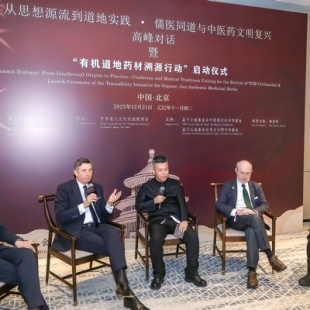



Beijing summit promotes intl use of TCM and geo-authentic medicinal herbs










The Summit Dialogue on the Revival of Traditional Chinese Medicine (TCM) Civilization took place on Sunday in Beijing, hosted by the Mencius Foundation as part of its "Oriental Civilization-Summit Dialogue" series.
The event aimed to foster dialogue between Eastern and Western civilizations by integrating academic research with practical application and advancing the creative transformation of Chinese culture.
Chinese and international participants discussed themes such as "harmony and balance" and "the unity of humanity and nature", emphasizing the shared philosophical foundations of Confucianism and TCM.
In addition, topics also included promoting the global reach of ancient Chinese medical practices and the urgent need to protect organic, geo-authentic medicinal herbs.
Meng Liang, chairman of the Mencius Foundation, highlighted that both TCM and Confucianism originate from a common worldview based on harmony, benevolence, and the nurturing of life. He noted that TCM's holistic approach to health represents the unique contribution of Chinese civilization to humanity.

Former Slovenian President Borut Pahor, also co-chairman of the Mencius Foundation Advisory Board, spoke about TCM's growing presence in Western healthcare. He pointed to acupuncture as a prime example of its integration into Western practices and emphasized the increasing use of herbal medicine. "Adaptogenic herbs like ginseng and astragalus, once exclusively part of Eastern pharmacology, are now staples in Western wellness trends," he said.
Pahor argued that TCM's philosophical principles have influenced Western views on wellness and prevention. "Concepts like 'food as medicine' and the importance of seasonal living resonate with the West's growing interest in holistic health," he remarked. He stressed that the global spread of TCM should be seen as a mutual exchange between civilizations, enriching both sides and offering opportunities for deeper understanding and collaboration.
Italian Sinologist Riccardo Pozzo highlighted that the people-centered ethics of Confucianism and TCM, based on benevolence, provide valuable insights for addressing contemporary challenges in Europe and beyond.
The summit also launched a traceability initiative for organic and geo-authentic medicinal materials to improve the quality of Chinese medicinal herbs through field research, scientific verification, and ecological protection, while also strengthening cross-cultural exchange and cooperation.