An Italian chef's spicy dialogue with China









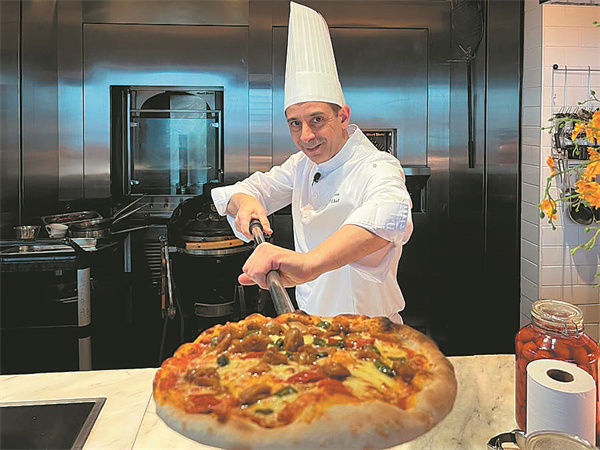
In the open kitchen of a hotel in Southwest China's Chongqing, the air was thick with the mouthwatering aroma of baking dough and sizzling meat, as executive chef Francesco Sanna was busy preparing his signature creation, the Chongqing Spicy Chicken Pizza.
He spread a mix of local green and red chili peppers and Chongqing-style stir-fried chicken over a hand-tossed pizza base, sprinkled it generously with cheese, and slid it into a high-temperature oven. Once out of the oven, the pizza was finished with a drizzle of garlic oil, creating a tantalizing fusion of spicy zest and creamy richness that brought Chinese and Italian flavors into a harmonious dialogue.
"Spicy chicken is a local Chongqing dish, and now it shines as a pizza topping. We use local chilies instead of the usual bell peppers, which give the flavor more layers,"Sanna says. Today, this innovative pizza has become a crowd favorite at the hotel's restaurant.
Sanna hails from the Italian island of Sardinia and currently helms the kitchen at the Niccolo Hotel in Chongqing. The hotel's name pays homage to Niccolo Polo, a 13th-century Italian explorer and father of the legendary adventurer Marco Polo, who traveled to China along the ancient Silk Road. For an Italian chef who has made China his home for over a decade, this connection feels like a serendipitous echo across time.
Sanna says that his fascination with China began early. As a child, images of the country in his textbooks — streets filled with bicycles and the beauty of Chinese characters and calligraphy — left a lasting impression.
When he was around 20, Chinese restaurants began popping up in his neighborhood, piquing his curiosity. He fondly remembers his first attempts at using chopsticks. "They showed me a few times, and I learned it quickly," Sanna recalls, adding that he even insisted on using them at home. "It made the meal more relaxing and allowed me to better savor the flavors."
That spark of curiosity eventually led him to China. In 2009, Sanna landed a job at a hotel in Shanghai."I originally planned to stay for two or three years," he says. "But now it has been 16 years."
Over the past 16 years, Sanna has traveled to nearly 30 provincial-level regions in China, living and working in cities including Beijing, Shanghai, Guangzhou and Foshan in Guangdong province, and Kunming in Yunnan province. His journey has given him a profound appreciation for the diversity of Chinese cuisine. "The culinary differences across China's various regions are huge, and even neighboring cities can have very different flavors," he says.
When he first arrived in Chongqing, known for its bold and fiery cuisine, the spiciness proved challenging. He recalls his stomach protesting the day after his first authentic hotpot meal. "But I didn't give up," he says. "Week by week, month by month, I gradually adapted." Today, he has found his own balance between spicy and non-spicy tastes.
For Sanna, Italian and Chinese cuisines share a core philosophy rooted in regionality.
"Both are highly regional," he explains. With Italian cuisine recently recognized by UNESCO as an intangible cultural heritage, Sanna sees parallels in China."China has a similar kind of culinary culture. I have always advocated using local ingredients because the freshest and best ingredients often grow right around you."
This philosophy guides his kitchen. In Chongqing, he embraces local chilies; in other Chinese cities, he seeks out their signature ingredients.
In his Chongqing kitchen, Sanna has been working to interpret local flavors through Italian techniques. "Culinary exchange isn't about simply copying; it's about learning from each other while respecting local traditions," he says. "I'm not just teaching Chinese chefs; I am learning from them as well."
Beyond fusion, Sanna is dedicated to bringing authentic Italian and Mediterranean flavors to Chinese diners. Classic dishes, such as handmade truffle pasta and Valencian seafood paella, remain staples on his menu, prepared with traditional methods to showcase their original essence.
Sanna says that he has witnessed a growing sophistication among Chinese diners regarding Italian cuisine. Years ago, pasta served "al dente" was often considered "undercooked". Now, requests for authentic Roman or Milanese styles are common.
As exchanges between China and Italy flourish, Sanna feels the cultural bond deepening."More and more Chinese people are going to Italy, and more Italians are coming to China," he says. "People's understanding of each other's culture and cuisine is becoming richer and more profound."