Fishing ban revitalizes Yangtze









As dawn breaks over the Daxi River, a tributary of the Yangtze River, 55-year-old Li Shilun steers his patrol boat through the morning mist, a daily ritual that marks his new life as a fish protection officer for almost five years.
Once a fisherman in Chongqing's Wulong district, where he relied on the river's bounty to support his family by running a restaurant, "Fisherman's Home", Li has taken on the responsibility of safeguarding the waters.
The Yangtze River Basin, strained by overfishing and environmental decline, had seen its fish populations dwindle. By 2018, the resources of the four major fish species had declined by over 90 percent compared with the 1980s.
In response, China implemented a transformative 10-year fishing ban in the Yangtze's critical waters on Jan 1, 2020. The sweeping policy reshaped the lives of more than 10,000 local fishermen like Li and ignited a broader movement toward ecological preservation.
During patrols, Li, now the captain of the fish protection team in Wulong's Yajiang township, teaches new team members how to identify fish species and report re-emerged species to authorities.
"The 10-year ban has achieved significant interim results in Chongqing," said Li Chunkui, director of the Chongqing municipal agriculture and rural affairs commission, at a news conference in October. Since the ban's implementation, the city has documented 67 more fish species while illegal fishing cases have decreased by 32 percent. Rare and endangered fish species such as the Yangtze sturgeon and Chinese suckers, or Myxocyprinus asiaticus, are now more frequently sighted in the Chongqing section of the Yangtze.
The world's third-longest river, the Yangtze stretches 6,300 kilometers from the glaciers of the Qinghai-Tibet Plateau eastward through Chongqing, Wuhan in Hubei province, and Nanjing in Jiangsu province, before reaching the East China Sea in Shanghai.
While water security remains a major issue in China's development, over 400 million people rely on the Yangtze for their drinking water.
China has attached great importance to restoring the river's ecology and urged officials from provinces along the river to focus on restoration and protection while avoiding large-scale development.
Chongqing, located at the upper reaches of the Yangtze and at the heart of the Three Gorges Reservoir area, is among the 11 provinces and cities in the Yangtze River Economic Belt — a key national development strategy that has made ecological protection its primary mission. The municipality has 754 rivers with a combined length of more than 18,000 km designated as no-fishing zones, positioning this region as a crucial node in the Yangtze River ecological barrier.
To protect the basin's aquatic biodiversity, local authorities, including the municipal public security bureau, agriculture and rural affairs committee, and market regulators, have collaborated to crack down on the illegal fishing supply chain from capture to sales.
Cross-regional cooperation between Chongqing and the neighboring provinces of Sichuan, Hubei, Hunan and Guizhou, as well as technological measures, including an artificial intelligence warning and monitoring system that helps detect illegal fishing activity, have strengthened the ban's effectiveness, according to Tang Ting from the Chongqing agricultural comprehensive administrative law enforcement corps.
In the past five years, Chongqing has handled a total of 5,243 fishing cases, with 2,661 involving criminal activity.
The city also focuses on fish source protection. In June 2022,Chongqing launched the first veterinary ship to treat sick fish in the Yangtze basin. Local fishery research institutes have led rare fish breeding efforts.



- PLA practices seizure of key ports during drills in waters to east of Taiwan
- China becomes the world's 4th manufacturing power
- China rolls out plan to boost health of children, youth through 2030
- Striding ahead on path of national advancement
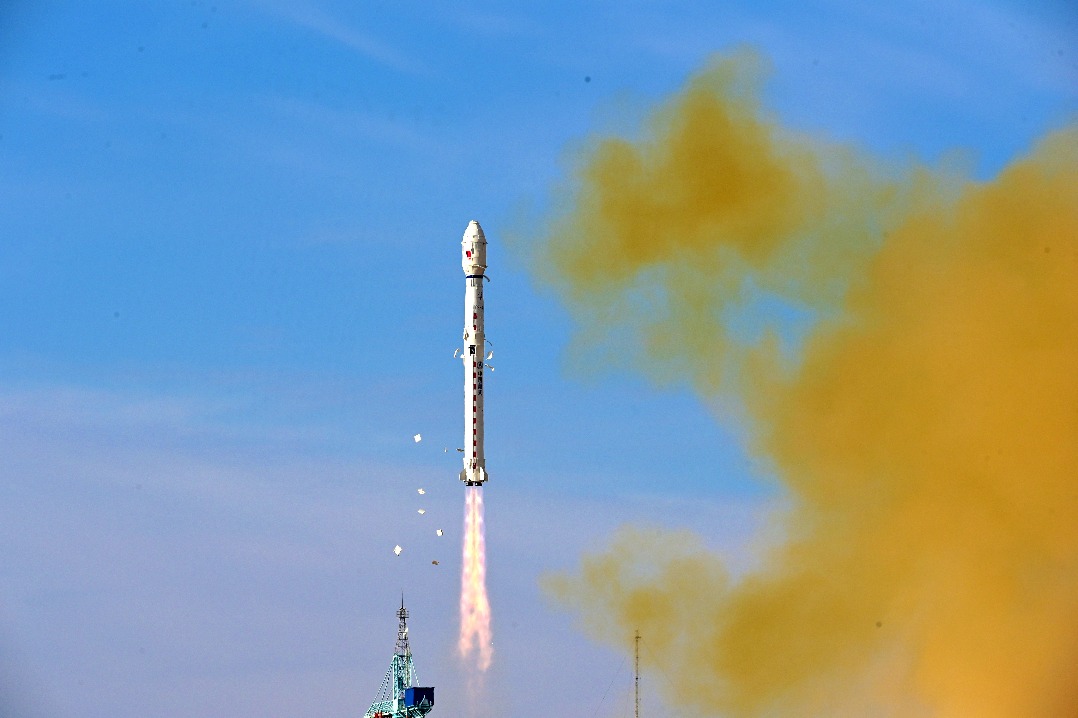
- China launches new satellite
- PLA conducts long-range live fire drills to south of Taiwan Island