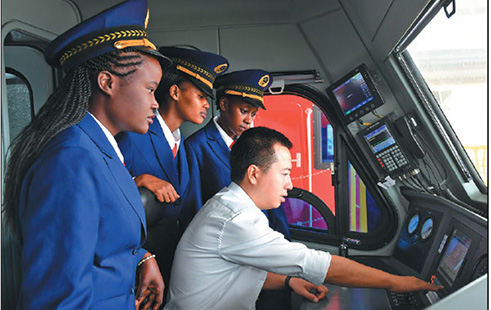
Belt & Road Initiative shores up China-Mideast cooperation


BEIJING - The Belt and Road Initiative is conducive to promoting connectivity and expanding trade cooperation between China and Middle East countries, experts have said.
The Belt and Road Initiative was a hot topic during Chinese President Xi Jinping's visit to Saudi Arabia, Egypt and Iran from Jan 19 to 23.
Proposed by Xi in 2013, the initiative comprises both the Silk Road Economic Belt and the 21st Century Maritime Silk Road, with visions to connect Asian, European and African countries more closely and promote mutually beneficial cooperation.
The Belt and Road routes run through the continents of Asia, Europe and Africa, connecting the vibrant East Asia economic circle at one end and developed European economic circle at the other.
INFRASTRUCTURE IS PRIORITY
"Connectivity is the artery of the thousand-mile land and maritime silk roads. To build connectivity with Middle East countries, China should start with transportation infrastructure," said Zhang Shuyu, a researcher with the University of International Business and Economics.
Zhang highlighted both the necessity and compatibility of cooperation between China and the Middle East in transportation infrastructure, noting that trade cannot be smooth without convenient transportation.
China has a strong competitive edge in areas such as railways, electricity, telecommunications, mechanical engineering, metallurgy and construction materials, which are needed by the Middle East.
China committed $40 billion to establishing a Silk Road Fund in 2014 to support cooperation projects in countries along the Belt and Road.
Infrastructure construction is important, but it is only part of the larger "1+2+3" cooperation framework, a cooperation plan proposed by Xi in 2014 at a ministerial conference of the China-Arab States Cooperation Forum in Beijing.
In the framework, "one" refers to energy cooperation as the main axis; "two" stands for infrastructure construction and trade and investment facilitation; "three" refers to breakthroughs that need to be made in the high-tech areas of nuclear energy, aerospace satellites and new energy.
Six Arab states, including Saudi Arabia, have inked agreements with China under the framework.
China Railway Group Limited announced Friday in a statement that the company, jointly with China's AVIC International, sealed a contract worth $1.5 billion on railway? construction with Egypt.
Majidreza Hariri, vice president of the Iran-China Chamber of Commerce and Industries, said Chinese companies are welcome to participate in the development of Iran's infrastructure damaged during war times.
HUGE TRADE POTENTIAL
"With the construction and development of infrastructure, ... the two nations (China and Iran) have paved the way for greater links along the Silk Road Economic Belt," said Sadegh Akbari, general director of the Organization for Investment Economic and Technical Assistance of Iran, in an article on China Daily on Saturday.
China promised to encourage its companies to import more non-petroleum products from Middle East nations to improve the trade mix and raise the two-way trade volume from $240 billion in 2013 to $600 billion in the coming decade.
So far, China has remained Iran's biggest trading partner for six years in a row and is the second largest trade partner of Saudi Arabia.
Though the plunge in oil prices dragged down China's trade with Iran and Saudi Arabia in 2015, growth potential remains to be exploited, Ministry of Commerce spokesperson Shen Danyang said on Wednesday.
Saudi Arabia is the top source of crude oil for China. Iran, also a big oil exporter, contributed 8 percent of China's total crude oil imports in the first 11 months of last year.
China's trade with Egypt remained strong in 2015. In the first 11 months, exports to Egypt rose 12.2 percent to $10.75 billion, while total trade volume grew 10.4 percent to $11.64 billion.
China also encouraged its companies to invest in such fields as energy, petrochemicals, agriculture, manufacturing and services of Middle East countries.
Hariri said that the oil, gas and petrochemical industries are the first that come to mind for investment and economic cooperation between China and Iran.
- Chinese President Xi Jinping's red carpet welcome in Iran
- President Xi's Speech at Arab League Headquarters: Full Text
- President Xi on China and the Arab World
- Egyptian scholar: Egyptians hail President Xi's upcoming visit
- Cartoon Commentary on President Xi's Middle East visit ③: Opening new era of Sino-Egyptian partnership