Bush must confront greenhouse denial
Updated: 2007-09-07 06:21
The fate of our warming planet hinges on six nations, and five of them are meeting in Sydney, Australia.
Through his long years of greenhouse denial, US President George W. Bush must have been particularly grateful to John Howard. The Australian prime minister was quick to join Bush in refusing to ratify the Kyoto protocol, and has batted for his country's coal interests as trenchantly as Bush has batted for US coal and oil interests.
Now Bush has had to deal with the impact on American public opinion of hurricane Katrina and Al Gore's movie, and can no longer afford to ignore climate change.
Howard, contending with a killer drought, is similarly finding that greenhouse denial is out of bounds. The flow of Australian rivers has fallen by a staggering 70 percent in recent decades. All Australia's major cities are in drought.
The "big dry" in the Murray Darling basin threatens 40 percent of food production. Global warming has become an issue in the January elections.
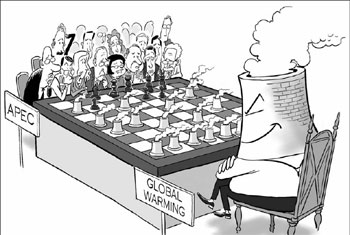
Howard is hosting the Asia-Pacific Economic Cooperation (APEC) summit in Sydney which is being attended by Bush.
Everyone who cares about the greenhouse threat should train a microscope on their actions.
The fate of human civilization will probably hinge on the fossil-fuel decisions of just six nations, and five of them are members of APEC.
If we are to avoid tipping the planet over a widely accepted danger threshold of 450 parts per million of atmospheric carbon dioxide, we can only afford to burn fossil fuels in a quantity measured in hundreds of billions of tons of carbon.
Industry estimates suggest that remaining oil deposits alone exceed this figure, if we include unconventional sources such as Canada's tar sands.
As for coal, the energy industry suggests several thousand billion tons remain to be burned. Even if we believe fossil-fuel proponents tend to exaggerate estimates of the size of deposits, it is clear that most of the remaining coal has to stay in the ground if we are to avoid climate catastrophe.
Three-quarters of coal reserves are in five nations: the US, Russia, China, India and Australia.
Add Canada, because of the scale of the oil deposits in the Athabasca tar sands, and there you have it: the fate of human civilization will probably hinge on the resource decisions of just six nations.
Those who place their hopes in bolt-on adjustments to the fossil-fuel status quo, notably carbon capture and storage technology, face the problem that mass production of the necessary technology is more than a decade off.
What can we expect of Howard, Bush and their fellow coal leaders this week? Howard has said he will instigate a carbon-trading scheme if re-elected, but will not be drawn on the all-important issue of caps. Bush opposes an energy bill passed recently in the House of Representatives that would place an obligation on electric utilities to use more renewables and less coal. He is endeavoring to run his own international negotiations in competition with the United Nation's long- running Kyoto process. On this kind of running, it would be surprising if the APEC summit offered any hope of the world kicking the coal habit.
Would different leaders in the Big Six make any difference? In Australia, Labor is ahead in the polls, but strong on defence of coal interests. In America, the Democratic challenger Barack Obama, from the coal state of Ohio, has co-sponsored a bill to boost technology that makes gasoline from coal via a process that would be ruinous for the climate.
Meanwhile, those not in the coal big league and best placed to lead the way to a different energy future are not doing so. In the United Kingdom, coal use is rising, renewables investment is derisory, and even investment in carbon capture and storage would pave but a short stretch of motorway.
Jeremy Leggett is author of Half Gone: Oil, Gas, Hot Air and the Global Energy Crisis.
The Guardian
(China Daily 09/07/2007 page10)
|
|