BIZCHINA> News

|
BIZCHINA> News
|
|
Plugging the leaks
By Qian Yanfeng (China Daily)
Updated: 2008-10-27 09:21 With the ongoing credit crunch and economic recession hampering worldwide trade growth, shipyards in China now face an abrupt downturn in demand and tighter access to credit after a nearly decade of freewheeling development in the industry.
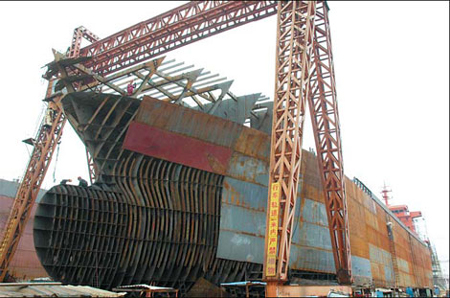 The estimated 3,000 or so shipyards have been expanding at a stunning rate on the back of the country's robust economic development as well as a global trade boom. With their cost advantage in a labor-intensive industry, Chinese shipyards may soon prove themselves to be the world's next shipbuilding leader very soon.
Last year, total orders at Chinese shipyards beat Japan, and were second only to South Korea. In terms of new orders, China already became No 1 in 2007, totaling 98.5 million deadweight tons (DWT), or 42 percent of the world's total. However, with the recent financial crisis affecting many economic sectors, the shipyards are starting to feel the pinch - ship buyers now are starting to hold back their orders while banks have tightened their fund guarantees amid gloomy market sentiments. According to a recent report from the China International Capital Corporation Limited (CICC), a joint investment bank in China, the number of new ship orders worldwide dropped 66 percent year-on-year in September. Chinese yards, in particular, experienced a 34 percent drop in new orders in the first nine months of this year, as compared to the global average of 27 percent. Guangzhou Shipyard International Company Limited, a subsidiary of China's shipbuilding behemoth China State Shipbuilding Corporation (CSSC), had only five new ships ordered in the first half of this year compared with 24 in 2007. Cheng Yang, purchasing manager of the Zhejiang-based Taizhou Wuzhou Shipbuilding Industry Co Ltd, says he and his colleagues in the sales department have been suffering from mounting pressure in the second half of this year as it has become increasingly difficult to secure new ship orders. "Shipyards did not need to look for orders in the past," says Cheng. "But now it is different. You have to go to the shippers to persuade them for a contract. "To be sure, we aren't the only victims. Many of the yards are coming under similar pressure, with some already delaying production. But once you know that, the sense of crisis simply gets intensified." Even the suppliers are starting to feel the stress. Cheng says he has had a growing number of shipbuilding suppliers visiting his office recently advertising their products. Obviously, the soft market demand has already passed into the upstream sectors. Industry watchers say with the Baltic Dry Index (BDI), the global benchmark for the cost of shipping commodities, tumbling over 80 percent from its May high to five-year-low in mid-October, the slumping demand for ships worldwide will continue. Underlying the slowing demand is the fact that even before the financial crisis set in, the shipping industry worldwide was already experiencing a capacity glut during the past five years. With 600 million deadweight tons of orders to be completed in the next three years, the global shipping sector is expected to have another 60 percent added to its current capacity, according to Ye Guoji, analyst from Ping An Securities. Saturated market It's a sign that the market has become highly saturated. China alone holds about 200 million deadweight tons in its order book. Ye says the financial crisis has accelerated the cooling down of the industry. Meanwhile, both the shippers and shipyards will suffer from worsening credit conditions as fallout from the financial crisis has made it increasingly difficult for ship owners to pay for the ships they ordered. However, industry watchers generally agree that Chinese shipyards' fully booked backlogs that extend three years down the road could provide a cushion against the overwhelming market slump, which, though, could also threaten many fledgling and privately owned yards. Private shipyards in China account for approximately 50 percent of the country's total production capacity. But the vast majority of them lag behind in technology and experience, and may have difficulties in generating enough financing to propel continued growth, says Cao Yousheng, deputy director of the Technology Research and Economy Development Institute under the CSSC. "While larger State-owned shipyards are better positioned to weather the current challenges, small private players may have difficulties in the timely delivery of ships," says Cao. "Apart from liquidity problems, they have to undergo stricter checks from ship owners who obviously have less interest in getting ships done during the market dive. This in turn may add to their liquidity squeeze and even drive many to bankruptcy." Newly opened yards, in particular, need to sign new contracts in order to maintain their production capacity and recover initial costs in equipment investment, Cao adds. "When the market is on a downward spiral, the risk is aggravated on the yards' side because ship owners may have a higher chance of canceling their orders," says Zhang Yao, corporate management director of Yangzijiang Shipbuilding (Holdings) Ltd, China's second largest private shipyard. It was also the first Chinese private yard to launch its IPO in Singapore. "Small yards in China usually lay down a very low downpayment ratio to secure contracts, which means they may have a higher risk of cancellations if the buyers can't find enough money to pay for their ships," Zhang says. The situation is further complicated by the fluctuation in steel prices and the yuan's appreciation, which has added to the risks for small shipyards that are less efficient in their production and cost controls. According to the statistics from China Association of the National Shipbuilding Industry, the over-6-percent appreciation in the yuan against the US dollar has cost China's shipbuilding industry a total of 1.4 billion yuan in the first six months of this year. If the appreciation continues into the next year, the impact upon Chinese ship exporters will increase. Thus it's important for Chinese shipyards, especially the small players, to increase their production and management efficiency while also stepping up design capabilities in high-value-added and hi-tech vessels, analysts say. They remain generally upbeat about China's shipbuilding industry, however. "Chinese yards still enjoy cost advantage compared with their counterparts in Japan and South Korea, and they have much greater room for improving production efficiency," Cao says. For Cheng from the Wuzhou shipyard, the current crunch also represents a good opportunity for the company to improve its corporate management and capability in shipbuilding while diversifying into new product lines. "The most important thing to do is to make ourselves stronger, so that we could become the winner in the next cycle." (For more biz stories, please visit Industries)
|
主站蜘蛛池模板: 三台县| 东丰县| 图片| 芜湖县| 河津市| 桂平市| 法库县| 江永县| 九龙坡区| 将乐县| 长治县| 饶平县| 潞西市| 兴宁市| 高唐县| 庆安县| 威宁| 张家川| 平陆县| 攀枝花市| 犍为县| 桃园县| 阿坝县| 上林县| 延寿县| 台湾省| 高密市| 当阳市| 鸡东县| 兴山县| 行唐县| 海城市| 五指山市| 宣汉县| 黄大仙区| 定日县| 淳安县| 孟津县| 镇康县| 毕节市| 迭部县| 道孚县| 禄劝| 虹口区| 边坝县| 紫云| 昌吉市| 昌宁县| 江津市| 凤冈县| 民权县| 崇阳县| 治县。| 泰州市| 平罗县| 濮阳县| 昌都县| 商水县| 江城| 和龙市| 长治县| 泽普县| 林口县| 嘉禾县| 中西区| 静乐县| 四川省| 蒲江县| 罗源县| 平阳县| 伽师县| 北流市| 平度市| 乌鲁木齐县| 当涂县| 页游| 黔江区| 临潭县| 宁南县| 乌苏市| 来安县| 镇赉县|



