BIZCHINA> Wen's Lens

|
BIZCHINA> Wen's Lens
|
|
Backward into the future
By YOU NUO (China Daily)
Updated: 2008-11-03 07:52

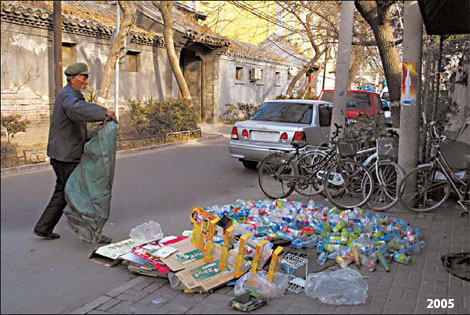 Six hundred years ago Beijing was consisted of narrow streets called hutong. Those that exist today are under government protection in the inner city and must be at least more than 200 years old. Except for a few hutong under the government's special renovation program to attract tourists and shoppers, many of the old narrow streets have remained, the scenes of their daily lives evidence of the changes that the country has gone through. Buying groceries from mobile vendors who carried and hawked their goods on oversized tricycles cruising from one hutong to another used to be the morning activity of the hutong residents. Towards evening there would be another shopping session, with every vendor claiming his or her goods - from tender green onions to fruits - to be fresh from the suburban farms. In the early days of economic reform when the very phrase "market economy" was still a taboo, roadside markets were spontaneously formed by small and privately funded grocery vendors as you can see from our old photo this week. They were referred to awkwardly as a "commodity economy". What looked like a timid step, or half-step, in theory was a great leap forward in practice. As it turned out, the "commodity economy" in the 1980s was indeed China's starting point for the market economy. Nowadays, hutong has returned to their quiet pre-market normal life. Gone are the morning and evening markets and noise of vendors' hawking and boisterous bargaining between buyers and sellers. One can easily appreciate it by taking a stroll through a hutong in a weekday afternoon. Most people now get their groceries from the supermarkets and convenience stores where, of course, few items are truly fresh. Even the passing noise made by children going to and coming back from schools can in no way compare to the past, when people having fewer children and the urban population - not including the migrant workers - are aging. However, change continues. New ideas and new practices have come to stay and are reflected in the details of people's daily lives. The hutong neighborhoods are not only responsible for tidying and cleaning themselves, but are also engaged in many civil campaigns such as protecting the ancient architecture and trees. One of the changes, seemingly small but significant, has been recycling - the theme of our color photo this week. Organized collecting and recycling of household waste such as used paper, plastics and metals has been going on in hutongs, thanks in part to the close-knit neighborly relations. Some old hutongs are more advanced in the environmental movement than their suburban, middle class counterparts and perhaps also more careful than many industries.
 (China Daily 11/03/2008 page1) (For more biz stories, please visit Industries)
|
主站蜘蛛池模板: 富源县| 黑水县| 巩留县| 宜川县| 北宁市| 饶河县| 乌鲁木齐市| 长葛市| 沙河市| 阳朔县| 巩留县| 玉龙| 偏关县| 汤原县| 栖霞市| 滨州市| 惠东县| 宝清县| 托里县| 信宜市| 永兴县| 洪洞县| 江都市| 什邡市| 牙克石市| 贵阳市| 如皋市| 都昌县| 澄江县| 金门县| 莆田市| 宿州市| 红桥区| 扎囊县| 临安市| 霸州市| 思南县| 定远县| 加查县| 永和县| 南靖县| 犍为县| 曲沃县| 沁水县| 江源县| 丽水市| 吉安市| 洮南市| 托克逊县| 宕昌县| 汉源县| 石楼县| 尖扎县| 邢台市| 望谟县| 额济纳旗| 筠连县| 河间市| 柳河县| 拉萨市| 大安市| 肥西县| 沭阳县| 郴州市| 定结县| 自贡市| 平塘县| 兰西县| 米林县| 河池市| 大厂| 平远县| 中卫市| 北碚区| 大厂| 无棣县| 佛教| 平阳县| 新宁县| 永春县| 沧源| 黄龙县|
