BIZCHINA> Review & Analysis

|
BIZCHINA> Review & Analysis
|
|
Foreign exchange assets require restructuring
By Wang Daxian (China Daily)
Updated: 2009-03-23 07:43
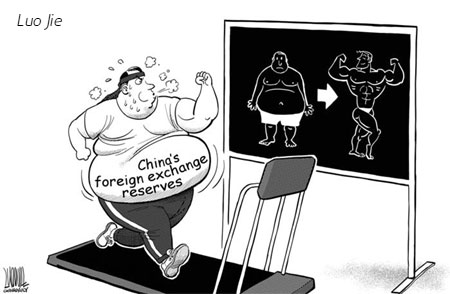 Against the backdrop of a financial crisis that threatens to get even worse, the government has two means to manage China's foreign exchange reserves: One is to take proactive measures to prevent foreign exchange reserves from increasing too rapidly; the other is to improve the foreign exchange reserve structure as well as the structure of financial assets and commodities in the country's international reserves.
China should gradually adjust the structure of its reserve currencies but avoid taking any drastic steps. Roughly speaking, US dollar assets account for 70 percent of China's foreign exchange reserves, euro assets for 20 percent and Japanese yen assets for 10 percent. China should make plans for gradually reducing its dollar assets while increasing its euro assets over a period of time and for China's own benefit, long enough to ensure that the US currency maintain a relatively stable value. China should also make efforts to increase its commodity assets and reduce its foreign exchange reserve assets in its international reserves. The international crude oil price has plummeted from nearly $150 a barrel at the highest to around $40 now. Gold, which once topped $1,000 an ounce, has come down to about $900 per ounce. Under such circumstances, China should buy crude and gold assets. Because of the negative correlation between the prices of gold and the US dollar, many countries, in the developed world in particular, have already moved to increase their gold reserves. By contrast, China's gold reserve, which stands at 600 tons, only occupies 1.1 percent of its international reserves, far lower than the world average of 10.2 percent. As the yuan is not fully convertible, nor is it an international settlement currency, China may consider the following two means to help resolve the huge pressure to appreciate the yuan caused by the country's huge foreign exchange reserves.
First, China should continue to encourage foreign financial institutions to issue yuan bonds. They can use the funds raised on the bond market to buy US dollars from the Chinese central bank. Apart from the benefit of lending US dollars to foreign investors, such an arrangement can also lower investment risks, especially the exchange rate risk, compared with buying US Treasury bonds. Second, Chinese commercial banks should be allowed to extend yuan loans to foreign banks, which in turn can use the borrowed money to buy US dollars from China's central bank and pay back the principal and interest later on an annual basis. Both arrangements will be conducive to the process of turning the yuan into an international currency that is fully convertible. Moreover, the Chinese government can spend the foreign exchange reserves on advanced equipment from abroad to help foster China's innovation. The government can also use the foreign exchange reserves to procure equipment overseas to improve the country's educational and medical facilities, for construction of rural infrastructure, for energy conservation, and for work safety and environmental protection. These State-owned assets can also be sold to domestic institutions and enterprises at preferable prices. By this means, the private sector, traditionally at a disadvantage in competing with State sectors, will get a shot in the arm for development. The root cause for the continuous increase in China's foreign exchange reserves points to the imbalanced structure of its economy. Therefore, China needs a fundamental change in its mode of economic growth. China should make its monetary policy more independent and further reform its exchange rate forming mechanism, making it more flexible. In addition, the two-way floating of the yuan's exchange rate will ease market expectations of yuan appreciating and discourage advance collection of foreign exchange payments by exporters, or delayed payments in foreign exchange by importers. The author is a special researcher with the Shanxi Academy of Social Sciences. The article was reprinted from Shanghai Securities News
(For more biz stories, please visit Industries)
|
|||||
主站蜘蛛池模板: 千阳县| 兴业县| 玉环县| 定远县| 宁安市| 钦州市| 青神县| 台南市| 巨野县| 德江县| 葵青区| 绥棱县| 岳普湖县| 上杭县| 石柱| 金山区| 涞源县| 合江县| 西安市| 哈巴河县| 全南县| 阳江市| 商南县| 手游| 广元市| 鄄城县| 丰台区| 大姚县| 砀山县| 博客| 安吉县| 土默特右旗| 花莲市| 通州市| 盐城市| 建宁县| 道孚县| 图木舒克市| 泰顺县| 平乡县| 门头沟区| 贵阳市| 西华县| 行唐县| 罗平县| 盘锦市| 庆阳市| 肇州县| 三门峡市| 井陉县| 太仆寺旗| 胶南市| 吴忠市| 中西区| 尚义县| 永年县| 册亨县| 贵港市| 清流县| 南通市| 吴忠市| 绥棱县| 宜兰市| 忻州市| 加查县| 莒南县| 广河县| 水城县| 兴义市| 枣阳市| 江孜县| 芦山县| 蓬溪县| 金华市| 牡丹江市| 新建县| 平凉市| 周口市| 班戈县| 东丰县| 淮阳县| 安仁县|



