BIZCHINA> BizViews

|
BIZCHINA> BizViews
|
|
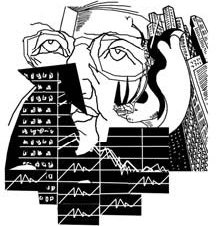
Behind those expert talks on stocks
By Hong Liang (China Daily)
Updated: 2009-06-02 15:02 The domestic business press is obsessed with "zhuanjia," or experts of all hues and diverse backgrounds.
Most of them are analysts working at stockbrokerages, banks and various think tanks whose affiliations are seldom specified. There is also an assortment of publicity-hungry college professors and self-styled investment gurus, who are only too eager to dispense free advice to anyone who cares to ask.
As a business reporter, I learnt a long time ago that readers tend to have short memories. The memory of readers on the mainland seems to be even shorter. Few people seem to remember that little more than a year ago when the domestic market was on the boil, many analysts and commentators were dancing to the tune of the bull. I was in Shanghai at that time and had talked to quite a few market "experts." They all sounded the same - upbeat. The market rally, as they all said, was based on rapid economic growth. I thought even the most junior reporter in our Shanghai bureau knew that. What most "experts" are best at is generalization. An expert may tell you this or that company is a good buy. But when you try to press for more details, he would invariably retreat to the safe haven of generalization, citing known macro-economic factors that can apply just as well to thousands of other companies in many different industries. When the stock market index was scaling record heights, a few experts did warn about overheating. But their voice was drowned in a sea of euphoria generated by the vast majority of "experts" who professed that the sun of the Chinese capital market would never set.
Surprisingly, the stock market crash in 2008 didn't seem to have in any way undermined the credibility of these undying "optimists." They continued to enjoy the media spotlight while the index was diving to newer depths. During that time, it was normal to claim that the domestic capital market was moving in line with overseas markets. To be sure, the financial crisis that is dragging the global economy into a recession is having an indirect impact on the domestic capital markets. What has remained largely unexplained is how the massive sell-outs that sent overseas markets into an occasional tailspin could have an immediate effect on the domestic bourses, which have remained mostly closed to direct foreign investment. An analyst friend in Shanghai confided to me once that his job was subject to many constraints. Other than meeting the minimum disclosure requirements, the top managements of many mainland corporations seldom feel obliged to discuss with analysts the murky aspects of their transactions, especially those involving inter-group interests. For that reason, it is difficult for stock analysts to confidently assess the real benefits that a merger or an acquisition can bring to the companies involved. Some stock analysts simply make it a point of never talking to the press. This should not be the case. Stock analysts can do the investment public a service by drawing attention, through the media, to the many unanswered questions about corporate transactions, and holding corporate executives more accountable for their actions. E-mail: jamesleung@chinadaily.com.cn (For more biz stories, please visit Industries)
|
|||||
主站蜘蛛池模板: 新宁县| 黄浦区| 桂林市| 通辽市| 沂水县| 余干县| 定西市| 宣恩县| 同心县| 建阳市| 安吉县| 邵阳县| 静乐县| 安西县| 赫章县| 陕西省| 西安市| 将乐县| 南木林县| 钟祥市| 葫芦岛市| 兴安县| 宣化县| 蒲江县| 陆丰市| 清徐县| 衡阳市| 壤塘县| 昔阳县| 专栏| 罗江县| 盐边县| 屏东市| 洪江市| 观塘区| 隆安县| 甘谷县| 东海县| 西宁市| 淮安市| 普宁市| 纳雍县| 宜州市| 延吉市| 江山市| 霍州市| 榕江县| 广东省| 长顺县| 辽阳县| 遂宁市| 泰兴市| 屏山县| 东山县| 鄂州市| 古浪县| 常德市| 济阳县| 岚皋县| 南澳县| 治多县| 科技| 新泰市| 雅江县| 益阳市| 浑源县| 青阳县| 柘荣县| 福泉市| 吴江市| 皋兰县| 嘉义县| 江阴市| 舟山市| 崇仁县| 夏津县| 永泰县| 开化县| 米泉市| 枣阳市| 长兴县| 蓬安县|