BIZCHINA> Top Biz News

|
BIZCHINA> Top Biz News
|
|
Climate talks offer hope
(China Daily)
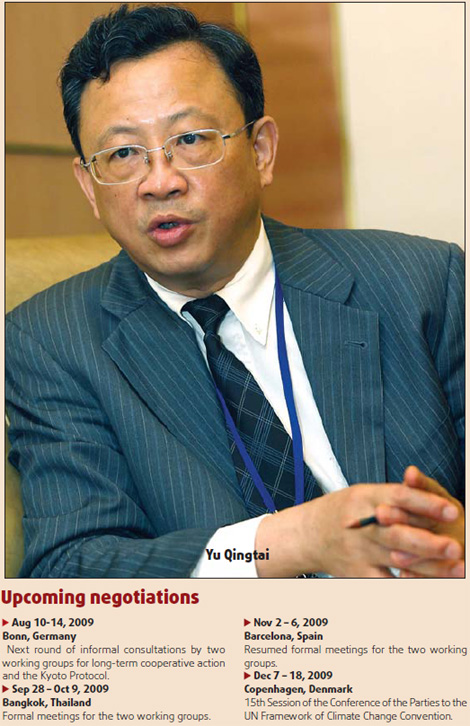
Updated: 2009-06-29 08:20 Editor's note: As a June round of climate talks ended in Bonn without major breakthroughs, and with the Copenhagen conference for a new UN treaty less than six months away, Ambassador Yu Qingtai, China's special representative for climate change negotiations, talked with China Business Weekly reporters Li Jing and Fu Jing about the latest progress and China's role. Q: Was any substantial progress made during the Bonn talks, especially on the most disputed topics such as carbon emission targets for developed countries? A: This round in Bonn is a crucial stop on the two-year course as recognized by the Bali Road Map agreed to in 2007 that charted the course for a successor to the Kyoto Protocol. In the previous climate talks, most countries expressed their own stances, and a lot of time was wasted on discussing procedures, without touching key issues such as developed countries' carbon emission targets for 2020 and how they should fulfill their commitments on financial support and technology transfer to developing countries. But this round in Bonn achieved some substantive progress. The negotiations were carried out by two working groups, one of which was for long-term cooperative action that focused on mitigation, adaptation, funding and technology to fight climate change. A comprehensive negotiating text was formulated after each country provided its own comments and suggestions. The document is crucial for future negotiations. The other work group was for the Kyoto Protocol, which discussed industrialized countries' commitments to cut greenhouse gas emissions between 2012 and 2020. The discussion involved the total amount and national targets, which was a good first step. Q: Are you satisfied with the progress made this time? A: The general progress of the negotiations was still quite slow, especially on the two key issues - developed countries' carbon emission targets and their responsibilities to provide financial and technological support. These two issues remain the major blocks to climate talks. Developed countries failed to show enough political will, even if they have the legal responsibility. Instead their attitudes were still quite rigid. Meanwhile, some developed countries are trying to introduce controversial concepts that go beyond the scope of negotiation, which also contributes to a stalemate. For instance, they are trying to put major developing economies such as China, India, Brazil, and South Africa under obligations to reduce carbon emissions that are only required for developed countries. Such claims are challenging the fundamentals of international cooperation on fighting climate change. The Kyoto Protocol already defined Annex I countries, or developed countries, as the troublemakers in global warming, while the non-annex countries, or developing nations, are the victims of the problem. These two types of countries are essentially different, so their responsibilities are also different. Questioning the basic principals of "common but differentiated responsibilities" could damage the general progress of negotiations.
A: Japan's target to cut emissions by 15 percent below the 2005 level by 2020 is only playing with numbers. The target equals only around an 8 percent reduction from the 1990 level, but as an industrialized country, Japan's obligation is a 6 percent reduction in carbon emissions by 2012, according to the Kyoto Protocol. This means Japan's target is only 2 percent between 2012 to 2020. Q: And what about the United States? What are your expectations for Sino-US cooperation to fight climate change? A: The United States has become more active since the Obama administration came to office. They have attached great importance to fighting global warming and have expressed their willingness to take more action. The US is also seeking cooperation with different parties wishing to push forward negotiations. Of course such attitudes have won approval from the international community. Although the US did not ratify the Kyoto Protocol, it still accepted the principles of Bali Road Map as a contracting party to the UN convention. So China, as well as many other countries, welcomes the actions from the US side and hopes it can contribute more in future talks. China is also looking forward to maintaining the dialogue with US on climate change cooperation. Even though some discrepancies still exist between China and the US - as one is a developing country and the other is a developed country - both nations are willing to cooperate with each other to facilitate international negotiations, as well as pushing forward on bilateral collaboration. China and the US share a dependence on coal as a primary energy source. And the two countries are trying to use green development as a stimulus amid the financial crisis, so the opportunities are wide open between the two countries. Officials, academic researchers and some non-government organizations from both sides already have had extensive communications, and they are trying to list some priority fields for cooperation.
 (For more biz stories, please visit Industries)
|
主站蜘蛛池模板: 郓城县| 买车| 永胜县| 常德市| 扎鲁特旗| 盈江县| 武川县| 青浦区| 大同市| 巫溪县| 靖安县| 荣成市| 镇赉县| 岐山县| 永康市| 资中县| 霍城县| 饶河县| 新和县| 象山县| 双牌县| 临夏县| 巴青县| 威海市| 博客| 皋兰县| 山阳县| 驻马店市| 汉源县| 五大连池市| 海原县| 夏邑县| 洛隆县| 普兰县| 仁布县| 贵港市| 梅州市| 金阳县| 龙里县| 年辖:市辖区| 陇川县| 田阳县| 嘉定区| 梨树县| 绥江县| 肇源县| 岳池县| 望谟县| 娱乐| 隆尧县| 乌海市| 敦化市| 宜兰市| 佛学| 瑞安市| 布尔津县| 清新县| 玛纳斯县| 塔城市| 来凤县| 桐柏县| 西宁市| 靖远县| 台南市| 新平| 常山县| 房产| 甘泉县| 峨眉山市| 汽车| 巴中市| 遵化市| 南澳县| 宁强县| 新晃| 辽中县| 内黄县| 南江县| 溆浦县| 蛟河市| 固安县| 临邑县|



