BIZCHINA> Editor Choice

|
BIZCHINA> Editor Choice
|
|
A new code of conduct
By Lu Haoting (China Daily)
Updated: 2009-09-07 08:05
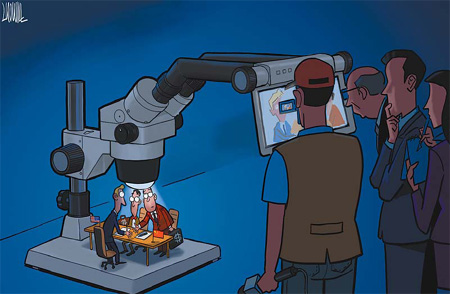 The Chinese government's probe into the Rio Tinto commercial spying case may not have a major impact on foreign companies' business investment decisions about China. But it renews questions about the boundary of multinational companies' acceptable commercial behavior in China, and the cost of crossing that line. Multinational companies that arrived in China in the early stages of its reform and opening are facing a different China now. These companies face a stricter regulatory environment, the phasing out of preferential policies toward foreign investors, a rising number of local consumers who fill online chat rooms with comments, and local media that are quick to pick up on foreign firms' blunders. "Multinationals have to deal with a different sophistication, not only with the government but also the media, customers, suppliers and the Internet," said Jorg Wuttke, president of the European Union Chamber of Commerce in China. The chamber has more than 300 members in the country. "Stakeholders are getting more informed, more sophisticated and sometimes more aggressive," Wuttke said. "Multinationals have to change their tune." Uncertainties
Four Shanghai-based employees of Rio Tinto were arrested in early August for allegedly bribing their way into obtaining information about Sino-Australian iron ore price talks. China is the world's largest iron ore importer. The four employees were detained in early July and were formally accused of the more serious crime of stealing State secrets. "Some foreign companies are a little worried about the wording on espionage and data information gathering," Wuttke said. "Many of us in business need a large amount of information that normally comes from publicly available sources to draw rather detailed conclusions after analysis. Some are now worried that if they find such information, will the authorities draw the conclusion they stole or purchased it somewhere," Wuttke said. Some foreign media reported that the Rio Tinto case elevated the uncertainty factor for foreign investors to do business in China. But Wuttke said the Rio Tinto case is "a selected singular case" that has no major impact on business investment decisions on China. "Multinationals certainly do not think about reconsidering China as an investment destination. I have not heard this once. The driver for foreign investment is market size and market access," Wuttke said. In the early 1980s, China was considered a cheap manufacturing center for foreign companies, and most products were exported to other countries. But with a double-digit annual economic growth rate and deeper consumer pockets in China, the country has emerged as a strategic market for multinational companies. While the credit crisis has dragged the global economy into the most severe economic maelstrom of the post-war era, the Chinese economy can still meet its GDP growth target of 8 percent this year and is expected to keep up the momentum next year, Fan Gang, director of the China National Economic Research Institute, recently told the media.
Fan attributed the strong economic growth to the government's 4 trillion yuan stimulus package, domestic consumption, and rising investments in the property and industrial sectors. The strong growth momentum in China is particularly important to multinational companies battling falling demand in other markets. The latest European Chamber Business Confidence Survey issued in July showed that 71 percent of chamber members believe China's economy is more resilient than Europe or other traditionally strong markets. Compared with three decades ago when the country was in desperate need of foreign capital and technology, the Chinese government is now "more sophisticated" in attracting overseas investment, said Victor Ho, partner for mainland and Hong Kong operations at the international law firm Allen & Overy. "It wants to direct foreign investment into certain areas while creating a more level playing field for Chinese and foreign companies," Ho said. (For more biz stories, please visit Industries)
|
主站蜘蛛池模板: 宽甸| 图木舒克市| 濉溪县| 玉山县| 临江市| 平阳县| 满洲里市| 灵寿县| 富源县| 赤峰市| 天门市| 高平市| 陆川县| 玛多县| 永清县| 金湖县| 南澳县| 泉州市| 汶上县| 霍州市| 且末县| 平乡县| 琼中| 叙永县| 巢湖市| 科技| 彭泽县| 武定县| 友谊县| 延津县| 南部县| 内江市| 柯坪县| 油尖旺区| 邯郸市| 尼玛县| 兴宁市| 广昌县| 吉安县| 富蕴县| 聊城市| 新疆| 大渡口区| 神农架林区| 石台县| 尼木县| 沛县| 平武县| 大宁县| 赤城县| 靖安县| 平邑县| 安溪县| 星子县| 张家口市| 乐山市| 新邵县| 桃江县| 湖州市| 乌兰县| 凤凰县| 本溪市| 安义县| 永善县| 石城县| 齐河县| 台东县| 大安市| 建瓯市| 寿光市| 菏泽市| 潢川县| 横峰县| 海伦市| 刚察县| 永兴县| 克山县| 丰顺县| 麻栗坡县| 广州市| 理塘县| 乐亭县|



