Studios focus on fund raising
Updated: 2012-01-04 07:50
By Huang Ying (China Daily)
|
|||||||||


|
Moviegoers walk past a film poster after leaving a cinema in Nantong, Jiangsu province. Domestic box office revenues surged 64 percent to a record 10.17 billion yuan ($1.62 billion) in 2010, and the figure is estimated to have risen 30 percent to 13 billion yuan last year, according to the State Administration of Radio, Film and Television. [Photo / China Daily] |

BEIJING - Jiang Defu, spokesman for China Film Co Ltd, the largest State-owned film producer and distributor, said that the company is restructuring in preparation for a listing on the Chinese mainland.
"Everything is going well and we hope that the debut day will come as soon as possible," Jiang said, though he declined to give a specific date.
Although China Film Co Ltd will not be the first film company to list in China, it is still drawing attention from the entertainment and financial industries because of its dominant market position.
The IPO rush among entertainment companies began in 2009 when Huayi Brothers Media Group was listed on the Growth Enterprises Market of the Shenzhen Stock Exchange, the first domestic entertainment company to list on the Chinese mainland.
The private film producer now has a market value of nearly 10 billion yuan ($1.5 billion).
Since then, other entertainment companies have gone public in China or abroad, including Zhejiang Huace Film & TV Co Ltd, Bona Film Group and Beijing Enlight Media Co Ltd.
The combination of the entertainment industry and the financial world can be seen as a sign of the rise of cultural industry, analysts said.
Chen Shaofeng, vice-dean of the Institute for Cultural Industries at Peking University, forecast that 120 to 150 companies in the entertainment and media sectors might seek IPOs by 2015, propelled by the development of the cultural industry.
In 2001, when China joined the World Trade Organization (WTO), only 88 films were made on the Chinese mainland. But the number surged to 526 in 2010, according to the State Administration of Radio, Film and Television (SARFT).
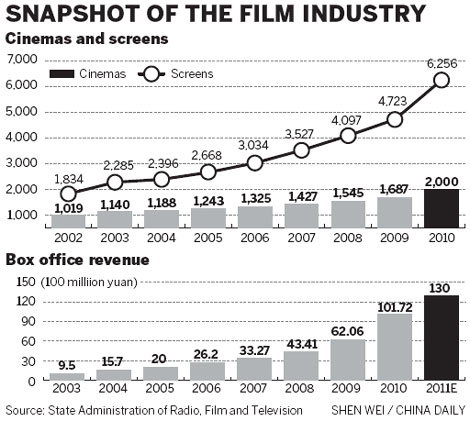
In 2010, domestic box office revenues rose 64 percent to a record 10.17 billion yuan, and they are estimated to have risen 30 percent to 13 billion yuan in 2011, according to SARFT.
Box office revenue growth has been closely linked with the expansion of cinemas. From 2002 to 2010, the number of cinemas rose from 1,019 to 2,000, while the number of screens skyrocketed from 1,834 to 6,256, data from SARFT show.
"I estimate that China's film industry will generate 30 billion yuan in box office revenues within five years, with the number of screens reaching 30,000," China Film Co Chairman Han Sanping said at a forum in Beijing recently.
"This will lay a solid foundation for overseas film producers and global film studios, especially those from Hollywood, to seek cooperation in China," he added.
"China has a recorded history of more than 5,000 years, and its splendid civilization and culture can be the source for our movies", Jiang said.
The boom in China's cultural industry is also providing many opportunities for foreign companies.
Under agreements signed when China joined the WTO, 20 foreign films may be imported every year and foreign cultural enterprises can enter the Chinese market by establishing joint ventures, with a shareholding of up to 49 percent, with domestic companies.
The Canadian giant movie screen maker IMAX Corp, which will have 85 screens on the Chinese mainland by the end of last year, expects the number of IMAX screens in the nation to rise to 200 in two to three years, Chief Executive Officer Richard Gelfond said in October last year.
More overseas film producers and studios are coming to China in hopes of co-producing films with their Chinese counterparts, to avoid the annual quota of 20 foreign movies.
"About five projects in partnership with Hollywood studios have been decided, including the one with famous US producer Mike Medavoy, who was behind the Oscar-nominated film Black Swan, and other projects are under negotiation," said Zhong Lifang, vice-chairman of Beijing Galloping Horse Media Co Ltd.
Galloping Horse is a rapidly emerging film company whose movie, Eternal Moment, took in more than 200 million yuan at the box office in the first half of 2011.
Chinese film producers are also looking to expand overseas.
Huayi Brothers and Bona Film both acquired stakes in Chicago-based China Lion Film Distribution company in October, a move aimed at promoting the simultaneous release of Chinese movies around the world.
Renowned Chinese director Feng Xiaogang's Aftershock was the first mainland movie distributed by the US film distributor in North America.
"As the first Chinese film company to go public on the Nasdaq, we are not only committed to producing high-quality Chinese films, but also devoted to distributing them well," said Yu Dong, founder and chief executive officer of Bona Film.
Chen said Chinese film companies tend to play the dominant role generally, while their foreign counterparts bring advantages in technology or talent to the co-productions.
The different roles in the partnerships show that "what Chinese film producers and distributors could learn from their overseas partners is rather limited", Chen said.
Against the backdrop of the prosperous film market, the challenges Chinese companies face are tough.
Imported films accounted for 43.6 percent of box office revenue in 2010, with Hollywood blockbuster Avatar grabbing 1.35 billion yuan alone, according to SARFT.
"Hollywood studios have a very developed process for making films, in addition to the advanced technologies used in film production," Zhong said.
"What's more important is that they're quite creative in terms of screenplays, which is a bottleneck among many Chinese movie companies right now," she added.
She said that it was also important to consider China's industry policies in choosing scripts.
"Content remains the core business of cultural enterprises," said Liu Yuzhu, director-general of the department of cultural industries under the Ministry of Culture.
He said that the biggest gaps between Chinese cultural enterprises and their overseas counterparts lie in four aspects: experience, capital, technology and operational management.
"In terms of competition from overseas rivals, I think we should put our domestic market first and try to learn from them in cooperation projects," Jiang said.
He said that China's film industry is experiencing a severe talent shortage, including post-production technicians and theater managers.
Related Stories
Films help to promote Wudang reputation 2011-10-25 15:18
China gaining clout in film industry 2011-10-28 11:00
Documenting the changes on film 2011-12-11 08:13
Zhejiang vows to leap in film & TV industry 2011-11-09 15:13
One more Chinese film competes for Golden Lion 2011-09-05 15:16
Mainland seeks more cross-Straits film and TV exchanges 2011-12-01 07:31
- Yuan hits new high on 2012 first trading day
- New measures to boost consumption
- Financial meeting focuses on risk
- Company defies 'fake foreign brand' label
- Diesel shortage fuels discontent
- Premier calls for confidence in growth
- Officials call for support of the cultural industry
- China's textile output growth slows in Jan-Nov