|
|
A worker from a Japanese company shows visitors a therapeutic "robot" seal named Paro, which is used to provide a companion to the elderly. The 2012 China Forum on the Development of the Senior Service Industry opened in Shanghai on Thursday. Zhou Wei / for China Daily |
Extra funds needed to accomodate aging population in countryside
The government plans to invest more to improve senior citizen services in rural areas because more elderly people live there than in cities, a social trend expected to continue until the middle of the century, a senior Ministry of Civil Affairs official said on Thursday.
Dou Yupei, vice-minister of civil affairs, said the rural elderly population is 1.24 percent larger than its urban counterpart.
By 2028, he said, the discrepancy is projected to increase to 11 percent.
By the middle of the century, the number of rural elderly will be 20 percent higher than urban elderly in 28 provincial-level regions, Dou said at the 2012 China Forum on the Development of Senior Service Industry in Shanghai on Thursday.
|
 |
"The proportion of elderly people in rural areas is far higher than in urban areas. The massive migration of young adults to urban areas is the driving force behind this phenomenon," said Wang Dewen, a World Bank economist specialized in social security system.
This trend will continue and families will come under more strain to support future generations of the rural elderly, Wang warned.
"We will increase our efforts to improve social support services for the aged in rural areas, especially for those left-behind seniors (whose adult children migrate to cities)," Dou told China Daily in an interview on the sidelines of the forum.
He said that during the 12th Five-Year Plan (2011-15), the government will allocate more funds and resources to provide better care services for rural elderly. He added that the government aims to have 50 percent of rural communities equipped with basic elderly-friendly facilities and provide senior services by the end of 2015.
But the gap between urban and rural elderly support services will remain because all urban seniors will have access to community-based care by then, under the central government's plan.
Wang urged the government to increase medical reimbursements for rural Chinese who have joined the New Rural Cooperative Medical Care System, calling it an effective way to reduce the financial burden of healthcare for the rural elderly.
In addition, he said it is urgent for China to perfect the New Rural Pension Scheme to ensure income support for the rural elderly.
Maggie Siu, vice-chairwoman of Hong Kong Age-Friendly City, which is affiliated with the Hong Kong Council of Social Service, said mutual aid services for the aged is a more economic way to meet the needs of the elderly in rural and remote areas based on the experience of Hong Kong. She said some senior citizens can be trained as peer councilors to help others.
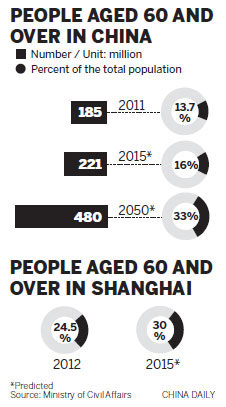
According to the Ministry of Civil Affairs, there were 185 million people in China aged 60 or older by the end of 2011. The country has the world's largest elderly population.
Under China's strategy for its ageing society, the government will enable 90 percent of elderly to spend their golden years at home enjoying in-home services and guarantee that 7 percent of the elderly can afford to live in senior citizens communities. The remaining 3 percent would be institutionalized.
Jane Barratt, secretary-general of the International Federation on Ageing, an organization for improving quality of life for elderly people worldwide, said the Chinese government is responding to an international trend.
She said growing older at home is becoming an increasingly popular choice for people in developed countries, and that some countries, such as Denmark, stopped building nursing homes in the 1960s.
"Older people who are disconnected from families and who are institutionalized can actually die earlier," Barratt said.
You can contact the writer at hedan@chinadaily.com.cn


Copyright 1995 - . All rights reserved. The content (including but not limited to text, photo, multimedia information, etc) published in this site belongs to China Daily Information Co (CDIC). Without written authorization from CDIC, such content shall not be republished or used in any form. Note: Browsers with 1024*768 or higher resolution are suggested for this site.
License for publishing multimedia online 0108263 Registration Number: 130349