Residents of the Tibet autonomous region are benefiting from high-quality medical services and are enjoying longer lives.
Tibet's population of 3 million has an average life expectancy of 67 years and the region has more than 110 people over 100 years old.
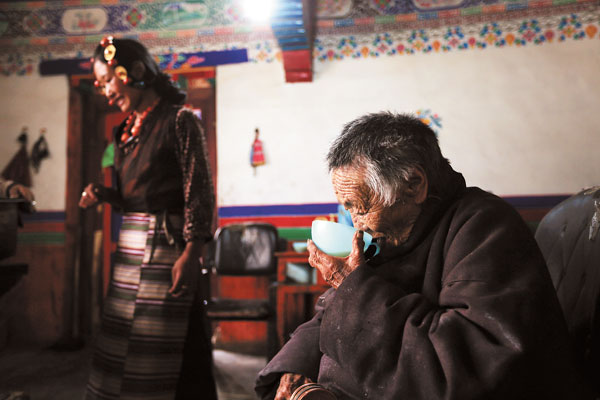
Begar, 106, lives with 36 extended family members, including seven great-grandchildren, the youngest aged 20 months, in No 13 village, Lashi township, Nagqu prefecture.
 |
|
Begar, 106, drinks tea at her home in No 13 village, Lashi township, Nagqu prefecture, the Tibet autonomous region on Sept 15. Residents of Tibet have benefited from improved medical services as the region adopts a universal healthcare system based on free services. Cui Meng / China Daily |
She receives a government allowance for elderly residents of 600 yuan ($96) a year and 80 percent of all her medical expenses are covered by insurance.
Tibet has a universal healthcare system based on free medical care that cost 2.08 billion yuan over the past 10 years.
Heavy injections of funds from central and regional governments have brought advanced medical equipment, more beds and an improved medical workforce to Tibet. Supporting facilities, such as electricity supplies for medical use, are also rapidly improving.
Farmers and herders pay 20 yuan a year, which entitles them to reimbursement for medical expenses of up to 60,000 yuan, an increase from 50,000 yuan in 2011. Expenses to treat serious diseases are covered up to 70,000 yuan a year per person. Women giving birth and neonatal emergency care are fully reimbursed.
From 2006 to 2011, 688 million yuan was reimbursed for 22.5 million outpatient hospital visits. About 706,000 inpatient visits received reimbursements of 988 million yuan, 75 percent of total hospitalization expenses, according to the health department in the region.
Successful surgeries have been performed for free on 3,000 children who had congenital heart disease in the region. In two years, all children with this condition in Tibet will receive free surgery, the regional government announced in February.
In the region, congenital heart disease occurs at a rate of 11.1 percent among people under 18 years old. Children in Nagqu and Ngari prefectures have alarming rates of the condition because of the high altitude and harsh climate of where they live.
This year, 1,540 of 612,704 children who were examined were found to have congenital heart disease, and 588 were sent to inland cities for surgery.
All residents of Tibet will receive a free check-up before the end of the year. As of Sept 14, 2.24 million people had received the checkup, including most monks and nuns.
Drimed, 58, from Kelag township in Xigaze prefecture, had his first ever health checkup on Saturday. The results revealed that he has high blood pressure. His village in Drongpa county lies in the far west of Xigaze and borders Nepal. With an average elevation of 5,000 meters, 95 percent of the residents are nomads with limited access to basic healthcare.
The medical team of 10 doctors has toured the prefecture and offered services to hundreds of farmers and herders to ensure early disease detection and timely treatment.
The doctors had to take their own medical equipment and a generator for power. The checkups included an electrocardiogram, checks of liver and kidney function and blood and urine tests.
On Sept 25, an emergency mobile "hospital" made up of eight ambulances began operation in Tibet. The ambulances will operate as a moving hospital and are expected to improve the region's ability to address natural disasters and public health hazards. The vehicles will allow doctors to perform surgeries, clinical tests, X-ray diagnosis and are equipped with water, oxygen and electricity supplies.
Li Chuan, an official from the health department in the region, is a Han Chinese but speaks the Tibetan language. He has extensive work experience at the center for disease control and prevention in Tibet.
"My first two working months were spent in a village in Qamdo prefecture. I had to learn the local dialect and got used to the food staples, or I would have perished," Li said.
His mission was to control the spread of plague carried by marmots. Li led a group of 50 villagers and eliminated the marmots by filling the holes where they live with poison and then sealing them. The plague can be deadly if people are infected with the virus and it reaches blood circulation, Li said.
Health workers responsible for the prevention plague follow the habits of marmots. When marmots hibernate from November to April, the workers return to their office. When the animals wake up and become active again, the workers are closely behind, Li said.
Seasonal monitoring and high levels of serum antibodies in blood tests from dogs, sheep and cattle indicate if the village faces the threat of the deadly plague, he said.
liyao@chinadaily.com.cn


Copyright 1995 - . All rights reserved. The content (including but not limited to text, photo, multimedia information, etc) published in this site belongs to China Daily Information Co (CDIC). Without written authorization from CDIC, such content shall not be republished or used in any form. Note: Browsers with 1024*768 or higher resolution are suggested for this site.
License for publishing multimedia online 0108263 Registration Number: 130349