

 Comments()
  Print
Print  Mail
Mail  Large Medium Small
Legal 'catch-up'
He also pointed out that the law is almost always in a position of playing "catch-up" and that usually means it is more in favor of those whose rights have been infringed. Yet the growth of complaints makes it almost inevitable that new laws and regulations will have to be enacted and the terms will have to be defined with greater accuracy. However, he believed that more emphasis should be placed on personal integrity and morality.
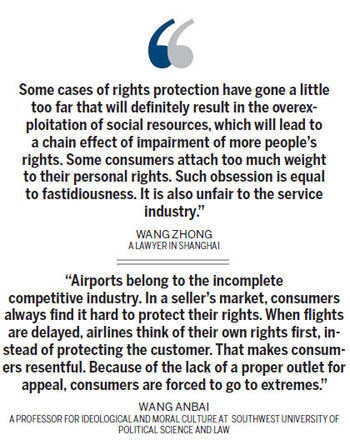
"Some cases of rights protection have gone a little too far. That will definitely result in the overexploitation of social resources, which will lead to a chain effect of impairment of more people's rights. Some consumers attach too much weight to their personal rights. Such obsession is equal to fastidiousness. It is also unfair to the service industry," said Wang Zhong.
As the service industry develops, it seems likely that cases of "overprotection" will occur more frequently.
Government data shows the tertiary industry accounted for about 43.1 percent of China's GDP in 2011, and employed approximately 270 million people. The sector contributed more than $400 billion to the nation's trade volume in 2011, becoming the world number four in terms of volume. In the same year, it also attracted some $55.2 billion in foreign investment, overtaking manufacturing for the first time to become the industry attracting the most foreign funding.
Mao Weihai, a sales manager at Shanghai Business Holiday Travel Service Co, has seen and dealt with the whole gamut of complaints during his 17 years in the tourism industry. From most widely voiced complaint - discontent about travel routes - to quite trivial matters, such as a lack input from guides during periods when tourists are officially unsupervised, Mao said that it is the travel agency's responsibility to offer a prompt apology, because that is part and parcel of life in the service industry.
"We send text messages to our customers every day with greetings or travel tips. When their trip is over, we always call customers to hear their feedback. Whenever there is a dispute, we will settle it right away. It is common for us to apologize first, provide customers with gifts as compensation or refund some of the costs to make amends. In the very few cases where the customer's request exceeds the company's bottom line, we will take it to a third-party institution, such as a tourism arbitration service. We always hope customers will come back to us anyway," he said.
While acknowledging that a large number of complaints will inevitably reflect badly on agencies, he also admitted that customers have been extremely tolerant of the incompetence or even illegality of some travel agencies. Most abide by the law, but few meet the service criteria required by the industry and several have been found culpable of deceiving consumers by directing them to designated shops where prices can be as much as 30 to 40 percent higher than in other outlets. Given the circumstances, it's hardly surprising that most of the laws relating to the travel industry are weighted in favor of the customer.
"If there is one thing that should be made clear, that is, what can be called a 'service'. Complying with everything written in a contract is not a service at all. Performing acts that are not written into the contract and are not expected by the customers, or something extra, can be called a service. In other words, travel agencies should be thoughtful, plan everything in advance and cater to the customers whole-heartedly. Only in this way can they improve their service and also make more money by being able to charge service fees," he added.
Lin Zi, a senior psychiatrist of 14 years standing and a founder of the company Linzi Counseling in Shanghai, said consumers' awareness of their rights and their social status are signs of positive social progress, but if customers believe they have more rights than they actually do, they can become overwrought when their complaints aren't acted upon.
Exaggerated self-worth
When consumers become too obsessed with their rights, Lin said, their perception of their own self-worth becomes exaggerated and they pay too much attention to their feelings. It's essential that mature adults are able to control their emotions.
"It is very dangerous when they go too far, because that's very likely to spoil interpersonal relations. They will not only be incapable of protecting their own rights, but may turn into 'monsters' and harm others," she said.
Tracing the source of such negative feelings, Lin said emotional insecurity derived from too many unhappy and inconvenient experiences is the culprit. The mental defenses have been overly built up. People like this will think it is better to cross the line to secure their rights.
Put into a larger social extent, the fact that the frequency of such cases is much higher nowadays may indicate that people are more anxious, according to Lin. The feelings of uncertainty and not being in control have made things even worse.
"Technically speaking, people living in a more mature society, where consumerism has a longer history, usually have a more realistic view of the services offered by the industry and know that things are often not as straightforward as they seem. However in China, where things develop so quickly and changes may occur almost overnight, people's expectations may be more naive," she said.
Hu Shoujun, a sociologist at Fudan University in Shanghai, echoed Lin's point, saying that it's necessary to establish laws and regulations to define the rights and responsibilities of both parties in such a fast-paced society, where frequent inconveniences can lead to unease and even irrational behavior when emotions rise to an extreme level.
"The high frequency of such cases largely results from a less-regulated service industry, unsafe products and a disorganized business environment. All these things have made customers more vulnerable psychologically, excessively protecting their rights and even using legal loopholes to extract compensation. What is more important is to establish an integrity system in which everyone is mutually reliant to a high degree," he said.
Contact the reporter at shijing@chinadaily.com.cn
Copyright 1995 - 2010 . All rights reserved. The content (including but not limited to text, photo, multimedia information, etc) published in this site belongs to China Daily Information Co (CDIC). Without written authorization from CDIC, such content shall not be republished or used in any form. Note: Browsers with 1024*768 or higher resolution are suggested for this site.
License for publishing multimedia online 0108263 Registration Number: 20100000002731