Experts predict robust outlook for Sino-Europe ties, as new leadership takes over in China
Though the global economic outlook remains uncertain, China looks poised to make impressive strides in the next decade under a new leadership on the back of policies that seek to enhance the quality of its products and its global image.
Experts, however, are keenly looking for cues on the future course that China intends to pursue in Europe, its largest trading partner. While some experts feel that the road ahead could be bumpy in light of the recent trade disputes, others see it as an ideal opportunity for Europe to mend fences, and cement diplomatic and trade ties.
The recently concluded Party congress was to many experts an indicator of the course that China intends to adopt over the next decade for its economy. Though there were no firm undercurrents, it was obvious that Europe does have a prominent role to play in China's long-term economic agenda.
|
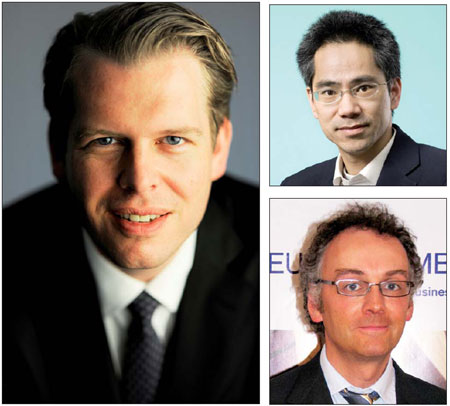
Clockwise from above left: Daniel Walther, vice-president of the SME Union; Peter Ho, professor of Chinese Economy and Development at Leiden University; Dirk Vantyghem, director of International Affairs at EUROCHAMBRES. [Photo/China Daily] |
The Communist Party of China has played a key role in China's economic ascendancy with several path-breaking reforms and policies. All the experts unanimously agree that this is something that the Party would continue to do to ensure steady, stable growth in the future.
Jim O'Neill, chairman of Goldman Sachs Asset Management, says he remains confident in China's economic prospects.
"I have no real reason to divert from what I have already been assuming since 2010 about this decade, that the real GDP growth (in China) will average around 7-8 percent," he says.
Though growth will be at a much slower pace in the next decade, it would still be the best among all BRIC nations, he says.
|
From top: Jim O'Neill, chairman of Goldman Sachs Asset Management in London; Pierre Picquart, China watcher and professor of geopolitics at the University of Paris; Stephen Phillips, CEO of the China-Britain Business Council; Francois Godement, China specialist and director of think tank Asia Center in Paris. [Photo/China Daily] |
O'Neill, who coined the term BRICs to describe the emerging nations of Brazil, Russia, India and China collectively, says: "China is in the early stages of going from a long period where it was all about the quantity of growth, into an era where the focus will be more on the quality of growth."
Andreas Boje Forsby, research fellow at the Danish Institute for International Studies in Copenhagen, Denmark, says that it is still too early decide on the actual course that the new leadership will take. He believes that the new leadership will look to leave their imprint in the overall development of China and follow the existing policies and guidelines as envisaged in the 12th Five-Year Plan (2011-15). The real challenge would be to ensure GDP growth rates of around 7-8 percent, he says.
Stephen Phillips, the chief executive of the China-Britain Business Council, an organization that helps British firms to invest in China and Chinese firms to establish business in Britain, says China has made significant progress in the last two decades.
The CPC has made it clear that it will uphold the policy of reform and opening-up and its plan to chalk out specific goals, missions and guidelines for overall development of China.
These reforms will include improving the economic system, market mechanisms, the basic distribution system, the socialist democratic system, cultural management and social management.
Giles Merritt, secretary-general of the Brussels-based think tank Friends of Europe, feels that European politicians should not link democracy issues and economic development of China.
Merritt says the European Union has often cited the lack of democracy in China as an impediment for granting market economy status. "It (the market economy status) is something that the West is using as a barrier for Chinese exports. I feel that there is a real misunderstanding in Europe on how the Chinese economy works," he says.
"The idea of persuading China to have the same mode of democracy as it exists in Europe or America is simply ridiculous."
China has its own ideas and centuries of culture to back its actions. With the wide coverage of the Internet, the higher level of education, and the rising demand for a sense of fairness, Merritt says there is now an increasing interest among the Chinese people on how their government is working and on the impact of the government policies.
Peter Ho, chair professor of Chinese Economy and Development and co-director of the Modern East Asia Research Centre in Leiden, the Netherlands, says: "History has proven that political changes in China have always been step-by-step."
The gradualism of political structural reform has been the key to successful economic and social transition and development in China, Ho says.


Copyright 1995 - . All rights reserved. The content (including but not limited to text, photo, multimedia information, etc) published in this site belongs to China Daily Information Co (CDIC). Without written authorization from CDIC, such content shall not be republished or used in any form. Note: Browsers with 1024*768 or higher resolution are suggested for this site.
License for publishing multimedia online 0108263 Registration Number: 130349