

 Comments
  Print
Print  Mail
Mail  Large Medium Small
The yuan will be fully convertible in the Shanghai Free Trade Zone, a development that puts it in a better position to become a global currency.
In a set of rules published on Friday that provide details on how the 29 square kilometer trial zone in northeastern Shanghai will operate, the central government said that it will allow "interest-rate liberalization and the currency's cross-border use on the condition that risks are well controlled".
That means institutions and individuals will be able to freely trade the yuan for any foreign currency — and vice versa — whether for trade or investment.
Before, government approval was required to convert the yuan for overseas investments.
Analysts said a free yuan in the zone will create onshore-offshore interest-rate and exchange-rate disparities, and force the onshore market to hasten deregulation and eventually make the currency fully convertible across the country.
This will boost the yuan's prospects as a global reserve currency, and challenge the US-dollar-dominated global monetary system that many believe is the root cause of many of the global economic problems today.
An average of $120 billion worth of yuan was traded per day in April, almost quadrupling the $34 billion three years ago, making the yuan the world's ninth most actively traded currency, according to Reuters, citing a survey by the Bank of International Settlements this month.
"The details on Friday are encouraging and in line with our expectations. The policies will lay the foundation for China's financial reforms in coming years," said Liu Ligang, chief China economist with Australia and New Zealand Banking Group Ltd.
Huang Zhiqiang, head of Bank of China's international finance research center, said the zone will become yet another offshore center for the yuan, after Hong Kong, Singapore and Taiwan.
It will give rise to corresponding monetary, bond, foreign exchange, commodities and equity markets in the zone and also have a positive effect on the onshore financial market.
Leading foreign banks, including HSBC and Standard Chartered, are reported to have already filed for a foothold in the zone.
"HSBC welcomes the policy blueprint ... which will open a new phase of China's financial reform process," said Peter Wong, chief executive of HSBC Asia-Pacific.
"We believe that further liberalization offers new opportunities for foreign banks in areas such as product innovation, fundraising and corporate investment."
China Construction Bank, one of the nation's "Big Four" banks, also filed for a branch and plans to expand its footprint in the zone over the next two years.
"We will conduct onshore and offshore financial services within the zone's regulatory framework and focus on innovation of financial products and services in key areas," the bank said on Friday.
The currency liberalization in the zone is part of a broader plan of China's new leadership to revamp the nation's financial industry to more effectively allocate financial resources and boost growth quality.
It comes as economic growth is forecast to be the slowest in more than two decades as the country shifts focus from quantity to quality.
Earlier this year, the People's Bank of China further liberalized the country's interest rate by scrapping the lower limit on the bank lending rates in June. But the upper limit, which is widely believed to be riskier and more conducive to competition, has yet to be loosened.
One of the key risks of full convertibility in the zone is arbitrage and speculation, taking advantage of cross-zone policy differentiation that can cause swings in the financial market and further inflate asset bubbles in the country.
"Arbitrage and speculation are inevitable, so there should be mechanisms in place to keep such activities in check," ANZ's Liu said.
Chris Leung, a senior economist with DBS Bank, said one of the mechanisms should be drawing a clear and effective financial border for the zone.
"There must be regulations to prevent access to tax concessions and yuan convertibility by nonzone companies," Leung said.
The zone's policy framework also promises to further open up the financial services industry to both private and foreign capital, and to encourage the establishment of foreign-owned banks and Chinese-foreign joint venture banks.
Trading platforms that are integrated with the global markets are allowed for the first time. Foreign companies will be approved to engage in commodity futures trading and encouraged to engage in financial innovation.
Moreover, barriers will be lowered for foreign investors to enter the service industry, including engineering, financial leasing, shipping and cultural services.
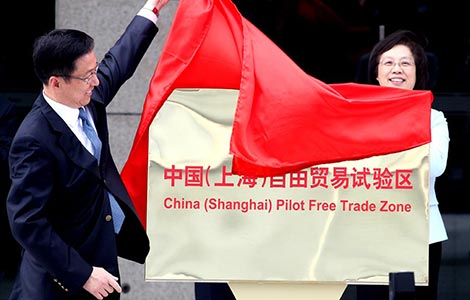 Shanghai inaugurates Free Trade Zone
 New BMW 5 Li hits Chinese market
 China to officially launch Shanghai FTZ on Sept 29
 Time to get smart
 Leaders' car picks around the world
 Shining models at 15th Aviation Expo China
 2013 Beijing Intl Jewelry Expo kicks off
 Microsoft revamps Surface to challenge Apple
Copyright 1995 - . All rights reserved. The content (including but not limited to text, photo, multimedia information, etc) published in this site belongs to China Daily Information Co (CDIC). Without written authorization from CDIC, such content shall not be republished or used in any form. Note: Browsers with 1024*768 or higher resolution are suggested for this site.
License for publishing multimedia online 0108263 Registration Number: 20100000002731