Comments
  Print
Print  Mail
Mail  Large Medium Small
Are executives of China's State-owned enterprises paid too much? It's a question that often sparks heated, even emotional discussions.
The private sector has been critical of SOEs, which dominate their fields yet pay their managers huge sums. Then again, many studies and media reports compare the absolute salaries at Chinese SOEs against their overseas counterparts, leading to the conclusion that Chinese SOE managers are underpaid.
A research team led by Gao Minghua, director of the research institute on corporate management at Beijing Normal University, declined to offer a simple "yes" or "no" to the question.
Instead, the team turned to an ocean of data, analyzing more than 2,300 A-share companies and their senior managers' salaries.
The conclusion is that the managers are paid both too much and too little.
Putting senior managers' packages into three categories - excessive, moderate and insufficient - the research team found that nearly 30 percent of the sampled companies pay their managers either excessively or insufficiently.
The basic idea behind the assessment is, you deserve what you've earned. If you generated much profit for the company, it is fair for you to get more.
In this light, even though executives at listed financial institutions in 2012 earned 3.85 times as much as those at non-financial listed companies, it wasn't unfair: The average profitability of public financial institutions was 9.04 times that of non-financial companies.
Another example is BP Plc and China Petroleum and Chemical Corp (Sinopec). Each generated about $380 billion in operating profit in 2012. But there was a large gap between their net profits, with $25.7 billion for BP, 2.72 times the $9.5 billion generated by Sinopec.
Moreover, BP is exposed to full competition without any government support. Sinopec, on the other hand, enjoys monopoly resources that private companies can't dream of.
"A simple approach of comparing the absolute level of their managers' compensation is meaningless," said Gao.
Surprisingly, among the top 100 companies the team studied that had "excessive" incentives, 86 turned out to be private companies.
Hidden compensation
"Some of the compensation for SOE leaders is hidden," explained Cai Jiming, professor of political economics at Tsinghua University. "Entertainment and transportation expenses aren't publicly disclosed," said Cai.
"The profits of SOEs are generated by four resources: policy privileges, natural resource monopolies, operationing income and risks," said Liu Yingqiu, a professor at the Chinese Academy of Social Sciences, a central government think tank.
"The compensation of their leaders should come solely from operating income and risks. Returns attributable to policy privileges and natural resource monopolies should be reported as fiscal income."
In another report measuring listed companies' financial governance, only 917, or 39.6 percent, had scores higher than 60 points.
 Chinese flock to Korean shopping malls
 Model with modified Audi A5
 Model with German luxury cars
 Getting in the mood
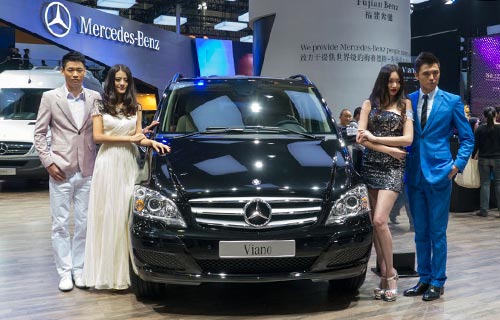 Models at Mercedes pavilion at 2013 Auto Guangzhou
 Buick Riviera concept car at 2013 Auto Guangzhou
 FAW-VW all-new Golf at Guangzhou auto show
 VW donates more than 5k child safety seats
Copyright 1995 - . All rights reserved. The content (including but not limited to text, photo, multimedia information, etc) published in this site belongs to China Daily Information Co (CDIC). Without written authorization from CDIC, such content shall not be republished or used in any form. Note: Browsers with 1024*768 or higher resolution are suggested for this site.
License for publishing multimedia online 0108263 Registration Number: 20100000002731