 |
|
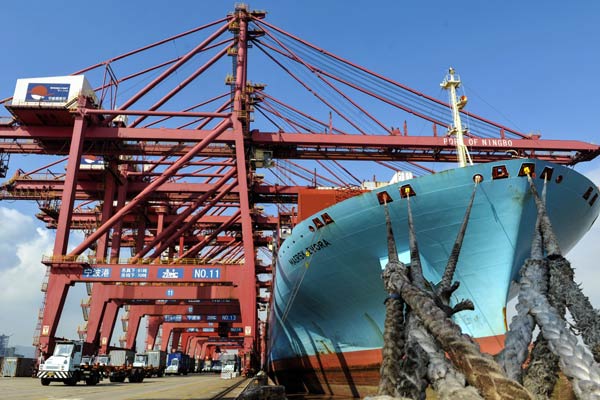
A cargo ship docks at a port terminal of Ningbo, Zhejiang province. The port traditionally serves the highly export-oriented Zhejiang, and other provinces along the Yangtze River. [Photo/Xinhua] |
Rail-maritime links on New Silk Road offer huge opportunities, say Zhejiang officials
Ningbo port is actively expanding its railway links with China's northwestern region, in an effort to better connect with Central Asia to implement the Silk Road Economic Belt strategy.
The port, to the south of Shanghai and the third largest port in China (the fourth largest in the world) in terms of cargo shipment, is seeking to expand its hinterland by encouraging more inland export shipment through Ningbo.
The port, lying within the Yangtze River Delta region, traditionally serves the highly export-oriented Zhejiang, and other provinces along the Yangtze River. Northwest China, and the farther Central Asia are an under-cultivated hinterland for the port.
Tong Mengda, chief economist at Ningbo Port Co Ltd, told China Daily that the company started a study of "cross-border railway transportation" in November, a month after President Xi Jinping made public the Silk Road Economic Belt and the 21st Century Maritime Silk Road initiatives in September and October.
The Silk Road Economic Belt initiative aims to boost transport and trade ties between China and Central Asia and Europe.
"We have a two-step strategy. The first is to better serve Xinjiang Uygur autonomous region by developing the railway-maritime link between the two localities. And the second step is to extend it to Central Asia," Tong said.
Developing cross-border railway transport is not only a challenge for the Ningbo port, but also for the entire Silk Road initiative.
Unlike maritime shipment, which directly connects two ports without much barriers, the cross-border land transport often involves various nations, policies, and technical standards. Coordination among different countries requires efforts that stretch far beyond the Ningbo port.
However, the port has decided to make a beginning in this regard by forging inbound transportation links with Xinjiang, a region that is a production hub for industrial goods such as aluminum ingots, purified terephthalic acid and caustic soda.
"Xinjiang has many natural resources. PTA alone has an annual transportation demand of over 10 million metric tons," Tong said.
To cut transportation costs, Ningbo Port is using the trains bound for Xinjiang to ship goods such as aluminum oxide (raw material for aluminum ingot) to avoid hauling empty rakes.
The railway-maritime link between the two regions could reach 10,000 twenty-foot equivalent units this year, Tong said.
While developing the inland regions, Ningbo port also has to contend with competition from Shanghai port, which is still the No 1 in terms of cargo and container throughput. But Tong feels that Ningbo port has some unique advantages like the railway-maritime direct link, which Shanghai does not have.
The second is its deep-water advantage. Vessels below 300,000 dead weight tons can navigate into and out of the harbor freely, and vessels above 400,000 DWT can come in and out with tide. Last year, the world's largest container vessel-Majestic Maersk, with a loading capacity of 18,000 TEUs, made its maiden voyage to Ningbo port, and next month it is expected to welcome a larger vessel of 191,000 TEUs.
From January to October this year, container throughput at the port grew by 11.9 percent over a year ago to 15.8 million TEUs, the fastest among all ports. But as the absolute size grew and China's economic growth slowed, top executives of the port know that the ultra-fast expansion rate of the past decade cannot be replicated.
"There is still enough room for growth, but it is limited. We think there is a limitation for large but no limitation for 'strong' growth. Our priority is to become stronger," Tong said.

Copyright 1995 - . All rights reserved. The content (including but not limited to text, photo, multimedia information, etc) published in this site belongs to China Daily Information Co (CDIC). Without written authorization from CDIC, such content shall not be republished or used in any form. Note: Browsers with 1024*768 or higher resolution are suggested for this site.
License for publishing multimedia online 0108263 Registration Number: 130349