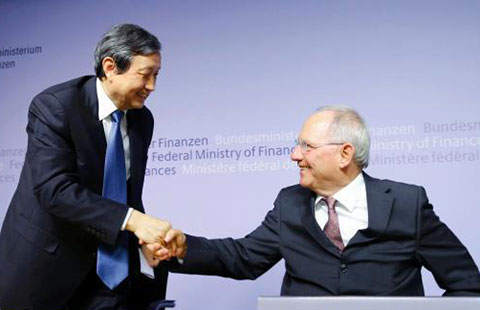
In China, the first half of every March is the time for the so-called two sessions - the annual meetings of the top legislature of the National People's Congress and the political advisers in the National Committee of the Chinese People's Political Consultative Conference.
The meetings have just begun, but the stock markets in Shanghai and Shenzhen have already showed their reactions: There won't be surprises.
The central government has set China's GDP growth target at 7 percent over last year, accompanied by mild inflation and a small increase in the overall money supply. Chinese leaders have no interest, judging from the information that has surfaced from the official press thus far, in competing with their neighbor India, which is aiming at 8 percent growth.
To be sure, China's cool-down will continue but what we're seeing is that the cool-down since last year is only the beginning - it will go down for more than just one year.
A real economy can never move nearly as fast as economists change their theoretical models. China won't complete its determined economic transition until it has shed much of its resource-dependent old industries and its cities have become more diverse in business and in lifestyle. Except for the tech-driven changes in some corners of the country, such as e-commerce and mobile applications, it is still way too early to predict how things will work out.
But managing China without surprises, in itself, is no less of a feat than managing the country's past nearly fervent growth, especially when its government debt level is vastly higher than just a few years ago, its small and not so small manufacturers are besieged by rising labor costs and declining export orders, and its bureaucrats are unwilling to do their everyday work when they are deterred by the anti-graft campaign to ask for bribes.
In many cities, including fairly large ones, mayors and their planning advisers seem to have lost their vision of the future when industry has met its limit, and even if they have a vision, it either sounds far-fetched or requires policies that are thus far nonexistent.
One example is the proposal for building an intercity rail system to connect Beijing, Tianjin and nearby cities in Hebei province. Having it won't cause any financial difficulty for a country that claims to be the world's second-largest economy and has abundant cash. But up to now, nothing has been done. All sorts of bureaucratic inconvenience continue to make cross-city business integration impossible. Interprovincial government cooperation seems harder to manage than foreign relations.
Other than its traditional strengths, the central government has yet to be equipped with the political weapons to tackle problems like this. No country's bureaucracy wants to take on new duties, even less a duty to solve a complex problem. It will be a long journey from China's present anti-graft campaign, however welcomed by citizens, to having a government capable of its own change and of accommodating society's innovations.
To make sure there won't be surprises, China must take the most important challenge to prevent government debt (mostly incurred by local governments in pursuit of unrealistic GDP growth plans) from running out of control.
As to how to dispose of their excessive assets and half-complete projects, local governments have little hope for a bailout from central authorities. Selling their assets and restructuring their debt seems to be a more feasible option.
The second challenge is to, while curbing local governments' old development ambitions, guarantee a minimum level of good growth to sustain urban jobs and consumer spending.
A series of investment development projects were launched by the central government last year, but they have only made limited progress, some of which have yet to break ground, due to local bureaucrats' lack of motivation.
So long as central government-led projects are going as planned and local governments are left to cope with their debt burdens, China won't see surprises. No surprises can allow the economy the time to generate its needed new blood and driving force for the future.
The author is editor-at-large of China Daily.

Copyright 1995 - . All rights reserved. The content (including but not limited to text, photo, multimedia information, etc) published in this site belongs to China Daily Information Co (CDIC). Without written authorization from CDIC, such content shall not be republished or used in any form. Note: Browsers with 1024*768 or higher resolution are suggested for this site.
License for publishing multimedia online 0108263 Registration Number: 130349