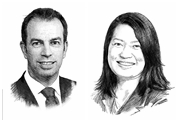
S&P economist warns that excessive concern over 'moral hazard' could trigger a financial crisis
Policymakers always face a dilemma between prioritizing growth or deleveraging, and central banks inspire skepticism when they pump money into the financial system to prop up growth.
But Paul Sheard, chief global economist of Standard & Poor's Ratings Services LLC, said that Japan's experience over the past two decades offers lessons for the people making decisions in China today.
Sheard, an expert on Japan's economy who held academic, markets and advisory roles in that country for 17 years, argued that aggressive monetary policy, the first arrow of what has come to be known as Abenomics, is crucial to break the "downward spiral".
The past two decades in Japan have been marked by persistent deflation that deters corporate investment and causes a rise in the real level of debt, which further intensifies deflation. In that respect, the consumption tax increase last April was "unwise", according to Sheard, when it comes to ending entrenched deflation.
The Japanese government was aware of the risk of raising the consumption tax. What prompted it to do so was concern over the buildup of government debt, which has exceeded 200 percent of GDP.
"Nominal GDP in Japan is 6.5 percent below its peak level, which occurred in the fourth quarter of 1997. In the same period, the United States' nominal GDP increased 101 percent. If your nominal GDP is growing, even with zero real growth, that helps to keep the debt ratio under control.
"I'd argue that in the long term, the fiscal deterioration is due to Japan allowing deflation to take root. So the first step toward putting the public finances on a sustainable path has to be policies to end the deflation as soon as possible," he said.
Japan's dilemma offers lessons for China. Many critics have said that the current debt hangover in this country is unsustainable and the only way out is to start the painful deleveraging process while sacrificing growth.
Other observers argue that you can never deleverage in a low-or no-growth economy.
While Sheard said that nominal GDP growth is important, he added the government should be careful about "the quality of leverage". If there are sectors of the economy that have what are in essence nonperforming assets on one side of the ledger and debt on the other that can never be repaid by the assets, the government has to make hard choices.
"The lesson from other countries is, it is better to confront the issue and deal with it than cover it up and play for time in the hopes that the economy can grow out of the problem," he said.
To deal with the gap between assets and liabilities, a common prescription from economists is to let the losses flow through to the creditors. However, that is "risky", Sheard said, as it could trigger a financial crisis. The other option, which he recommended, is for the government to step in and provide the necessary capital to entities, or to monetize contingent debt by taking it onto its own balance sheet.
Despite its obvious drawbacks, many economists support the first option in light of concern over "moral hazard", which refers to a situation in which one party takes more risk because someone else is likely to bear the burden of that risk.
Sheard takes the middle ground. He said that if a government worries too much about moral hazard and allows a financial crisis to develop, it ends up bailing out the system anyway. That does not imply an unconditional bailout.
"The best approach is to act in such a way as to further the reform agenda, which will send a clear signal to the markets that it is a 'one-off' deal," he said.
"That's what the US did in 2008-09 ... it did the Troubled Assets Relief Program, which injected up to $700 billion into banks and other financial institutions to recapitalize them), it did quantitative easing, but it also did the Dodd-Frank Act, and it put restrictions on what the Federal Reserve Board could do and changed the whole bailout framework."
He said the worst thing is what Japan did in 1990s, which was to use forbearance, try to cover up the problems and wish that in time, things will come good.

Copyright 1995 - . All rights reserved. The content (including but not limited to text, photo, multimedia information, etc) published in this site belongs to China Daily Information Co (CDIC). Without written authorization from CDIC, such content shall not be republished or used in any form. Note: Browsers with 1024*768 or higher resolution are suggested for this site.
License for publishing multimedia online 0108263 Registration Number: 130349