 |
|
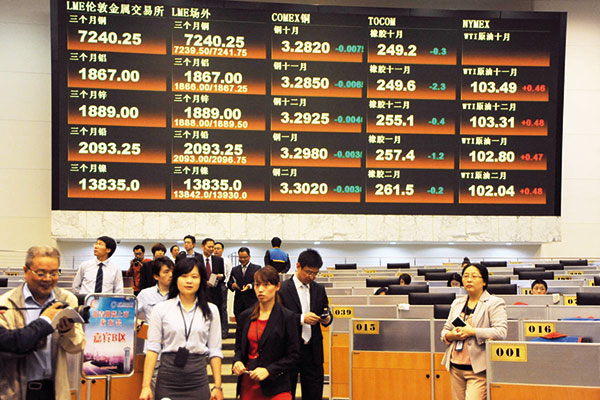
The Shanghai Futures Exchange was established in 1999. China will launch the Shanghai International Energy Exchange, which will admit foreign traders. [Photo provided to China Daily] |
Chinese companies look to have bigger say in market for global commodities
Chinese companies are increasingly trading in global commodities to secure long-term supplies and exert more influence over pricing mechanisms.
As one of the world's largest consumers of commodities such as agricultural products, metals, minerals, oil and gas, China has historically purchased these commodities from international markets at unfavorable prices due to lack of participation in international commodity exchanges, which set commodity prices.
But that is now changing as increasingly, Chinese banks, securities firms and commodity trading firms are joining international commodity exchanges, mainly to buy and sell commodities on behalf of their clients in China. This in turn helps them hedge against future price fluctuations.
For example, if a Chinese oil refinery knows the quantity of crude it requires in a year's time to meet production targets, it can purchase Brent Crude on the US-listed Intercontinental Exchange, or ICE, at a price determined by the futures market. By receiving a locked-in price, the firm is able to accurately determine its business model and be certain of profit margins.
Before such trading activity became possible, the same company would have needed to either buy crude oil in bulk for storage, or wait a year until the oil is required, facing the risk of increased prices.
"It is natural for Chinese companies to take a more dominant position in the global commodity trading space, both physically and financially, because China is one of the biggest commodity consumers in the world," said Bjarne Schieldrop, chief analyst of commodities at SEB, a Nordic bank.
He said that in the commodity markets, the fundamentals of supply and demand determine the long-term price, but in the short-term, on the day when a trade is made, the price is set by financial markets because sentiment can move prices up and down.
"At the moment I think China is huge on the physical side while the rest of the world has dominance in the financial markets," Schieldrop said.
One of the reasons that China has historically not engaged in commodity trading on financial markets was because it was highly focused on securing actual supplies.
In addition, China's capital account restrictions, which limit the amount and type of financial flows into and out of China, also has been a factor behind its limited involvement in international commodity trading. The liberalization of the capital account in recent years is allowing more Chinese banks to trade on international exchanges, Schieldrop said.
Chinese companies' increased trade in commodities in foreign exchange is also a natural continuation of rising Chinese investment and financing activities in the international commodity markets, said Josh Clarke, counsel in the Perth office of the law firm Squire Patton Boggs.
For example, in Australia, as Chinese companies have bought shares in natural resources firms, more of those Australian companies' activities are financed by Chinese banks that already have a working relationship with their shareholders.
This trend has led Chinese banks into the commodity financing sector, and as a result of such involvement, participation in the commodity trading and hedging space became a natural progression, Clarke said.
This increasing commodity trading by Chinese banks will benefit the global commodity trading markets by increasing liquidity. It will benefit the clients of the Chinese banks, for example, through making available to those clients the means to hedge their forward price risks.
In 2012, Bank of China's commodities trading arm, BOCI Global Commodities (UK) Ltd, became a member of the world's biggest metals bourse, the London Metal Exchange, giving it the right to trade by phone and electronically. This was followed by China Merchants Securities, one of China's largest securities companies, and GF Financial Markets, a Chinese derivatives broker, which also started trading on the LME.

Copyright 1995 - . All rights reserved. The content (including but not limited to text, photo, multimedia information, etc) published in this site belongs to China Daily Information Co (CDIC). Without written authorization from CDIC, such content shall not be republished or used in any form. Note: Browsers with 1024*768 or higher resolution are suggested for this site.
License for publishing multimedia online 0108263 Registration Number: 130349