 |
|
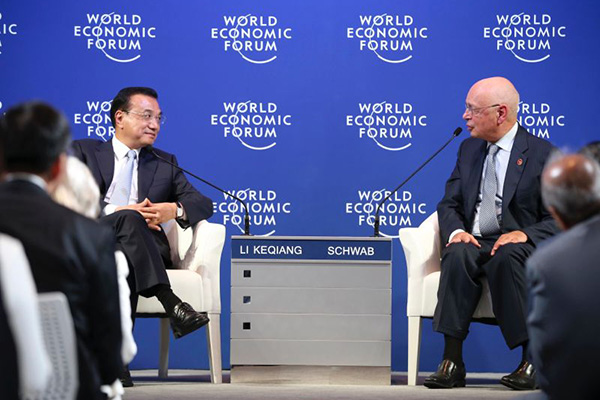
Chinese Premier Li Keqiang speaks with global corporate leaders at the Annual Meeting of the New Champions of the World Economic Forum in Dalian, Liaoning province on September 9, 2015. [Photo provided to China Daily] |
We have no intention to boost exports by devaluing the yuan. This is not in keeping with our policy of structural adjustment. Still less do we want to see a global "currency war". As the Chinese economy has become so highly integrated into the global economy, a "currency war" would only bring more harm than good to China. As a matter of fact, after the small adjustment of the exchange rate, I once talked about this with relevant departments and some export-oriented firms in China. They said they hope the renminbi exchange rate will remain basically stable at a reasonable and balanced level. Should there be market expectations of continued depreciation of the yuan, these companies could hardly get any long-term export order. How could this be beneficial for China's exports?
As you know, commodity trade takes up a large part in China's total foreign trade. Between January and August this year, China imported 220 million tons of crude oil, up by 10 percent over the previous year. Soy bean imports rose by 7 percent, and iron ore imports were over 600 million tons, more or less the same as last year. However, commodity prices have dropped significantly, with some plunging 40-50 percent. We have been affected as a result. There were less tariffs and hence the strains on China's public finance. But commodity prices are not something for us to decide. Total import volume has not declined, yet the value of imports has come down as a result of falling prices. Who should be held accountable for this? It is a topic that can be further discussed and debated. If international commodity prices rebound, we would get more import tariffs.This would mean more public money to spend on improving people's lives. There would be change in the PPI too, which is beneficial for improving corporate profitability and performance. This is an issue that requires joint efforts for a solution.
As for internationalization of the renminbi, it should be a market-driven process. It needs to fit China's reality of economic development and will take some time. We will gradually achieve full convertibility of the renminbi under capital accounts. One thing is certain: a continually devaluing renminbi is not conducive to the renminbi internationalization process. This is not our policy orientation. China wishes to join the SDR, not just for making the renminbi more internationalized, but also for fulfilling China's due international responsibilities as a big developing country. China is not a source of risks for the global economy; China is a driver of world economic growth.
Thank you.
Arif Naqvi, Founder and CEO of the Abraaj Group: Thank you Your Excellency for having this open dialogue with us. My question relates to FDI and investment environment. A lot of multinational companies are paying very close attention with doubt to the openness of China's domestic economy. Some are concerned about the Chinese government's policy change to foreign investment in the country,their diminishing advantage in investing in China and intellectual property rights protection. What new measures will the Chinese government take to boost FDI?

Copyright 1995 - . All rights reserved. The content (including but not limited to text, photo, multimedia information, etc) published in this site belongs to China Daily Information Co (CDIC). Without written authorization from CDIC, such content shall not be republished or used in any form. Note: Browsers with 1024*768 or higher resolution are suggested for this site.
License for publishing multimedia online 0108263 Registration Number: 130349