Insurance sector needs innovation to aid supply-side reform


 |
|
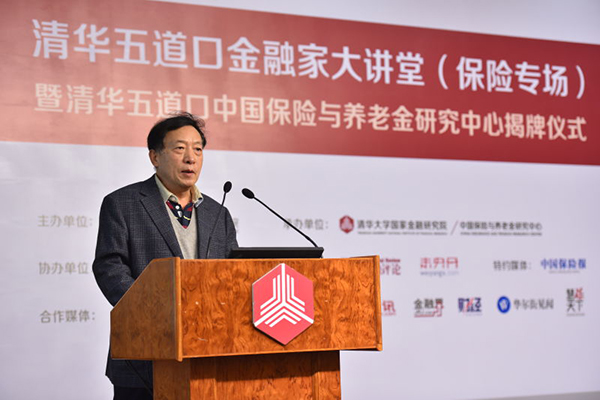
Wei Yingning, former vice-chairman of China Insurance Regulatory Commission, delivers a speech at the launch ceremony of the China Insurance and Pension Fund Research Center at the PBC School of Finance at Tsinghua University on Nov 20, 2016. [Photo provided to chinadaily.com.cn] |
China is likely to surpass Japan in insurance premium this year, second only to the United States, predicted Wei Yingning, former vice-chairman of China Insurance Regulatory Commission, in Beijing on Sunday.
Total insurance premium in the first eight months of this year has reached 2.3 trillion yuan ($333.4 billion), close to last year's total of 2.4 trillion yuan, up by 34.68 percent year-on-year, according to Zhou Yanli, another former vice-chairman of the insurance watchdog.
However, the country is far from being an insurance superpower as penetration and density are still low, Wei added in his keynote speech delivered on the launch ceremony of the China Insurance and Pension Fund Research Center at the PBC School of Finance, Tsinghua University.
The country's insurance penetration, which is the ratio of total insurance premium to GDP which and which reflects the importance of the industry to the whole economy, was 3.57 percent in 2015, while the world average was 6.23 percent. The density, which is the ratio of total insurance premium to total population and which measures residents' willingness to buy policies, was $281 last year, compared to the global average of $621.
China has set a target of 4.5 trillion yuan in total insurance premium, 25 trillion yuan in total asset, five percent in penetration and 3,500 yuan in density in the insurance sector's 13th Five Year Plan (2016-2020) released in August. Wei said he thought this target is achievable as the sector expects large opportunities ahead due to four factors.
First, international experience shows that when per capita GDP ranges between $5,000 and $10,000 in a country, its insurance sector grows fast and China, whose per capita GDP was $8,016, is right in this group. When per capita GDP is below $5,000, residents do not earn much and do not have enough money to buy insurance policies and when per capita GDP is above $10,000, the market has become rather mature, he added.
Second, there is high demand as people have higher needs for better health, life quality and security when their income and wealth increase.
Third, China has many fiscal policies, including pretax deduction for commercial health insurance policy buyers, to aid this sector and will have more in the future. The country has allowed insurance companies to invest in more areas, including elderly care facilities and communities, leaving more room for the development of insurance companies.
Fourth, the internet has brought changes in insurance sales channel expansion, product design, business models and service. Technologies in big data, cloud computing, internet of things and blockchain will usher in next round of innovation.
However, Wei added that while internet finance has changed the fundamental model of finance as no banks are needed in borrowing and lending and the internet itself has become the medium, the internet insurance has not changed the nature of insurance, which indicates that internet insurance is still in the very early stage of development and will witness more innovations later. Furthermore, technologies in big data and cloud computing have not really entered people's daily life and the insurance sector, which means there is still plenty room for development.
Li Kemu, former vice-chairman of China's insurance watchdog, said that insurance companies should improve product design to better meet people's needs, responding to the country's supply-side reform.
Zhou Yanli, also former vice–chairman, agreed him on insurance sector's important role in the country's supply-side reform as mismatch in the supply-side and demand-side is obvious. He said that insurance products offered are homogenous and citied Chinese mainland people's enthusiasm in Hong Kong insurance policies as a counterexample. In 2015, Chinese mainland residents bought insurance policies worth HK$ 31.6 billion in Hong Kong, up by 29.5 percent year-on-year.
He added that property and liability insurance still plays a very limited role in protection against key accidents.