Sharing economy promotes global inclusive growth


BEIJING — Mobike, one of China's largest bike-sharing companies, launched its services in Manchester, United Kingdom this week, after its rival ofo launched 20 bikes in Cambridge earlier this year.
Led by bike-sharing operators, the tides of China's sharing economy attracted a lot of attention at the just concluded 2017 Summer Davos.
The sharing economy has become a must-have investment for venture capitalists. It has also been considered as a driving force of global inclusive growth.
"We hope that our bikes will be in every city on this planet within ten years," said Dai Wei, founder and CEO of ofo, whose name is meant to resemble a bicycle.
Dai anticipated that ofo will provide services in about 20 countries and regions by the end of 2017, mostly countries involved in the Belt and Road Initiatives. His company got its start at Beijing's Peking University. It now has bicycles in 120 cities and has seen more than 1 billion rides taken within the last two years.
"China's inclusive environment and innovation spirit created the boom in bike-sharing," said Dai.
Sharing - whether bicycles, automobiles, property or any other assets - has become popular in many of China's urban areas, as residents look to make their lives easier and save resources.
A recent report showed that about 600 million Chinese were involved in sharing of some kind in 2016, almost half the country's population.
The trading volume of the sharing economy more than doubled year on year to about 3.5 trillion yuan ($516 billion) last year, according to a report released by the State Information Center.
The sharing economy will grow at an average annual rate of 40 percent over the next few years and will account for more than 10 percent of the country's GDP by 2020, the report predicted.
At a larger scope, the development of sharing economy shows inclusive growth in the country and the way of global governance in the eyes of Chinese leaders, said Xue Lan from Tsinghua University.
China has set a target to finish building a moderately prosperous society by 2020, which means the complete eradication of poverty. Meanwhile, the country has made impressive efforts to promote inclusive development, helping other countries, especially developing ones, to share the fruits of development.
The Belt and Road Initiative, for example, will mark a new chapter of openness and win-win cooperation around the globe.
"Our company shares the same ideas as the country's leadership," said Hu Weiwei, founder of Mobike.
Attracted by the huge market potential, capital has been thrown at the bike-sharing sector. As a result, the whole industrial chain has felt the benefits, from best-known brands and medium-sized factories to small businesses.
"The sharing economy has not only created successful startups but saved traditional bike manufacturers, and also has promoted green transport," said Hu.
Chinese on-demand mobility giant Didi, another epitome of the country's sharing economy, is using electric vehicles to promote environmentally friendly transport.
There are 2 million electric vehicles worldwide, among which 600,000 are in China, and Didi is using 200,000 of them, according to the company's president Liu Qing.
The benefits of sharing are obvious both economically and environmentally. The emerging business model, however, is not without controversy due to the questionable usage and disposal of shared assets as well as divergent experience of market players.
For bike sellers, the prospects seem to be mixed. Sellers focusing on sports and racing bicycles are happy that bike-sharing is promoting healthier lifestyles, but thousands of other retailers are worried about how they will fare in the fast-changing market.
Failure and a lack of regulations co-exist in China's booming bike-sharing market. "Inclusive and prudent supervision is needed to cultivate the sharing economy and make it a driving force in the Fourth Industrial Revolution," said Xue.
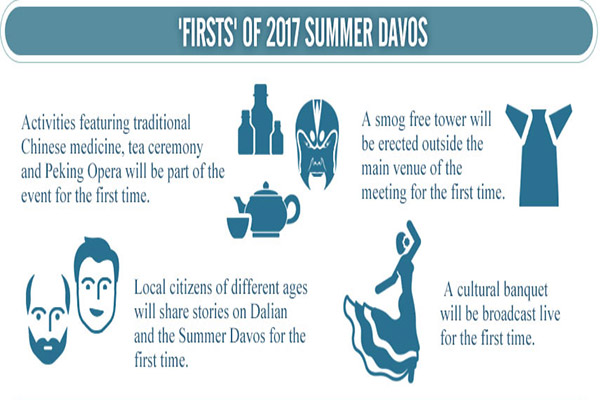
2017 Summer Davos closed its annual meeting on Thursday in northeast China's coastal city of Dalian, highlighting technological innovation and inclusive growth for sustainable development.
During the three-day Meeting of the New Champions 2017, more than 2,000 participants including officials and entrepreneurs from over 90 countries and regions shared their insights on economic globalization challenges, the sharing economy and new technology.
The meeting was themed "Achieving Inclusive Growth in the Fourth Industrial Revolution." Attendees tried to find ways to achieve a more inclusive style of growth that prioritizes meaningful job creation and sustainable development.