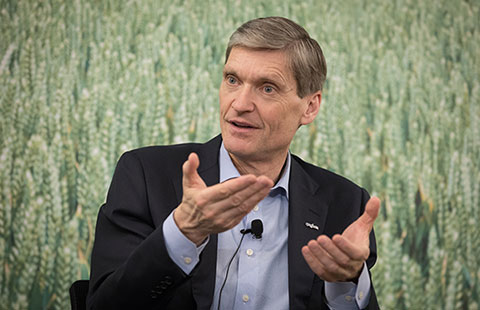
What's at stake at China-US Comprehensive Economic Dialogue?


BEIJING — Senior Chinese and US officials will meet on economic and trade issues, leaving opportunities for the two sides to crack many hard nuts under the new format.
The first round of the Comprehensive Economic Dialogue (CED) will begin on July 19 in Washington. It is one of four major dialogue mechanisms the two sides established in April.
With the new platform in place, experts have called on both countries to employ new ways of thinking to address and resolve thorny bilateral and global issues.
New mechanism
The dialogue will come 10 days after Chinese President Xi Jinping and US President Donald Trump met on the sidelines of the Group of Twenty (G20) summit in Hamburg, Germany, in which they reaffirmed their commitment to healthy and stable economic ties.
China and the United States have been vigorously advancing economic and trade relations. The two sides have made important initial progress in carrying out the 100-day action plan, a key chapter of the CED.
A range of deals on financial services, energy and investment have been inked. China greenlighted US beef exports after 14 years of bans, while the United States agreed to allow chicken imports from China.
"The results so far in the 100-day program to improve trade and investment appear to have been more constructive than many critics argued," said Douglas Paal, vice president for studies at the Carnegie Endowment for International Peace.
"It is possible there will be further progress at the CED," he noted.
"We hope it will be a meaningful exchange and help to build an even stronger basis for our economic and trade relations, as we deal with the uncertainties of the global economy," Chinese Ambassador to the United States Cui Tiankai said.
"We are looking forward to the mutually beneficial outcomes of this dialogue," he said.
Trade deficit
The dialogue will come days after President Trump highlighted fair and reciprocal trade ties at the G20 Hamburg summit. Experts expect addressing the US trade deficit with China will be a top priority for discussion at the CED.
Bilateral trade moderated over the past two years, as the world's top two economies slowed down for cyclical and structural reasons, and a stronger dollar battered US exports, said Zhou Shijian, an economics professor at Tsinghua University.
According to the Ministry of Commerce, two-way trade contracted 6.7 percent in 2016 with Chinese exports to the United States down 5.9 percent and China's imports from the United States down 9.1 percent.
Trade volume rose 13.5 percent in the first four months of 2017, with China's exports to the United States up 11 percent and China's imports from the United States up 20 percent.
To address the US trade deficit with China, it makes a lot of sense for the US side to lift the ban on exports of high-tech products to China in areas such as clean energy, Zhou said.
Every US government since the Reagan administration had eased restrictions until President Obama took office in 2009.
In his eight years in office, Obama vowed to loosen the controls on several occasions, but never honored his commitment.
"The United States currently holds a trade deficit with China of about $300 billion. The gap could be narrowed by one third if the ban were lifted," Zhou said.
According to the US Department of Commerce, the US deficit with China stood at $347 billion, accounting for 47 percent of the US total trade deficit.
It was good news for the United States that China just allowed imports of US beef. But experts expected it would only have limited impact in balancing trade considering the small trade volume.
Whether the current US government is determined to bridge the trade gap or not, how it deals with high-tech product exports to China is probably a touchstone, Zhou said.
Bit talks resume
Experts said the upcoming dialogue will be a good chance for negotiation on a Bilateral Investment Treaty (BIT).
BIT talks began in 2008, when China and the United States sought to increase mutual investment. But little progress had been made before they agreed in 2013 to conduct negotiations on the basis of pre-establishment national treatment with a negative list approach, which outlines sectors closed to foreign investment.
After 33 rounds of negotiations over the past five years, the BIT talks have been shelved by US President Donald Trump's administration.
Chinese Ambassador to the United States Cui Tiankai urged Washington to revive the BIT negotiations, adding that reaching a high-level bilateral investment treaty was an important outcome of previous economic and trade dialogues between the two countries.
In 2016, Chinese companies invested a record $46 billion in the United States, tripling the amount in 2015 and a tenfold increase compared to just five years ago, according to a report jointly released by the Rhodium Group and the National Committee on US-China Relations (NCUSCR) in May.
Growth of Chinese investment in the United States moderated in 2017. Zhou explained China's foreign exchange regulation, tax reform of the Trump administration and the lack of progress in the BIT talks may have contributed to the moderation.
"The US government needs money to revive the US economy. No better time for it to advance the BIT talks with China. It should do something to create a sound atmosphere for the negotiation," Zhou said.