Economic globalization at a crucial moment


BEIJING - As economic globalization appears to have come to a crosscroad where a next step to be taken by major players will lead to either a new world or a dead end, insight and far-reaching vision are essential for the future of the world at such a crucial moment.
It is a moment when protectionism, populism and isolationism are on the rise in especially developed countries, seen in a trend of anti-globalization, anti-free trade, anti-establishment votes and domestic social split.
At such a moment, protectionism, populism and isolationism have all found economic and political outlets, including depressed cross-border trade and investment, heightened trade barriers, stalled regional integration and toughened immigrant policies.
They have emerged where there are economic downturns or crises. The sluggish economy has shrunken the interest cake to share, hitting particularly such social groups as the blue-collars.
They have been deliberately used by some political forces to circumvent pains from true realities and necessary reforms, trying to make globalization a scapegoat for exposed defects in economic structure and governance.
They have come at a time when the last round of technological and industrial revolution and old-fashioned economic and development patterns have exhausted their fuels for growth, falling short of enabling a balance in both development and benefit distribution.
Truly, it has been a challenge so far in the process of globalization to achieve a balance there. However, this failure should not mean an end.
It just calls for ideas and actions to make things better. The process of globalization has so far worked to lift millions of people out of poverty around the world.
The existing discontent about globalization reflects the existence of problems in how to manage and control the globalization process, instead of globalization itself, according to US economist and Nobel laureate Joseph Stiglitz.
Globalization once came as a historical choice and reasonable solution to advancements in social productivity and technology. Driven by new scientific and technological outcomes, it has led to industrial transfers and resources regroupings worldwide in the form of globalized trade and investment by transnational companies.
On top of the emerging new round of technological and industrial revolution, transformations in both the international labor division system and the global value chain are ushering in a new stage of the economic globalization.
The world scenario that boasts some 900 million social media users and some 360 million participants of cross-border electronic commerce, with an increase in cross-border personnel movement outpacing that in global population, is among the early signs.
The cross-border information flow nowadays, 46 times that in 2005 as shown by a Mckinsey Global Institute report last February, means a gigantic exchange of commodities, services, capital and personnel.
More significantly, it implies a lowered threshold for accession to globalization for smaller companies, start-ups and individuals.
While turning the world into a deeply interdependent one, globalization has also re-shaped much of the world's thinking. Many issues and their solutions in parts of the world can no longer be closed off from the rest of the world, as economic and political factors have interlocked and domestic and international problems overlapped in an unprecedented way.
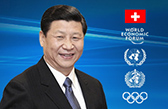
Where to go at this crucial moment of economic globalization is to be discussed at the 2017 annual meeting of the World Economic Forum (WEF) to be opened on Jan. 17 in the Swiss resort Davos. High expectations are being focused on Chinese President Xi Jinping and the proposals he puts forward.
China's decades-long reforms and opening to the outside world represent a successful course of integration into the global economy, as the country benefits from the process of globalization.