BIZCHINA> Center

|
BIZCHINA> Center
|
|
Related
OTC market central to Tianjin's development
By Jin Jing (China Daily)
Updated: 2008-06-11 11:10 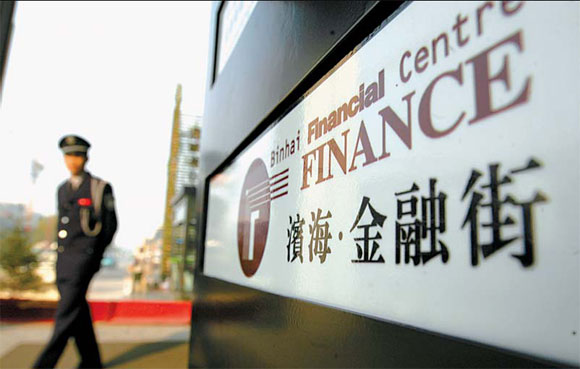 Of the many initiatives planned to turn Tianjin Binhai New Area into a financial center, it is the proposed over-the-counter, or OTC, market which is taking center stage. The State Council has said that the central government will actively support Tianjin's bid, which is seen as an important step for China towards building a diversified capital market. Competition to host the nation's first OTC market was fierce. Cities, including Shenzhen, Beijing, Shanghai and Chongqing, had all submitted applications. Tianjin won the bid because of its special position as the test zone of coordinated reform. Tianjin submitted a comprehensive development plan to the State Council in September 2006. The plan included 10 major development initiatives in the areas of finance, real estate and administration. "The OTC market is center to the development of Tianjin's financial services and set the example of coordinative development, with Tianjin becoming the economic center for northern China," said Zhou Chunsheng, a professor at Cheung Kong Graduate School of Business. There are two existing main stock exchanges at present, one in Shanghai and the other in Shenzhen. Now a second board for small and medium-sized enterprises is planned for Shenzhen this year. Analysts expect China's OTC equity market to be launched within two years after the second board is established in Shenzhen. The OTC securities market will allow stocks to trade via a dealer network. Trading can be done either on the computer or by phone. It is designed specifically for small and medium-sized enterprises, which are not eligible for listing on the major exchanges. Analysts estimate that the OTC market, when open, could help more than half a million unlisted companies on the mainland to raise funds directly from the public. Currently there are only 1,551 companies that are listed publicly in the Shanghai and Shenzhen stock exchanges. "Many small- and medium-sized companies, which are unable to meet exchange listing requirements, usually have difficulties in obtaining financing from banks because of their small scale and limited earnings capability," said Zhu Haibin, an analyst at Essence Securities. "The government's move will also provide industrial funds and venture funds an 'exit' to realize the gains from their investments," said Zhu. The OTC market is usually established in countries or regions with strong financial system, such as the US, UK, France and Hong Kong. The US has the world's largest OTC market - Over the Counter Bulletin Board (OTCBB) where more than 6,700 companies trade. In the international market, companies needs to provide legal reports, auditing reports from accounting firms and corporate governance evaluation reports, before it is allowed to enter an OTC market. The government can control risks through the three reports, but management risks should be undertaken by investors. "Individual investors are allowed to invest in OTC equity in mature markets. But at the initial stage of development, we will not allow individuals to join in OTC investment in order to prevent risks," Cui Jindu, vice-mayor of Tianjin, said in a CCTV interview. "At the initial stage, the OTC market is more suitable to those institutional investors with years of experience and those that can operate through market maker rules," said Zhou Chunsheng. "And the introduction of retail investors later can help to make the trading more active." Market maker is a firm who quotes both a buy and a sell price in a financial instrument or commodity, hoping to make a profit on the turn or the bid/offer spread. Wu Feng said that market transparency and effective supervision are very important in the establishment of an OTC market. "Mainland's capital market is still lacking transparency, which it needs for improvement," he said. Cui Jindu said that the detailed plan for OTC market establishment is still under discussion. "The entry level for OTC companies must be largely lower than the main board and the second board," said Cui. "The risks involved in the OTC market is expected to be higher than the main board and the second board, thus the government should strengthen the supervision on it," said Chen Xuebin, a professor at Fudan University. In late March, the China Securities Regulatory Commission announced it was to set up a supervision department for unlisted public companies. "The move is expected to help the government strengthen supervision over small and medium-sized companies and improve their management, before those companies enter the OTC market," Wu said. Analysts said that the existing local assets and equity exchanges are expected to be included in the OTC market in the future, which will help the government in terms of consolidated supervision. OTC markets are mainly for unlisted public companies while assets and equity exchanges are for unlisted nonpublic companies. "The way to combine an OTC market with local assets and equity exchanges still need further discussion," said Zhou. (For more biz stories, please visit Industries)
|
主站蜘蛛池模板: 莒南县| 枣阳市| 万全县| 遂昌县| 林芝县| 邵武市| 廉江市| 黄山市| 红桥区| 乐业县| 准格尔旗| 河北省| 广州市| 黄梅县| 故城县| 万安县| 克什克腾旗| 如皋市| 赣榆县| 怀仁县| 葵青区| 永善县| 高州市| 高台县| 磐石市| 通海县| 巴林左旗| 全南县| 宜春市| 汝阳县| 蓬安县| 洛南县| 太谷县| 正宁县| 股票| 苍溪县| 巩留县| 阿坝县| 图们市| 呼伦贝尔市| 南安市| 通州区| 邵阳市| 昭平县| 玛沁县| 沐川县| 昌宁县| 枞阳县| 滨州市| 蕲春县| 荣成市| 沙河市| 梅州市| 肥东县| 临安市| 哈密市| 金昌市| 茂名市| 淅川县| 华蓥市| 峨山| 桦甸市| 饶平县| 开远市| 宁陵县| 虎林市| 佳木斯市| 卢湾区| 定西市| 海丰县| 霍邱县| 苗栗县| 新泰市| 松江区| 墨竹工卡县| 武乡县| 奉化市| 德昌县| 丽江市| 梁平县| 彭山县| 堆龙德庆县|
