BIZCHINA> Center

|
BIZCHINA> Center
|
|
Related
Turning the page
By You Nuo (China Daily)
Updated: 2008-06-30 10:07
 For people outside China, China is always China. But Chinese people who have experienced so many profound changes may feel as if they live in a different country every 20 to 30 years.
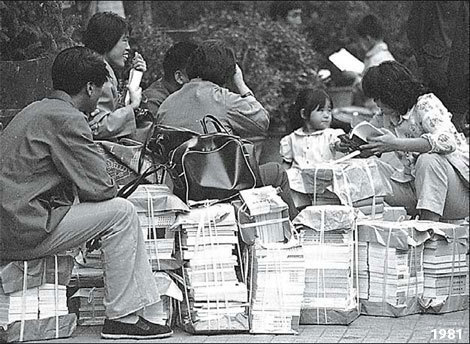
Many commodities that were hot sellers in the 1970s have disappeared from Chinese life. Gone are the bamboo-wrapped thermos bottles, black-and-white television sets shaped like portable coolers, heavy-duty bicycles for carrying enormous sacks of goods in addition to the rider, and ration coupons in various sizes. But one commodity has remained a constant in the marketplace since the so-called era of "reform and opening up". It is the book. When China began opening up, it ushered in a nationwide thirst for knowledge. When all schools resumed their regular teaching programs, when engineers and technicians were re-assigned to their duties, and especially when Deng Xiaoping, the leader of the reform, called science and technology the "number-one kind of productivity," the demand for books was surging. But the distribution system was still clumsy and slow and people traveling to large cities, as those shown in the 1981 black-and-white picture in downtown Beijing by our photographer Wang Wenlan, often had to buy many books for their hometown relatives and friends, and take many more copies than their bags could hold. Never mind the hassle. They were happy, as you can tell from their smiles. For books and the knowledge they contained could empower their family members to obtain challenging jobs, to make more money - and to catch up with the nation's modernization campaign.
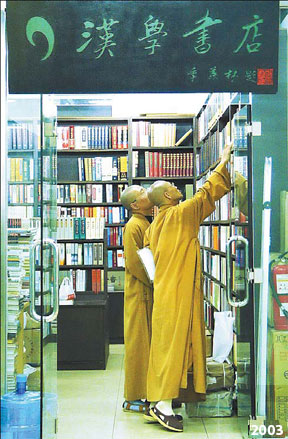
Those were mostly simple editions for the mass market - with no hard covers or fancy designs, and many could just be textbooks and practical manuals. From a strictly utilitarian point of view, books were tools. When bundled by strong plastic strings, they could even be used as makeshift chairs. But if books were just simple useful tools 30 years ago, nowadays they tend to carry a greater significance. More people have been developing diverse interests, and have turned to literature to suit their cultural tastes, artistic preferences, academic orientations and moral aspirations. Thirty years ago there might have been a time when the country boys read ardently to become engineers or to launch their own small companies. Now, at least in some corners of the nation as shown by Wang's more recent photo at a bookstore near Peking University, Beijing, it's a world of deeper thinkers. Two Buddhist monks are seen here choosing titles in a "Bookstore of China Studies". The name, in the Chinese context, refers mainly to the research in the Chinese classics from the ancient times. Buddhism, first imported from India almost 2,000 years ago, has contributed to an important part of those books.
In bookstores in major cities, literature about the Chinese tradition have been selling very well in the last couple of years - from Confucianism to Buddhism. They are not books for people to sit on. They are the ones designed to rest their hearts.

(For more biz stories, please visit Industries)
|
主站蜘蛛池模板: 合川市| 新乡县| 龙州县| 遂川县| 尚义县| 巴彦县| 十堰市| 寿光市| 房山区| 佛坪县| 漳州市| 长泰县| 兴仁县| 富川| 四子王旗| 五台县| 财经| 渭南市| 黔东| 桓台县| 深州市| 麻栗坡县| 宁安市| 潞城市| 耒阳市| 福海县| 佛山市| 加查县| 巴东县| 兴隆县| 兰坪| 盈江县| 连平县| 商丘市| 沾化县| 宜阳县| 辽中县| 阿拉善盟| 琼结县| 镇赉县| 怀柔区| 光泽县| 雷山县| 东乌珠穆沁旗| 建湖县| 广汉市| 马龙县| 涞水县| 尉氏县| 略阳县| 五家渠市| 壶关县| 辉南县| 丹阳市| 九龙城区| 砚山县| 益阳市| 临清市| 秦皇岛市| 东兰县| 锡林郭勒盟| 郸城县| 白沙| 商丘市| 耒阳市| 富平县| 基隆市| 永清县| 黎城县| 固安县| 琼结县| 沧源| 铜梁县| 宿州市| 海伦市| 长子县| 新竹市| 茶陵县| 绥阳县| 农安县| 灌云县| 宁陵县|