BIZCHINA> 30 Years of Reforms

|
BIZCHINA> 30 Years of Reforms
|
|
Related
Country grapples with runaway property prices
By Hu Yuanyuan (China Daily)
Updated: 2008-08-19 11:36
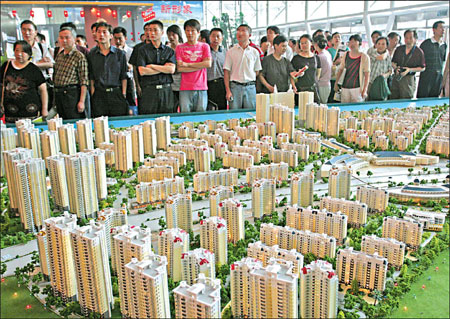 For most Chinese, owning a house is as much a necessity as it is a dream. And, for the Chinese government, making more houses available for the common people is one of its policy priorities.
The residential housing market now accounts for more than 70 percent of all property development in China. But only 10 years ago, the vast majority of people lived in housing provided by their work units, often in cramped conditions. The housing reform program introduced in the late 1990s has encouraged greater participation by the private sector, resulting in a huge increase in supply. Many homebuyers are taking advantage of the widening availability of bank financing to acquire their first homes.
As a result, per capita living space in urban areas has risen from 16 sq m per person nationwide in 1995 to 28 sq m per person in 2007, with hundreds of millions becoming homeowners, according to the National Bureau of Statistics. Homebuyers' soaring demand has been fueling a real estate boom in China for years, but has also sent property prices skyrocketing. To tackle speculation and cool down the sizzling property market, the government has ushered in a number of measures since 2005, including the introduction of new taxes on sales and capital gains and higher interest for mortgage lending on second homes. Meanwhile, the government has become increasingly concerned by the volume of funds seeking real estate investments in China, particularly the "hot money" entering the market looking for short-term gains. To deal with this, the government has, over the last several years, introduced a series of new regulations aimed at foreign investors in real estate. Foremost among these is perhaps Circular 171 that requires overseas investors in completed buildings to establish an onshore wholly foreign-owned enterprise or a joint venture before investing. This makes life difficult for foreign investors, but the potential returns from real estate investment in China are still exciting enough to keep investors streaming in. The economic fundamentals are still strong and there are opportunities across a range of sectors and in a range of geographical locations. (For more biz stories, please visit Industries)
|
主站蜘蛛池模板: 柳州市| 康平县| 隆化县| 牟定县| 堆龙德庆县| 通化市| 濮阳县| 肥东县| 扶绥县| 龙海市| 台前县| 闻喜县| 西充县| 阜城县| 仙桃市| 中阳县| 黄大仙区| 怀柔区| 东乌珠穆沁旗| 隆林| 鹿泉市| 双峰县| 长沙市| 阿尔山市| 平定县| 温泉县| 镇远县| 祁连县| 天等县| 高邮市| 恩平市| 芒康县| 永仁县| 五家渠市| 满城县| 红桥区| 多伦县| 依兰县| 邯郸县| 大余县| 盐城市| 社旗县| 通辽市| 广东省| 玉环县| 黎川县| 拉萨市| 庆阳市| 晋中市| 花莲县| 特克斯县| 馆陶县| 曲沃县| 综艺| 桃园县| 双桥区| 偏关县| 津市市| 米林县| 云林县| 出国| 和林格尔县| 民勤县| 波密县| 平定县| 平谷区| 宣威市| 宁陕县| 武鸣县| 梅州市| 四子王旗| 新兴县| 屏南县| 银川市| 梁平县| 澳门| 招远市| 新竹市| 饶平县| 百色市| 哈巴河县| 吉木乃县|
