BIZCHINA> Review & Analysis

|
BIZCHINA> Review & Analysis
|
|
Related
US financial woes offer lessons
By Jiang Yong (China Daily)
Updated: 2008-09-19 17:49 The worsening US subprime crisis has turned in to the "financial hurricane of the century" that is wreaking havoc on Wall Street. On Monday, the Lehman Brothers filed for bankruptcy, Merrill Lynch was sold to Bank of America. The US government has agreed to provide a $85 billion emergency loan to rescue the huge insurer American International Group (AIG). The three "bomb blasts" rocked Wall Street to the core, sending shockwaves through the US economy and very likely the presidential election as well. On September 14, Bank of America acquired the 94-year-old brokerage Merrill Lynch, the third largest investment bank in the US. On the same day, AIG, once the top insurance company in the world, applied for $40 billion in federal loans to stay afloat through the worst period of the disaster. However, the heaviest blow so far to financial markets worldwide had to be the collapse of Lehman Brothers, the fourth-ranked investment bank in America. Founded 158 years ago, Lehman Brothers survived the American Civil War, the two world wars, the Great Depression, the September 11 terrorist attacks and one takeover attempt before this week. If the venerable investment banks on Wall Street can be described as "cats with nine lives", Lehman Brothers probably had 19. But that was apparently not enough today, as the 158-year-old business went for bankruptcy protection after languishing in the red for two quarters in a row, and the Korea Development Bank, Barclay's of Britain and Bank of America abandoned their plans to acquire it. After the three concussion grenades turned the financial market upside down on Monday, the Dow Jones ended the day losing 504 points - the sixth biggest fall in history and the steepest since 9/11. The Financial Times Index, meanwhile, tumbled nearly 4 percent, while the CAC40 in Paris dropped by 3.78 percent. The oil futures price fell to less than $100 a barrel on the New York Mercantile Exchange as the US dollar nosedived against the euro and Japanese yen after news broke of Lehman Brothers' demise. Also on that day, the Federal Reserve (Fed) rounded up 10 cross-national banks and securities companies to form a $70 billion stability fund for the financial market as well as providing a safety net for financial institutions threatened by bankruptcy and ensuring market liquidity. It also relaxed credit conditions for securities brokerages, while the European Central Bank (ECB) and the UK's central bank launched a market rescue plan worth billions of euros. ECB also injected $43 billion into some 30 banks through one-day refinancing operations. Bank of England provided short-term loans worth about $9 billion to several banks valid for three days, while Japan's central bank governor vowed to maintain market stability with sufficient capital injection whenever necessary and keep a close watch on the effects of the US financial crisis. It had injected $14.4 billion by Tuesday. Unfortunately the emergency measures by the US, European Union (EU) and Japan can only ease the tension in financial markets temporarily. As the subprime crash is fast turning into a full-blown financial crisis, the financial regulators are now overwhelmed by rising emergencies. 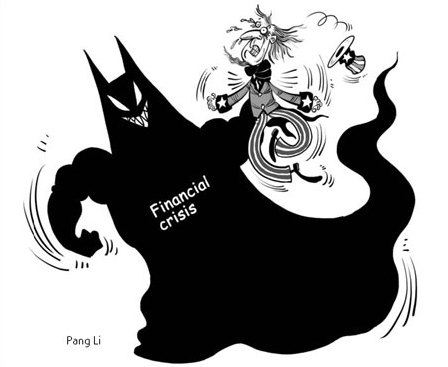 In March, the US government lent JPMorgan Chase $29 billion for taking over troubled investment bank Bear Stearns. Not long after that the federal authorities started providing liquidity assistance to investment banks by allowing them to trade their assets, including bad ones, for treasury bonds with the Fed. The policy used to be available only to regular banks. The US government threw down $200 billion to rescue leading mortgage lenders Freddie Mac and Fannie Mae because they are "too big to let die", but the effort was met with even more widespread and spirited media criticism. Today, because of worries over ethical risks and depleted treasury reserve, the US government has been forced to withhold guarantees for banks interested in buying Lehman Brothers. This shows the US government, faced with a fast-sinking financial market where institutions go under at the pace of one every week, is already stretched thin.
As the stimulating effect of tax rebate wears off, the US economy is again showing signs of turning bearish. A recent Wall Street Journal survey of 51 economists found there is the possibility that American consumption will fall in the third quarter, the first time in 17 years. Former Fed Chairman Alan Greenspan said the collapse of Lehman Brothers is the event of the century. Its development will prove more serious than he had foreseen and is far from over. At a time when some of the largest US financial institutions are faced with persistent uncertainty, more could go bankrupt in the near future, he said, adding that the US stands a less than 50 percent chance of avoiding an economic recession. Researchers at Brookings Institute believed the collapse of Lehman Brothers will not only set off a domino effect throughout financial markets worldwide but also impact the US presidential election. Some election experts have pointed out that public opinion polls so far have shown American voters generally think neither Barrack Obama nor John McCain is very good at handling economic issues. But the Republican Party now holds the presidency, and its economic policies are widely perceived as more Wall Street friendly than otherwise, so the financial crisis will probably hurt Republican presidential nominee McCain more than Obama. To deal with the impact of the US subprime crisis and check the downward momentum of the domestic economy, the People's Bank of China made a "sudden move" on Monday, cutting the interest rate of one-year loans by 0.27 percentage points to 7.2 percent while lowering the reserve rate for small and medium-sized banks by 1 percentage point. This is the first time since Feb 2002 the country's central bank cut interest rates and the first time since Nov 1999 the reserve rate was reduced. The financial industry saw this move by the central bank as a turning point in China's macro-control strategy. The worsening US subprime crisis puts China's enormous US dollar assets and its opening financial market at tremendous risk. It also makes more Chinese people think about ways to prevent financial crises from spreading across the world amid globalization. The author is director of Center for Economic Security Studies of the China Institutes of Contemporary International Relations (For more biz stories, please visit Industries)
|
主站蜘蛛池模板: 屯昌县| 望奎县| 永泰县| 于都县| 双流县| 吉林省| 平利县| 永顺县| 辉县市| 龙州县| 沧州市| 和田市| 布尔津县| 和林格尔县| 寿光市| 文山县| 赞皇县| 洱源县| 阳西县| 民县| 呼和浩特市| 剑阁县| 额尔古纳市| 望城县| 九江县| 乌拉特后旗| 苏尼特右旗| 隆子县| 饶河县| 布拖县| 石屏县| 白沙| 吴桥县| 修武县| 锡林浩特市| 遵义市| 始兴县| 延吉市| 北碚区| 德兴市| 邢台市| 海丰县| 蛟河市| 武鸣县| 凤庆县| 威宁| 深州市| 嫩江县| 庐江县| 海伦市| 肥东县| 句容市| 河池市| 临夏县| 武城县| 平原县| 湘潭县| 和林格尔县| 滦平县| 苏尼特右旗| 吉木乃县| 依安县| 平利县| 鄯善县| 奈曼旗| 博罗县| 博客| 侯马市| 朝阳市| 衡水市| 连州市| 绥化市| 抚松县| 磴口县| 凤山县| 玉山县| 新龙县| 洪湖市| 曲周县| 鄱阳县| 盘锦市| 凌源市|

