BIZCHINA> Editor Choice

|
BIZCHINA> Editor Choice
|
|
Chance encounter
By Wang Zhenghua (China Daily)
Updated: 2008-12-22 07:53
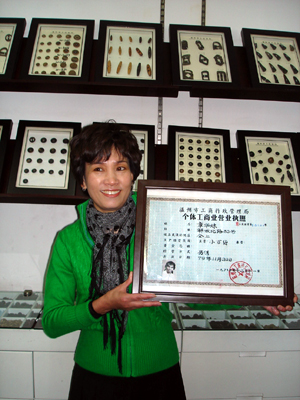
But only one year later local authorities asked the business-savvy Wenzhou woman to apply for a business license with which she could do business openly. "I was hesitant at the time," says Zhang, the first self-employed entrepreneur to obtain official permission to engage in a private business. "If I registered, what if they demanded to 'cut off the tail of capitalism' in the future?"
The woman's father was more far-sighted, saying that it is appropriate to collect the license because the whole country, after experiencing continuous revolutions and movements, was clamoring for reform and opening up. "So we filled in a form at the local industrial and commercial bureau and handed in a picture. They sent the license in November 1979 and told us to nail it on the wall," Zhang recalls. From then on, she didn't have to sneak around in her little booth any more, and so arrived a prosperous Wenzhou, the cradle of China's private economy. After 30 years of development, the private sector has become the main drive of Wenzhou's economy, about 600 km south of Shanghai. Private enterprises, accounting for 99.5 percent of the total number of companies in Wenzhou, contribute 95.5 percent to the city's industrial output, 80 percent to taxes and 95 percent to exports. They are active in the four core light industries - electrical equipment, garments, shoes and cigarette lighters - and highly involved in nine other sectors. The private economy also serves as a solution for the employment pressure in a city with limited land resources. Private companies have attracted 2 million local farmers-turned-workers and 3.5 million migrant individuals. There are another 2.3 million people from Wenzhou running their businesses across China and the globe. "The private sector helped Wenzhou transfer from poverty to having adequate clothing and food, and then to a general state of being well-off," says the city's deputy Party chief Zhu Xianliang. "And more importantly, Wenzhou was a model for other cities in China. It is an effective way to common wealth." But in late 1970s and early 1980s, small retailers like Zhang had to sometime play hide-and-seek with supervisors. Their fears were not unfounded. In one notable case, Zheng Yuanzhong, once nicknamed the "king of home appliances" in Wenzhou and now the CEO of Judger Group, was thrown behind bars during a crackdown on speculation in 1983. After being imprisoned for half a year, the entrepreneur was released in 1984 and later started his current garment business. "So then we dared not to open a big booth, which made it easy to hide when people from the 'speculation crackdown office' came," Zhang recalls. "We were operating with small capital. It would have been a disaster if we'd been caught." More pressure came from social prejudice though, when people admired those working for the State and despised self-employed individuals or households. "My classmates were ashamed of me after learning I started my own business. They would turn their heads away when passing my house and pretend not to know me," Zhang says. But despite the discrimination, more small businesses sprang up and "almost every household was unfolding a table in the daytime selling all kinds of merchandise", she recalls. By selling commodities not offered in State-run stores at very competitive prices these little businesses won the hearts of consumers while giving their owners swollen wallets. "I made 100 yuan a month, more than double an ordinary worker's salary," Zhang says. "That made me feel at ease." That faith has sustained her. Now the owner of Huamei Garments' Accessory Co, Zhang has millions of yuan in turnover from the sales of buttons. After several up and downs in the business circle she says she has become stronger with each challenge. And amid the present global economic meltdown her shop concentrates on the domestic market while trying to build its own brand. "The change in the past 30 years has been so dramatic," sighs Song Chengfeng, who used to work as a clerk at the speculation crackdown office but now serves as the secretary-general of an association in Wenzhou to assist self-employed individuals. The man, now in his 50s, made handwritten copies of the first group business licenses issued in Wenzhou, including Zhang's, when he joined the district industrial and commercial bureau, which was transferred from the speculation crackdown office. "Entrepreneurs in Wenzhou are known for their pioneering spirit," he says. Increasingly, local enterprises are now focusing on innovation and building their own brands. Presently up to 100 Wenzhou-based companies are preparing for listings. They are also seeking partnerships with international players. One of the leading privately owned companies in Wenzhou is CHINT Group, a leading player in the low-voltage electrical, power transmission and distribution industries in China. Its sales turnover reached 20 billion yuan by the end of 2007. Founded in July 1984 in Wenzhou, CHINT has expanded from a home workshop of seven workers to a leading manufacturer of electrical products, with eight specialized branches, over 800 specialized partners and 19,000 employees. Main products lines of CHINT cover high, medium and low voltage electrical apparatus, power transmission and distribution equipment, meters and measuring instruments, electrical products for construction, automation control devices and automobile applications. Its founder and chairman Nan Cunhui used to be a shoemaker. Now the 44-year-old has become one of the most successful entrepreneurs in the nation and has garnered a long list of honors. "The success of CHINT originates from the country's reform and opening-up policies," says Lin Kefu, secretary of the Party's CHINT sub-committee. "It also relies on the tremendous support of the Wenzhou government for private companies." CHINT also encourages innovation, which Lin says is threading through its talent pool, management, technology and corporate culture. The company possesses more than 200 domestic or overseas patents.
 (For more biz stories, please visit Industries)
|
主站蜘蛛池模板: 大英县| 肥城市| 西和县| 容城县| 遂川县| 阳东县| 福贡县| 遂川县| 界首市| 新泰市| 恩施市| 宝丰县| 象山县| 自贡市| 兴城市| 云和县| 仲巴县| 永定县| 秀山| 阳高县| 乌拉特后旗| 曲水县| 花垣县| 鹿邑县| 定边县| 遂川县| 五莲县| 涡阳县| 贞丰县| 临澧县| 吴旗县| 南投县| 磐安县| 永福县| 贺州市| 舒城县| 高阳县| 察隅县| 仁寿县| 海口市| 东台市| 渝中区| 罗山县| 阳泉市| 长宁区| 宁乡县| 通道| 通州区| 杭锦旗| 武安市| 松江区| 通化县| 鸡泽县| 安康市| 井陉县| 奉化市| 莎车县| 福清市| 琼中| 五常市| 稻城县| 永吉县| 霍山县| 绿春县| 商水县| 昆明市| 渝中区| 田阳县| 大余县| 贵阳市| 敦煌市| 本溪市| 修水县| 漾濞| 合江县| 南丰县| 上饶县| 长丰县| 吴川市| 乐平市| 井研县| 青神县|