BIZCHINA> Top Biz News

|
BIZCHINA> Top Biz News
|
|
CPI and PPI fall, but deflation threat eases
By Wang Xu and Zhang Ran (China Daily)
Updated: 2009-06-11 10:00
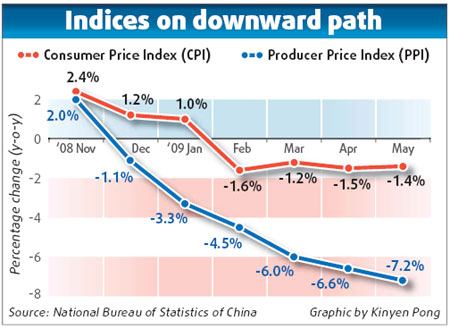
Consumer and producer price indices continued to fall in May despite recent rises in commodity prices, but analysts say both the indices are likely to register positive growth in the second half of the year and the threat of inflation may loom next year. The consumer price index (CPI) fell 1.4 percent in May from a year earlier, the National Bureau of Statistics said yesterday. The producer price index (PPI), which monitors factory-gate price changes, also dropped at an annualized rate of 7.2 percent. Since the outbreak of the financial crisis, economists have fretted that the nation may have to battle with deflation - which features a prolonged period of price declines, economic contraction and slow credit growth.
Although the CPI and the PPI remain in negative territory, analysts said the threat of deflation is not as high as at the end of last year. "Concerns about deflation are receding as global commodity prices rise and economic indicators generally point to improving fundamentals," said Jing Ulrich, managing director and chairman of China Equities at JP Morgan. According to the composite leading indicators (CLI) released by the Organisation for Economic Co-operation and Development (OECD) on Tuesday, most of the major economies are close to emerging from recession and a recovery is possible by the end of the year. The CLI seeks to identify turning points in the economic cycle about six months in advance. China's CLI rose to 94.3 in April from 93.4 in March and represented the third consecutive monthly rise. Sun Mingchun, economist with Nomura International, said the data implies that China's GDP growth may expand to 10 percent in the fourth quarter from a year earlier, up from 6.1 percent in the first quarter. "As last year's high base elapses, deflation should begin to moderate in the coming months and turn into mild inflation in the second half," Ulrich said. Some economists say the rapid growth in liquidity, at home and abroad, would also help fan inflation and there are already signs of that. "There is a high possibility that the Chinese and global economies have to deal with stagflation - an inflationary period accompanied by rising unemployment and lack of growth in consumer demand and business activity - in the future," the State Information Center, a government think-tank, warned in a report released yesterday. "China should prepare for the risk of inflation bouncing back faster than economic growth." The think tank suggested the government move to tighten monetary policy once consumer inflation surpasses 3 percent while economic growth stays below 9 percent. M2, the broad measure of money supply, grew 25.95 percent in China by the end of April, the highest in a decade. Overseas, the Federal Reserve, Bank of England and Bank of Japan are already purchasing government and corporate bonds in a policy known as quantitative easing. That is effectively printing money and could very likely lead to inflation once the economy recovers. The price of New York's main futures contract, light sweet crude for delivery in July, shot to US$70.01 on Monday, more than doubling over the past three months. Analysts say a weaker dollar and inflationary effects of quantitative easing are the main drivers of the oil price rise. Still, most analysts say the Chinese government's focus in the short term will still remain on boosting the economy and it is unlikely to tighten monetary policy. Zhang Xiaojing, an economist with the Chinese Academy of Social Sciences, said the CPI and the PPI fell more steeply than he expected, adding it would be a couple of months before the central bank considers raising interest rates. Li Kang, chief economist of Xiangcai Securities, reckons that it is too early to worry about inflation, which is likely to come to the fore as early as 2010. (For more biz stories, please visit Industries)
|
|||||
主站蜘蛛池模板: 博爱县| 靖江市| 平塘县| 奉节县| 遵义县| 邵东县| 北碚区| 双辽市| 鲁山县| 汽车| 富顺县| 遵义市| 上饶市| 富宁县| 香格里拉县| 昌江| 铁岭市| 苏州市| 普洱| 吴旗县| 合水县| 竹溪县| 汽车| 汾西县| 锦屏县| 九江县| 凌云县| 朝阳县| 濮阳市| 含山县| 叙永县| 冷水江市| 加查县| 黄陵县| 绥江县| 醴陵市| 乌拉特后旗| 新建县| 景宁| 涪陵区| 乌兰浩特市| 贞丰县| 门头沟区| 阿拉善左旗| 尼勒克县| 同德县| 阳城县| 新绛县| 中阳县| 黄骅市| 左权县| 阜城县| 左云县| 清新县| 双鸭山市| 女性| 信宜市| 岚皋县| 内江市| 贵德县| 富蕴县| 成安县| 汉沽区| 隆昌县| 武鸣县| 周宁县| 巴塘县| 额尔古纳市| 罗甸县| 金堂县| 高淳县| 灵丘县| 峨眉山市| 伊川县| 卓尼县| 邹平县| 重庆市| 夹江县| 河间市| 文昌市| 天柱县| 垣曲县|