BIZCHINA> Top Biz News

|
BIZCHINA> Top Biz News
|
|
Collaring a thriving market
By Liu Jie (China Daily)
Updated: 2009-08-17 08:02
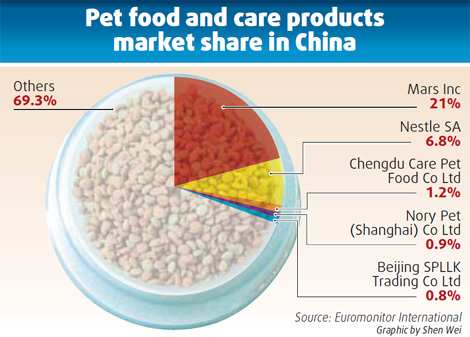
 While the economic downturn has put some venture capitalists in the doghouse, figuratively speaking, one investment fund for a Chinese website catering to pet lovers has raised more than $10 million. The fund, initiated by a cooperative including International Data Group, SoftBank and Alibaba Group, boosted Aigou.com (for "love dogs" in Chinese) to China's largest pet website in terms of registered users. People close to the deal said the investors plan to ramp up promotion of Aigou.com within a few years. The site was established in 2006. Investors' enthusiasm for Aigou.com is for its content, as the pet industry in China has not only escaped the economic slowdown largely unscathed, but also looks poised for a continued upswing.
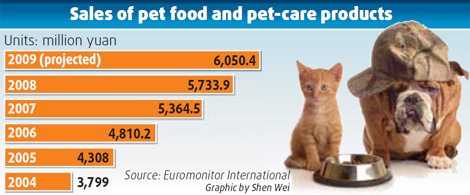
Chinese consumers spent 5.73 billion yuan on pet food and pet-care products in 2008, a 6.9 percent increase over the previous year, according to Euromonitor International. The global market research and consulting company predicted the market will rise 5.6 percent in 2009, to 6.05 billion yuan. Although the growth rate this year is a slight decline over last year's rate, China's consumers remain loyal to their pets and the market. Lifestyles fuel trend Chinese people's ever-increasing affection for their dogs, cats, fish, birds, rabbits, miniature pigs and other pets has been stimulated by an increase in household disposable income in recent decades. Analysts also found that changing lifestyles, notably the strong growth in the number of small and single-person households, represents a significant counterweight to the current economic climate. Pet ownership also counteracts the weakening of traditional social networks and helps owners combat loneliness, they added. Fang Weiwei, 29, has lived in Beijing with her cat, Chouchou, for five years. "I take care of her like a baby," said Fang, a public relations manager. "She is my anchor in my busy work and in my loneliness without a boyfriend." Fang and Chouchou are hardly a rarity in China's big cities. There are about 100 million pets across the country, and that number is expected to rise, according to Nestle SA, a major manufacturer of pet food. The trend is helping the sellers of pet food and pet-care products, especially international corporations, to continue their development in China and buck economic trends; while many consumers are trading down to less-expensive goods for themselves to save money, they refuse to pinch pennies as they lavish their attentions on Buddy and Fifi. As a result, premium products are seeing sales increases. Declining sales of lower-priced products might largely be a result of rising unemployment among lower-income households in China. Those people have usually chosen economical products for their pets. Collapsing export demand has resulted in the closure of many factories in the country's more economically developed coastal provinces, forcing millions of migrant workers to return home from cities such as Shanghai and Shenzhen.
The annual household disposable income in China is forecast to grow just 4.1 percent in 2009, the worst performance in a decade, compared with 8.4 percent last year, according to the Blue Book on Chinese Society issued by the Chinese Academy of Social Sciences. On the other hand, the rise in smaller households, particularly the single-person households and dual-income, no-kids - or so-called DINK - families, has increased the demand for pets. Attitudes have changed, with pets regarded more as family members than as working animals, especially among young urban residents. They are able and willing to indulge their pets with premium food and other products. According to the China Small Animal Protection Association, annual spending per pet in China was about 3,000 yuan on average in 2008. The expenditure was more than 6,000 yuan per pet in five key cities - Beijing, Shanghai, Guangzhou, Chongqing and Wuhan, that are the hubs of single-person and DINK households. In Beijing alone, spending on pets exceeded 2 billion yuan last year. The figure includes food and care products, veterinary care, grooming and recreation. Pet food and care producers are competing to cash in on a market with huge potential, and the international manufacturers have a competitive edge over domestic companies, thanks to their research and development and investment in brand building. In keeping with the fixation on "luxury" pets, the owners of such animals generally prefer international brands, which are perceived to be healthier and more nutritious. (For more biz stories, please visit Industries)
|
|||||
主站蜘蛛池模板: 鄂托克前旗| 兴义市| 十堰市| 韩城市| 开江县| 武乡县| 黄石市| 正镶白旗| 柳江县| 道孚县| 渭源县| 广水市| 东阿县| 分宜县| 临颍县| 固原市| 建宁县| 来凤县| 溧阳市| 班玛县| 东光县| 麟游县| 武宣县| 兴海县| 西乡县| 东阿县| 乌兰县| 上饶县| 敦化市| 邢台县| 陇南市| 五常市| 丹巴县| 太白县| 沛县| 巢湖市| 台山市| 稻城县| 安宁市| 镇沅| 麻阳| 巫山县| 绥中县| 北票市| 集贤县| 永顺县| 台南市| 威远县| 长白| 上虞市| 涪陵区| 天水市| 中宁县| 顺平县| 江源县| 阳原县| 云南省| 大邑县| 花垣县| 东台市| 高台县| 东安县| 留坝县| 大化| 双牌县| 赫章县| 城口县| 龙口市| 江永县| 余江县| 南昌市| 禹城市| 宽城| 黑河市| 曲松县| 甘洛县| 蛟河市| 夹江县| 桓仁| 罗田县| 尉犁县| 贞丰县|