Economy
Bank stance to ease inflation risk
(China Daily)
Updated: 2010-06-22 09:46
 |
Large Medium Small |
|
 |
|
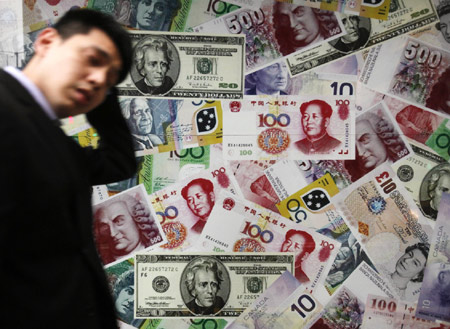
A man walks past a collage of various international currencies at a money exchange store in Hong Kong. Provided to China Daily |
Gradual appreciation of currency will help promote structural adjustment of export-oriented firms
Editor's note: The decision by the People's Bank of China, the central bank, to "further strengthen the formation mechanism of the yuan's exchange rate and increase the flexibility of the currency" on Saturday has aroused worldwide attention for its far-reaching effect on both the Chinese and global economy. The next day, the central bank released another statement claiming that there would not be a one-off revaluation of the yuan, which is well in line with Chinese economists' expectations, who said outside pressure would not disappear following the latest move.

In the short term, it is more important for the monetary authorities to let the yuan float in a broader band rather than pegging it to a basket of currencies.
Given the recent exchange rate movement of the world's major currencies, if China strictly follows the rule of pegging the yuan to a basket of currencies, it may depreciate substantially against the US dollar. But the central bank will not allow that to happen, especially when the exchange rate issue has become highly sensitive.
The yuan could appreciate 3-5 percent against the US dollar this year. The Chinese authorities will not accept a big increase in the yuan's exchange rate against the dollar, because the yuan's effective exchange rate has risen substantially against the greenback this year and the trade surplus is shrinking.
The new announcement of the yuan's exchange rate regime, which has been interpreted as the start of yuan appreciation, does not mean that outside pressure for yuan appreciation will disappear. The pace and margin of the renminbi's rise against the US dollar will become the main theme for the next round of discussion on the yuan's exchange rate.
Once the yuan resumes appreciation, the authorities must keep a close eye on cross-border capital controls and prevent resurgent excess liquidity as a result of rising asset prices.
China remains in the stage of initial industrialization while the US has entered a post-industrial era.
The root of the huge US trade deficit with China lies in the differences in their economic structures and development levels.
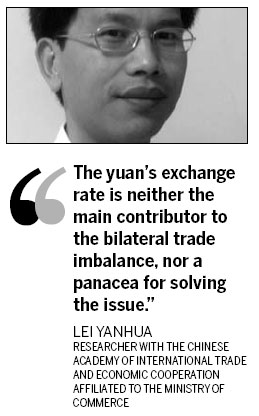
The yuan's exchange rate is neither the main contributor to the bilateral trade imbalance, nor a panacea for solving the issue.


Yuan appreciation will result in a decline in the growth of China's exports, from which migrant workers, China's most vulnerable group, will suffer the most.
Sluggish exports in turn will impact China's long-term efforts to expand domestic demand and transform the economic development pattern.
So far, China is the most powerful driving force for global economic growth.
A slowdown in China would deal a blow to economic confidence worldwide and affect the smooth recovery of the global economy.
The decision of the People's Bank of China, the central bank, to proceed with the reform of the yuan's exchange rate regime is of great significance, because it symbolizes the end of China's temporary yuan peg policy to mitigate the impact of the global financial crisis over the past 23 months. Such a move also indicates China will adopt an independent exchange rate regime without yielding to external pressure.
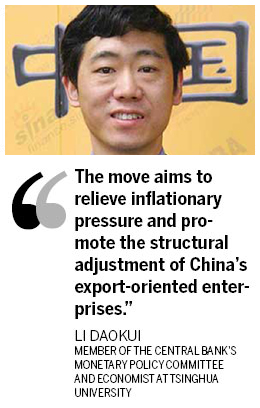
The move aims to relieve inflationary pressure and promote the structural adjustment of China's export-oriented enterprises.
The yuan's exchange rate will become more flexible and is likely to experience two-way fluctuations in the future, which means the exchange rate of the yuan may either appreciate or depreciate against major currencies. If the euro continues to remain weak against the US dollar or the value of the US dollar rises by a large margin against other major currencies, the yuan could depreciate against the dollar.
Therefore, the central bank's latest move cannot be simply interpreted as the start of yuan appreciation against the dollar. Even if the yuan appreciates in the future, according to historical experience, the central bank will keep the currency basically stable at a reasonable and balanced level and allow the yuan to appreciate in a gradual, moderate and controllable way instead of a sharp one-off revaluation.