Economy
Free trade deal lifts business
By Zhou Yan (China Daily)
Updated: 2010-11-15 09:17
 |
Large Medium Small |
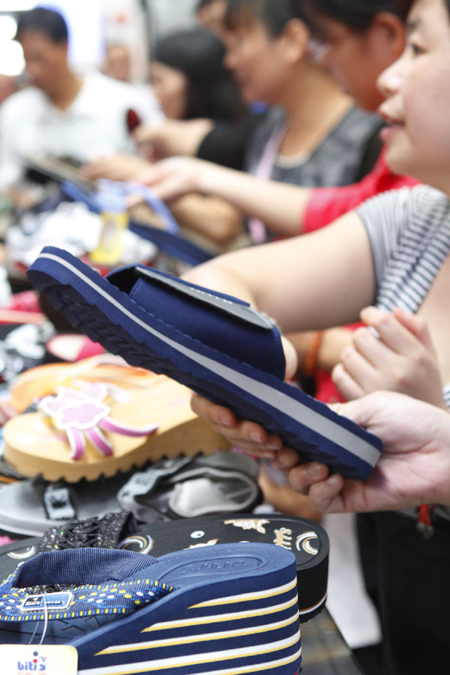
People bargain for a good price for Vietnamese-made sandals at the China-ASEAN Expo held in late October in Nanning city in Guangxi Zhuang autonomous region. Buoyed by the China-ASEAN Free Trade Area's zero-tariff framework, 1,178 enterprises from the 10 ASEAN economies attended the event, a record number participants in the expo's seven years of history.[Photo/China Daily]
Southeast Asian nations look to China to expand their businesses
SHANGHAI - More than 600 years after mariner Zheng He's voyage to Southeast Asia as China's first maritime trade visit to the region, entrepreneurs from these states are now riding the wave of the nation's economic boom and seeking a foothold in the Middle Kingdom.
Fueled by the new free trade zone established in January between China and the Association of Southeast Asian Nations (ASEAN), these business-savvy merchants have gained more steam for their commercial expansion in China.
After patiently waiting for years, Clay Industries Sdn Bhd (CISB), one of Malaysia's largest vitreous porcelain sanitary ware makers under the Claytan Group, has now made its fist foray into the Chinese mainland.
"We immediately made the decision to invest in the Chinese market once the China-ASEAN Free Trade Area (CAFTA) was officially announced early this year. It reduces our tariffs from 10 percent to zero and significantly cuts our operational costs in China," said Andrew Wong, senior manager of Clay Industries' International Market Department.
The trade zone, the world's largest by population with 1.9 billion people and a combined gross domestic product (GDP) of approximately $6.4 trillion in 2009, is expected to help push bilateral trade and investment through providing preferential market access to the two sides' businesses. Most of the goods in the area have become tariff-free since January.
The average tariff on ASEAN's original six members - Indonesia, Thailand, the Philippines, Malaysia, Singapore and Brunei - was slashed from 9.8 percent to 0.6 percent in January 2010.
Benefiting from the agreement, Clay opened its first three stores in Shanghai's Parkson, a Malaysian department store operator, in August to test the water.
The response was very positive after three months of operations, Wong said. The price of Clay's middle to high-end products with prices around 3,500 yuan ($522), did not deter Chinese customers.
"Sales in Shanghai have surpassed our expectation," said Wong, who didn't reveal the detailed sales figures.
Encouraged by Chinese customers' strong consumerist tendencies, Clay has mapped out a more aggressive expansion plan in the country. According to Wong, Clay plans to open five more stores in Shanghai within two months and an additional 20 to 30 stores will open in affluent Zhejiang and Jiangsu provinces adjacent to cosmopolitan Shanghai in 2011.
Spurred on by CAFTA's zero-tariff framework, 1,178 enterprises from the 10 ASEAN economies attended the China-ASEAN Expo held in late October in Nanning, Guangxi Zhuang autonomous region - a record number of participants in the expo's seven years of history.
Riding on strong domestic consumption in China, Indonesia's batik maker Danar Hadi, a family-owned company established in 1967, decided to attend the expo for the first time to see business potential in China.
"China-made textile goods are everywhere in Indonesia. Likewise, we hope our unique design and high quality will help us to carve out even only a fraction of a share in this large market. Several clothes agencies and buyers have showed their interest in cooperating with us during the six-day exhibition," said Aryo Prakoso Vidyarto, a sales manager with Danar Hadi.
He added that the lower tax in CAFTA will lead to a price reduction for its products sold in China to increase their competitiveness.
It's still a new and unknown market for Danar Hadi, but Aryo said he wasn't bothered if it took five years to familiarize Chinese customers with its products. Given the size of the population, he said there was plenty of room for the company to grow.
The ASEAN bloc's figures showed that exports are equal to 54 percent of the 10 nations' collective GDP. Further, the bloc has grown to become China's fourth-largest trading partner since the launch of CAFTA, with bilateral two-way commerce standing at $211.3 billion in the first nine months of 2010, up 44 percent from the previous year.
"The overall view (of CAFTA) is active. Our government supports our enterprises to do business with China. What we need to do is to improve our products and increase our production capacity," said Mangkorn Dhanasarnsil, vice-chairman of the Federation of Thai Industries.
However, because the bloc's 10 nations are developing at different economic levels, trade imbalances have resulted. This means smaller businesses in the region's less developed nations find it hard to gain shares in the Chinese market because they lack a competitive edge and have less preferential government policies to support them.
Experts point out these gaps will hinder the progress of regional economic integration.
"Although bilateral trade between China and ASEAN economies developed rapidly, trade with Singapore and Malaysia alone makes up more than half. Trade volume between China and ASEAN's new members remains very small," said Xu Ningning, deputy secretary-general of China-ASEAN Business Council.
Because the four newest members of ASEAN - Cambodia, Laos, Vietnam and Myanmar - maintain relatively high tariffs, the entry barrier for doing business in China has yet to be removed.
Huang Shifu, a Vietnam-born Chinese man who exports Vietnamese yellow rosewood for furniture to China, said that he hasn't benefited at all from the much-talked-about CAFTA.
Instead, the rising cost of yellow rosewood caused by the Vietnamese government's stringent export polices, including higher tariffs, to protect its raw materials has almost erased any benefits from the rising prices of his products.
| |||||||



Under CAFTA, tariffs on Asean's latest four members will be gradually reduced and entirely removed by 2015. The original six members will totally eliminate tariffs by the end of this year.
Experts say entrepreneurs from the newest members, such as Huang, have to wait for the arrival of the tariff reduction for quite a while.
Only 45 percent of enterprises in the CAFTA zone have adopted the facilitation measures under the agreement, said Angel Lam, senior representative of the ASEAN secretariat, citing figures from Asian Development Bank.
The new zone is only 10 months old. China and the 10 ASEAN economies have to strive to propel the implementation of all the measures under the agreement to benefit all people in the area, Lam said.